
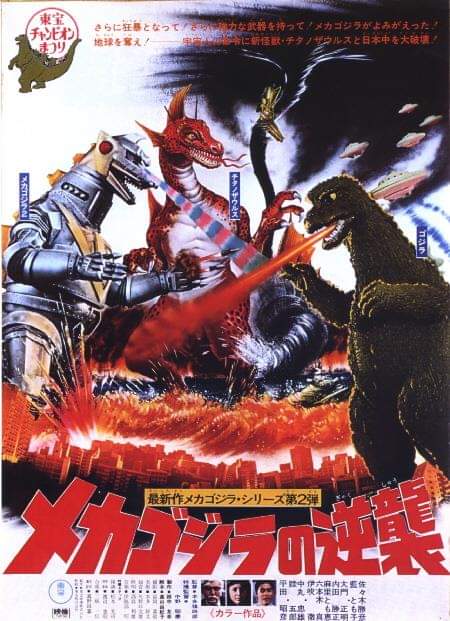
Fate has a funny way of working out sometimes. Take the two Mechagodzilla movies Toho put out in the mid-70s for example what was supposed to reverse Godzilla’s box office slump by not only giving the world one of the King Of The Monster’s most endearing foes, but also taking the series closer to its root by dropping some of the goofy slapstick that had been creeping into the franchise.
Ultimately, 1975’s Terror Of Mechagodzilla proved to be the final installment of Godzilla’s Showa Era, but a strange bright side that came out of his decade long hibernation was that both movies that featured the robot doppelganger each ended being helmed by the directors who, over an epic twenty year period, crafted the most entries.
As Jun Fukuda (with 5 installments under his belt) made Godzilla Vs. Mechagodzilla, its follow up meant that finally returning to the fold was Ishiro Honda who created the lion’s share of the entire Toho universe and his return couldn’t have come at a better – or more somber – moment.

After the events of Godzilla Vs. Mechagodzilla, Interpol agents have spent their time trawling the bottom of the ocean, trying to find the remains of Godzilla’s vanquished, robotic doppelganger, but after a submarine is destroyed by a mysterious, aquatic Kaiju, marine biologist Akira Ichinose is hired to look into things.
His search leads him to Shinzô Mafune, a professor who was disgraced thanks to his wild claims that he’s discovered a new kind of dinosaur he’s named Titanosaurus (a bit harsh considering its ling been established that Kaiju’s actually exist) and has now gone full mad scientist after teaming up with the Simeons, the race of apes from space (try saying THAT 10 times fast) last seen in Godzilla Vs. Mechagodzilla. Helping them in their obsessive plan to team up Titanosaurus with the rebuilt Mechagodzilla in order conquer the earth us Mafune’s daughter, Katsura, but ina weird quirk of fate that only happens in the movies, both Akira and her fall in love when he comes calling about her father’s work.
However, things are even more complicated than they seem as the entire reason Mafune is helping the Simeons is because they rebuilt Katsura as a cyborg after she was nearly killed in a scientific accident as a child and Akira has no idea that his prospective boo not only is feeding information to Earth’s invaders but she contains more metal than a tin foil factory.
Standing in the aliens way – as always – is Godzilla, who predictably doesn’t give a single, solitary shit about doomed romances and marauding monkey people, but with the odds stacked against him, can the King Of The Monsters possibly hope to prevail in the rematch against one of his toughest adversaries?
Sadly, the return of director Ishiro Honda and composer Akira Ifukube to the world of Godzilla didn’t bring in the required box office Toho was hoping for to keep the franchise alive and it’s a fact that’s as disappointing as it is inexplicable as Terror Of Mechagodzila is arguably superior to any Kaiju movie released for the entirety of the 70s. Taking Fukuda’s lead and keeping any wackiness to a sensible level, the movie manages to recapture the same tone Honda employed during Godzilla’s heyday back in the 60s thanks to films like Ghidora: The Three-Headed Monster and Destroy All Monsters. Sure, our radioactive lead still pops randomly up to save the earth like a 164 foot Superman and his facial features are much softer than they used to be (his face weirdly resembles an adorable dog in this one), but the fun and adventure still carries an edge to steer things well clear of overt cartoonishness.
The human plot is – well, not only is it the same old aliens-using-monsters-to-rule-the-world routine, but it’s the same aliens too! However, the movie chooses not to play up the ape-ish nature of the Simeons this time, thus avoiding more footage of actors in silver space suits wearing gorilla masks. And yet, despite noticably lacking originality, Honda keeps the human stuff ticking along nicely with the subplot of the professor’s daughter being rebuilt as a cyborg to control Mechagodzilla – despite lending itself freely to hokey melodrama – actually becoming quite touching and lends a fittingly down beat ending to the end of this particular era of the King Of The Monsters.

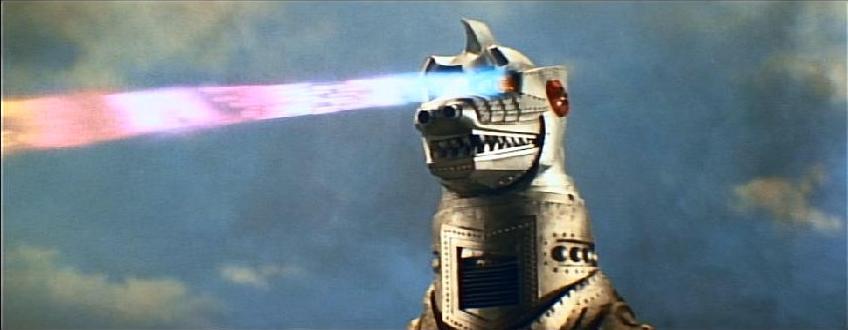
Still, planet conquering monkey people and cyborg romances are all very well and good, but the real reason we’re here is to watch Godzilla and his robot nemesis throw down for the second time. The re-deploying of one of the most formidable adversaries the series has to offer lends something of a WWE-style rematch feel to proceedings with the opening credits playing re-edited footage of their last tustle (there’s amusingly no sign of King Caesar at all) with Ifukube’s themes pounding over the top that awesomely acts like some sort of pre-match promo video. I’m not going to lie, whenever I watch it, it actually gets me oddly pumped and when we finally get to the monster fights themselves between Godzilla, his mecha-twin and the bright orange, Elizibeth Debicki-necked, wailing Titanosaurus, I’m practically chomping at the bit. However, with Mechagodzilla already bring such an already known commodity, Honda tends to veer away from the titular robot monster and focus more on movie’s newer Kaiju Character who seems to be something of a throwback to the simpler creature designs of Toho’s past. While Titanosaurus is a decent, meat and potatoes sort of beastie with a distinct roar and the ability to whip up hurricane force winds by wiggling his tail flap, his introduction means that Mechagodzilla us left usually standing ominously to the side, like he’s trying to photo bomb the action without looking too conspicuous. However, even though our chief antagonist is willing to sit out most of the more hands-on fighting, he’s still formidable as fuck and the brawls are of a good, solid quality, full of cool moves and incidents. In fact, it’s a nice chance to see villains gang up on him for a change as he’s the one who usually got a sidekick in tow and he certainly takes his lumps in this one – spewing smoke from his maw after taking a missile to the belly or even getting buried alive while Titanosaurus literally dances on his grave.

As the film finally ends and Godzilla swims off into the sunset, he turns slightly, as if to say goodbye to an era of movies that were fun, if more than a little silly. His next resurgence wouldn’t come until the late 80s and proved to be much more serious – if action packed – affairs with nary a victory dance, a sidewalk suffle or a wire-fu dropkick in sight. However, while Godzilla would eventually return, Terror Of Mechagodzilla sadly marked the end of the road for Honda as this movie marked the end of an illustrious career directing.
Godzilla wouldn’t be portrayed as an out and out hero again for nearly 15 years and for o a long time Kaiju fan like me, it’s genuinely emotional to experience that last, rubber-suited, googly-eyed farewell.
Mechagodzilla’s terror equals an end of an era.
🌟🌟🌟🌟
 We Have Issues