

When it comes to intelligently co-opting pre-existing iconic visuals and story tropes into its collective, possibly only Quentin Tarantino has managed to take so many other people’s work and generate it into something completely new more than the opening episodes of Stanger Things. Think I’m exaggerating? We’ll, for a start, if you were to come up with a drinking game that required you to take a swing every time a homage or reference to an 80s property popped up on screen, you’d be in an ambulance halfway through the second episode. But as Tarantino knows, the second you can take those scattered ideas and fuse them into something that is undeniably your own, then your liberal acts of borrowing suddenly become works of genius.
While the first two episodes of Stranger Things were undeniably gripping, I’ve been waiting for the moment when the show finally managed to take all those jumbled references and mash them together and create an image that’s resolutely it’s own. Ladies and gentlemen, now is that time.

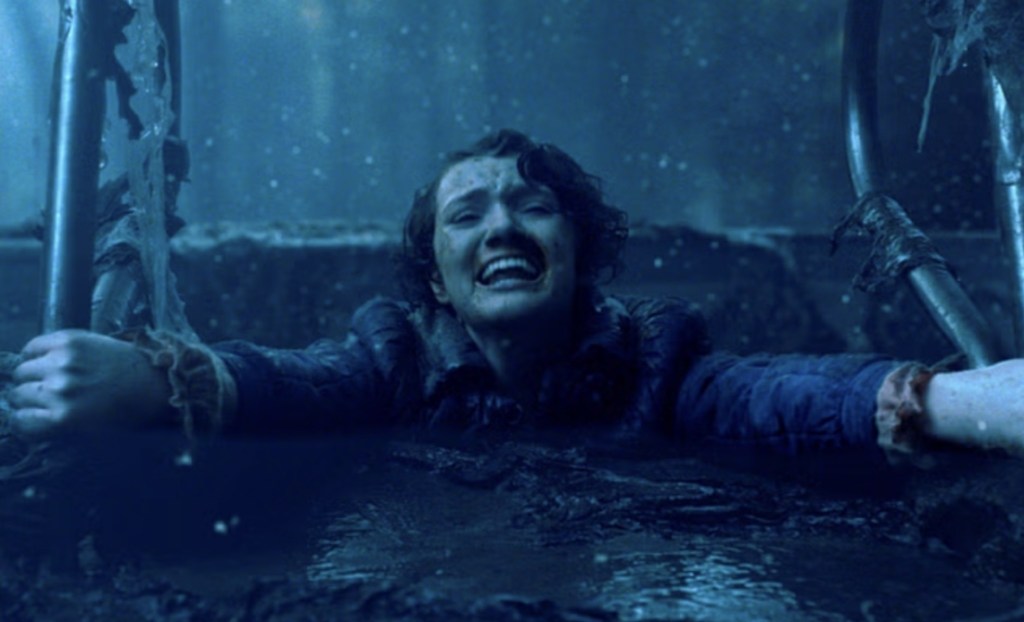
When last we left the citizens of Hawkins, studious “good girl” Nancy Wheeler was losing her virginity to local walking hairdo, Steve Harrington, but outside, her friend, poor fifth wheel Barb was discovering that she wasn’t alone as she thought when the Demogorgon – an otherworldly creature that’s already caused the disappearance of local boy Will Byers – attacks her and forces her to meet her end in what looks like a messed up, Lovecraftian version of the town.
Meanwhile the world keeps turning and the various searches for Will keep going. The official search, headed by the usually lackadaisical Chief of Police, Hopper, takes an odd turn when his investigation leads to the secretive Hawkins Laboratory who, unbeknownst to Hop, is actually indirectly responsible for the boy’s vanishing. However, what Hopper doesn’t realise is that all of his clues are actually leading to Eleven as she’s recently escaped after a near lifetime of experiments that’s given her telekinesis. The man responsible is Brenner, who has a history with such things as Project MKUltra, and thanks to some flashbacks, we see that he’s even inspired Eleven to use her powers to kill.
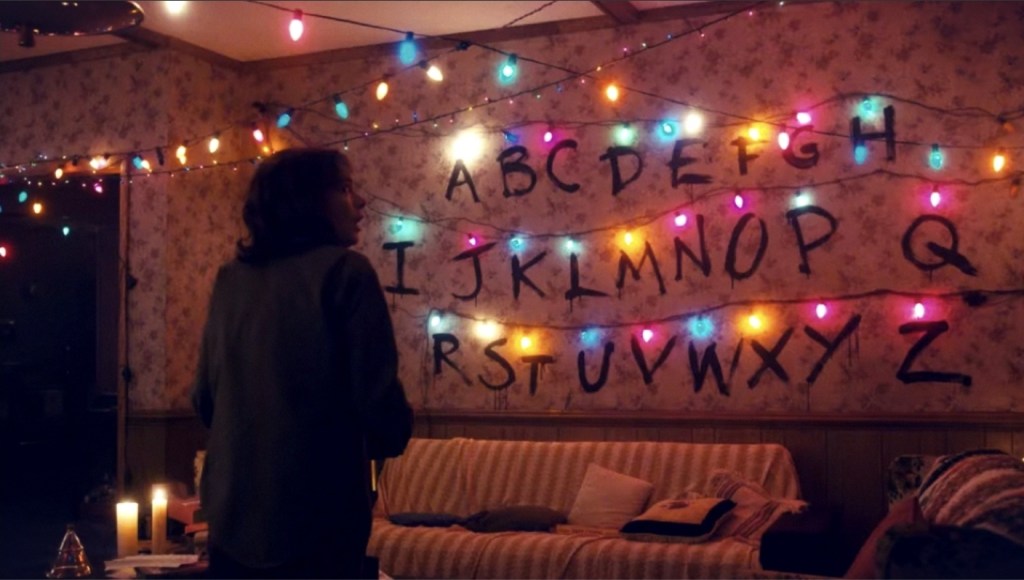
Of course, Eleven is now cozied up to Mike and the gang and even though Lucas is still incredibly dubious about letting a girl with superpowers join the search for their friend, they stock up on provisions and head out when night falls to locate Will once and for all. However, the one person who actually seems to be making any headway is actually Will’s ever more unhinged mother, Joyce, who has correctly surmised that the flashing lights in her house is actually her son trying to communicate from wherever the Hell he is. However, after using Christmas lights and paint to turn her living room into a sort of giant ouija board, the Demogorgon seems to take exception to the communication and once again tries to push it’s way out of a wall. However, everyone’s desire to hunt for Will hits a cruel brick wall when a tragic discovery is made at the local quarry.
You can pinpoint the exact moment when Stranger Things stopped being that insanely promising show that riffed a lot on the 80s to me, and suddenly blossomed into a show that can still do all of the above and still stand on its own two feet. It’s the moment when Winona Ryder’s Joyce, driven half out of her mind by the worry that her vanished son has caused, finally gets the bump she needs to truly believe that Will is still alive. After coating her entire house in Christmas lights while following up a hunch, she experiences a moment that may draw heavily on the parental loss of Poltergeist and the flashy lit wonder of Close Encounters, but as she finally communicates with her son via some yes/no questions and a ball of glittering bulbs, Stranger Things manages to nail that iconic image that’s allowed it to transcend to the next level. It’s a perfect moment, both driven by hope (Will’s alive) and dread (possibly not for long) that’s sold completely by the look in Ryder’s face as it literally lights light up in the dazzling glare.
From this point on, Stranger Things was no longer just your average streaming show and as a result, it’s popularity started to grow exponentially. How else do you explain the #justiceforbarb movement that exploded in outrage when a side character cruelly met her end (could you imagine fans doing this in the actual eighties with Justice For Annie banners being waved after a screening of the first Friday the 13th?). The fact that the show was starting to catch on like wildfire is also relevant because without that Joyce moment giving you such hope, there could have been a danger that Stranger Things was starting to get stuck in an early rut.

The growing relationship between Mike Eleven is still cute, the growing resentment from Lucas is still present and the general day to day of Hawkins in general was still enticing, but the addition of genuine wonder was the final piece of the puzzle that the show needed to snare it’s audience big time. It also helps that it wrong foots you to the point that the shock ending poleaxes you mercilessly when it’s discovered that a boy matching Will’s description has been found drowned in the quarry. It’s a great one-two punch that gives you hope and then whips it away while slapping you across the face and it shows that the Duffer Brothers (not to mention episode director Shawn Levy) are wise enough to mix things up before they get too repetitive.
Oh yeah, Barb’s callous end may have upset those not used to a well scripted body count (we’re supposed to care when somebody dies), but even though it proved to us that no one is technically safe, the rug pulls manage to halt the very real fact that thecshow was on the fringes of becoming repetitive. Shows powered by mystery need forward motion, otherwise they stagnate or just get too convoluted and while such things as Mike and Eleven’s relationship, Eleven’s illuminating flashbacks and the continuing melodrama between Nancy, Steve and Jonathan (sorry jonny-boy, that technically was stalking), the show needed a big old depth charge to stir up the waters less they get predictable. I mean, even though there’s a legitimately tense moments with Mike’s younger sister and the Demogorgon, how many times can it pop out of that damn wall before it becomes stale?
Thank God then, for David Harbour’s Hopper who’s gradual transformation from bad tempered wash out to bad tempered sleuth has quickly become some of my favorite parts of the show. While everything else is wrapped in teen angst, adolescent panic or adult despair, the always slightly pissed off demeanor of Hawkins Chief of Police has proved to be a great counter point that harkens to tough, 80s cop movies while everything else worships at the alter of throwback horror, teen drama, or Spielbergian sci-fi.
After quickly building to a solid standard of quality, Stranger Things manages to break its own ceiling by finally proving that there’s far more to the show than simply “yay 80s”. Cherish this moment, because this is the episode where things went from good to great and it was made completely possible by both being remarkably touching and quite beautiful – and by bring as cruel as can be.
Fuck Barb.
🌟🌟🌟🌟
 We Have Issues