
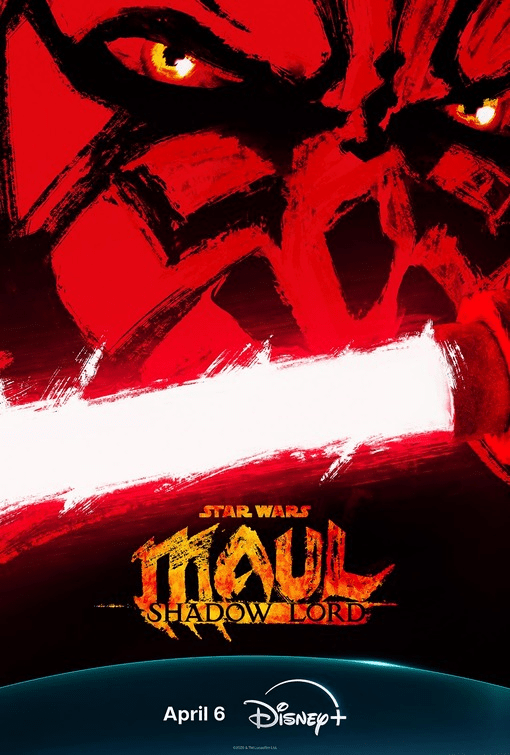

The Dark Revenge is as an effective launch for the new Star Wars animated series on Disney+. Set roughly one year after the conclusion of The Clone Wars, the episode follows the former Darth, now just Maul, as he works to rebuild his criminal network in the shadows of the freshly birthed Galactic Empire. The story is set on Janix, a new planet in Star Wars canon, a neon-lit urban world that has remained largely untouched by Imperial oversight, providing a fitting backdrop for Maul’s calculated moves. Without relying on the traditional Star Wars opening crawl, the chapter opens directly into action, establishing a tone that blends cop/crime show elements with the franchise’s familiar lightsaber combat and political manoeuvrings. This approach grounds the narrative in a post-Order 66 reality, where survival and ambition drive characters on all sides.
The focus is on Maul’s efforts to restore his Shadow Collective, the loose alliance of syndicates he once commanded. After the setbacks on Mandalore, he has regrouped with loyalists including Mandalorian warrior Rook Kast and a contingent of Nightbrothers from Dathomir. Maul orchestrates a heist in Janix’s financial district, aimed at assets controlled by local crime figure Nico Deemis (not subtle naming). The operation is designed not merely for profit but to sow discord between Deemis and another syndicate player, Looti Vario, exploiting existing rivalries to weaken both. Maul’s strategic patience is on display here; he is no longer the impulsive apprentice of earlier stories but a figure who understands the value of indirect pressure and long-term positioning. The heist itself unfolds with precision, involving coordinated strikes by his team, before escalating into open confrontation when local security forces respond. It is here that Maul makes his entrance, lightsaber in hand, moving with the deliberate lethality that has defined the character since his debut.
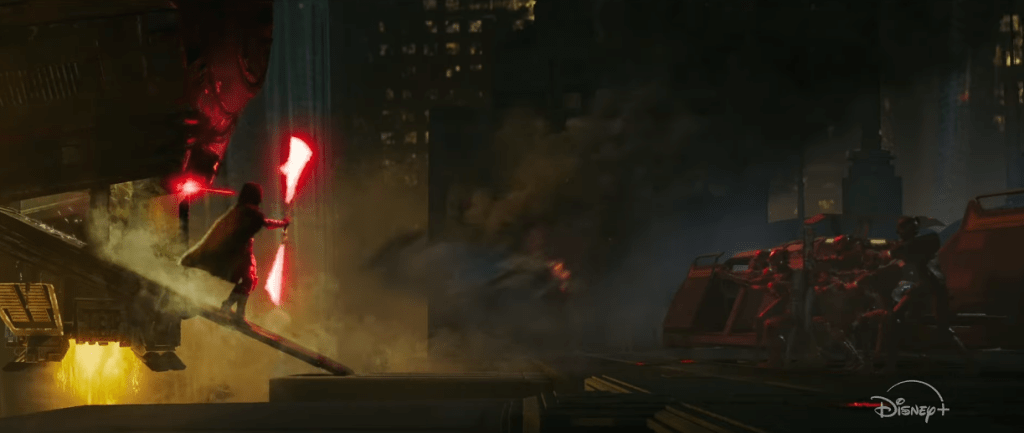
The episode builds directly on the established animation style that has been Lucasfilm’s house style since the The Clone Wars, now the best it has ever been, that delivers fluid motion and detailed environments that capture the gritty underbelly and neon lights of Janix. Everything has a film-grain texture and selective brush-stroke lighting, that makes for beauitful night scenes. This creates a noir atmosphere without overpowering the Star Wars aesthetic.
Action choreography excels as blaster fire and melee sequences are staged with care, allowing you to follow events even when it moving at pace. Maul’s duel with responding police units, accompanied by a restrained Duel Of The Fates, is handled with restraint. The music does not overwhelm but underscores the moment’s intensity.
Sam Witwer returns as Maul, delivering a subtle performance that conveys the character’s resolve and intellect. Maul’s dialogue to carries the quiet authority of someone who has learned from failure. The episode spends time illustrating his leadership style, issuing orders with minimal elaboration, observing outcomes from the periphery, which adds layers to his portrayal as a crime lord in the making.
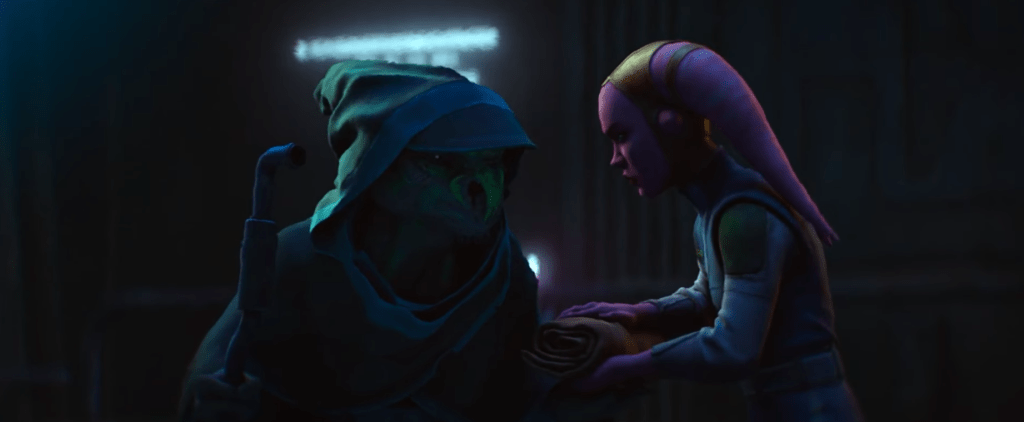
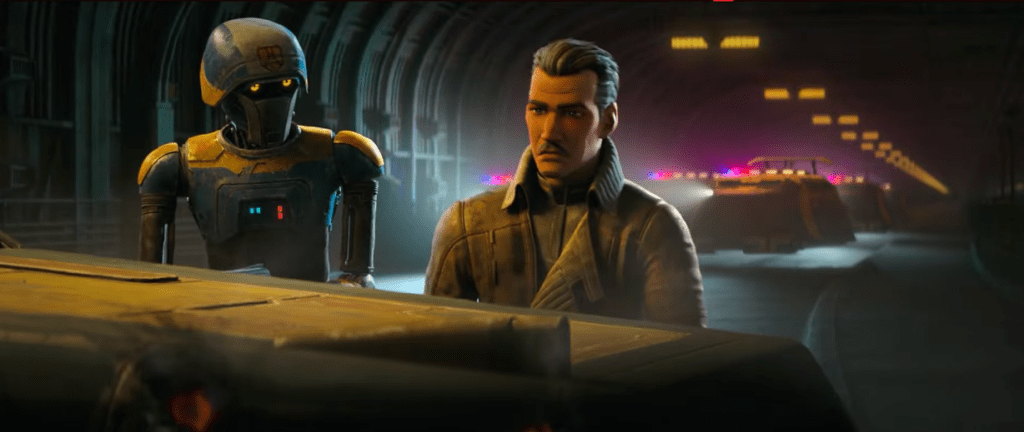
New characters are introduced efficiently. Devon Izara, a young Twi’lek Jedi Padawan voiced by Gideon Adlon, appears alongside her master, Eeko-Dio Daki. Their scenes provide a counterpoint to Maul’s schemes, showing the day-to-day realities faced by surviving Jedi in the immediate aftermath of Order 66. Devon’s perspective is pragmatic and world-weary, shaped by constant evasion rather than grand heroics. Eeko-Dio is all about control and not registering on anybodies radar. Detective Brander Lawson (Oscar nominated Wagner Moura), investigating the heist alongside a droid partner, Two-Boots (a second Star Wars droid voice for Richard Ayoade), bring a cop show vibe to Star Wars that has never been seen before.
Maul’s pursuit of revenge is framed not as blind rage but as a structured campaign against those who abandoned the Shadow Collective during the Mandalore crisis. The episode illustrates how criminal networks operate through leverage, misdirection, and selective violence. At the same time, the Jedi survivors’ thread underscores themes of adaptation and moral compromise in a time when the old order has collapsed. These elements are presented without heavy-handed commentary with events and character actions to convey the ideas. The result is a chapter that feels self-contained while laying groundwork for ongoing arcs involving syndicate rivalries, Imperial encroachment, and personal vendettas.
The episode does not attempt to resolve major threads or deliver sweeping revelations in the premiere. Instead, it focuses on establishing rules for the series: the scale of Maul’s operation, the precarious position of Force-sensitive survivors, and the complex web of alliances on Janix. This approach builds anticipation naturally with those familiar with Maul’s broader arc, from his origins in The Phantom Menace through his Clone Wars appearances, being able to recognize continuity in his motivations, while newcomers receive enough context to follow along without confusion. Hopefully we are passed the stage of the casual viewer thinking “Somehow, Maul survived.”
The Dark Revenge is the beginning od an exciting new chapter in Star Wars lore. It presents Maul as a protagonist whose intelligence and determination drive events, while surrounding him with a cast whose individual struggles reflect the wider changes in the galaxy. For fans of the large Star Wars universe, particularly those invested in Maul’s journey or the post-Clone Wars era, the chapter delivers a thoughtful and engaging start. There is the feeling that this could do for the crime syndicates what Andor did for the Rebellion. It grounds everything, even though it’s fantastical, and expectations for further exploration of revenge, loyalty, and power in a landscape where old alliances have crumbled and new ones are forming.
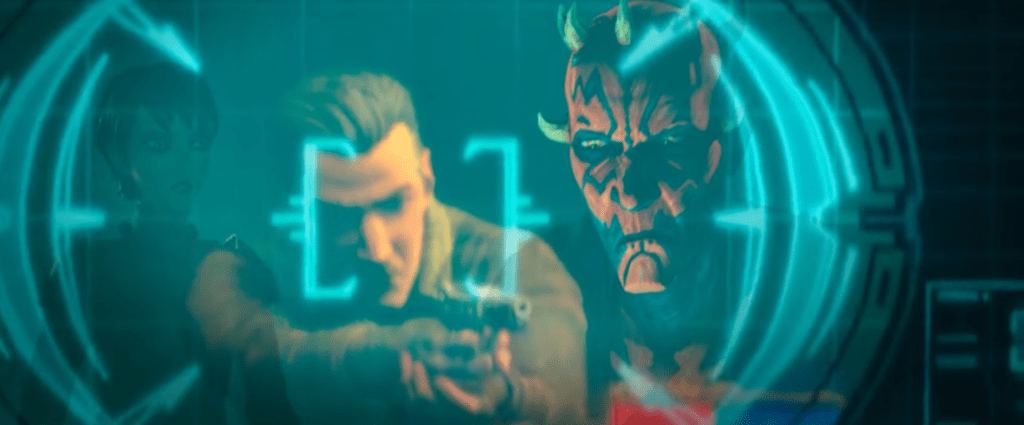
The episode delivers on the expectation of what was expected from but not delivered by The Book Of Boba Fett – a Star Wars crime show that takes you into the inner working of the underworld. The balance of action, intrigue, and character development suggests a series that will honour both its legacy and its potential to expand the franchise’s storytelling range.
🌟🌟🌟🌟🌟

 We Have Issues