
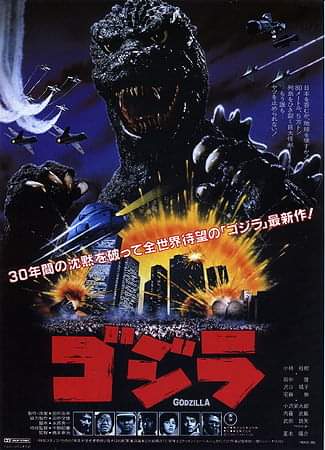
After swiming off into the sunset at the end of 1975’s Terror Of Mechagodzilla, Toho Studios finally decided to rouse Godzilla from nearly a decade of hibernation. However, in a move much more in keeping with modern franchise filmmaking Godzilla’s belated return would ignore almost the entire run of previous movies and instead follow directly on from the 1954 original, playing as both a sequel and total reboot of the series thus far. And so was born the “Heisei” series of Godzilla movies (created during the reign of Japan’s Emperor Akihito) and although it didn’t truly fully up to speed until 1989’s Godzilla Vs. Biolante, this whole new saga for the radioactive bane of Japan is still generally considered the best of the three eras of Toho’s King of the Monsters.
However, before we get to the juicy stuff that eventually saw Godzilla face Mecha King Ghidorahs, space clones and even his own mortality, first, the big guy would have to cement his return.

After the Japanese fishing vessel, Yahata Maru encounters a huge, destructive force in the middle of a raging storm, it’s found a short while later by intrepid reporter Goro Maki, who happens to be sailing in the area. After discovering that the majority of its crew has expired harder than turned milk, he is nearly kilked at the mandibles of a dog-sized, trilobite parasite only to be saved by Hiroshi Okumura, the Maru’s sole survivor, who later confirms the worst: a new, bigger Godzilla has surfaced and he’s angrier than a vegan in Nando’s.
While Maki believes that the return of Godzilla will give him more column space than Carrie Bradshaw, he is shocked to find that his bosses decide to nix the story in favour of keeping panic to a minimun; yet, he still strives to compile more data by unscrupulously using Okumura’s sister, Naoko, to add to his story.
However, any pretence of secrecy is literally blown out of the water when Godzilla encounters a Russian nuclear submarine on his travels and – you guessed – blows it out of the water, upsetting the Soviets and, in turn, their enemies in the States. Godzilla continues to make a global mischief of himself when he comes ashore and treats a Japanese nuclear power plant like a salad bar at a Harvester and soon the Japanese government find themselves between a rock and a hard place when both the U.S. and the Soviets conspire to drop a nuke on Japan in order to stop the Kaiju’s rampage before he decides to go on a world tour.
However, the doomsday clock is accidently sent ticking when an unfortunate incident sees a Russian warhead mistakenly launched at Godzilla as he enters Tokyo and while the world struggles to detonate the damn thing, the Japanese government unveil their secret weapon against the Kaiju marauder: the heavily armed, hovering battle platform dubbed the Super X. With Maki, Okumura and Naoko trapped in a crumbling Tokyo high rise, while the battle rages and a nuke hurtling towards their location, can Godzilla’s latest rampage be brought to a volcanic end?
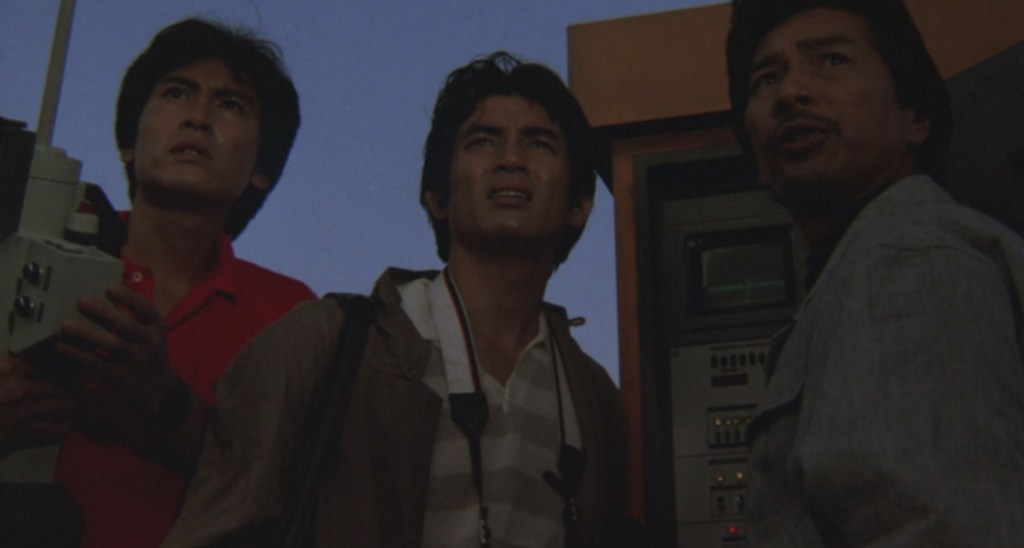
After decades of increasingly anthropomorphic appearances that saw ever more campy escapades such as gravity defying dropkicks and hand shaking robots, the first thing you notice about Godzilla’s 80s redux is how much the filmmakers strive for a sense of realism, which is quite a strange thing to say considering that one of the early scenes sees a man fighting for his life against a giant weevil – but global politics and cold war squabbling are the order of the day here, not alien invasions and mind control.
In fact, quite a lot of the film manages to mirror the butt puckering complexities of the Cold War much in the same way the original movie used its immense powers of allegory to invoke the aftermath of the Hiroshima bombing. Thus director Koji Hashimoto decides to focus on the fearful American and Soviet forces almost falling over each other in their fearful eagerness to nuke Japan with Godzilla in it, just in case he ever desides to take a destructive scenic tour of the Kremlin, or the Statue Of Liberty, thus making THEM the true villains of the piece. In fact there’s quite a powerful experience watching the horrified Japanese prime minister watch these two superpowers go from pointing fingers at each other to insisting that it’s for the greater good to sacrifice Japan entirely.
Seeing such a mature Kaiju movie made in such a vapid era such as the 80s that is so critical of the politics of America is an interesting experience, if often a little surprising and the film chooses to hold back on fully unleashing Godzilla until it’s completely necessary to show him in full and the deadly seriousness of the plot and actors rub against a dude in a lizard suit punching real estate in a fascinating way. While that other, big budget monster mash of the era, the 70s remake of King Kong, used the same lush, blockbuster look of an Irwin Allen disaster movie, Godzilla opts to ditch the camp entirely and – if it wasn’t for the goofy, final reel caperong of an oblivious, comedy hobo – would have held the steady composure of a funeral reading all the way through.

After a decade of googly eyes and flaking scales, the new Godzilla design, while obviously rubbery, looks pretty fucking cool by 80s kaiju standards (it certainly looks better than the gorilla suit in the aformentioned King Kong remake) and, most impressively, a 16 foot robot version was even built for close ups that snarled, roared and could tilt it’s head to match this new version’s historically bad attitude. Behold the truly breathtaking stylish touches given to the 80-foot star as he emerges, like a horror movie monster, from the mist as a night watchman recoil in genuine horror. With pointed fangs, bloodshot eyes and a truly intimidating case of resting genocide face, this was a vicious, more violent Godzilla than we had ever seen before, arguably even more so than Ishiro Honda’s original vision of the beast.
However, while the movie certainly scores huge points for bringing the Big G back to his destructive, political roots, you often feel that Return Of Godzilla is SO in love with how mature it is, is often forgets to move with purpose, instead focusing solely on its examinations of the Cold War or building up its ultimately ineffectual characters while you patiently wait for Godzilla and the high-tech Super X to start stalking each other through a rapidly devastated Tokyo.

At times savage, intelligent and even weirdly moving (the score goes bizarrely into love theme territory when Godzilla is finally vanquished), Return Of Godzilla is not only movie relentlessly solid as the Kaiju himself, but is notably a massive influence on future installments such a Shin Godzilla. However, some truly fantastic moments are somewhat let down by a pace that plods too much in order to get to the point and this seismic return is ultimately only a prelude of bigger and better things to come.
🌟🌟🌟
 We Have Issues
One comment