
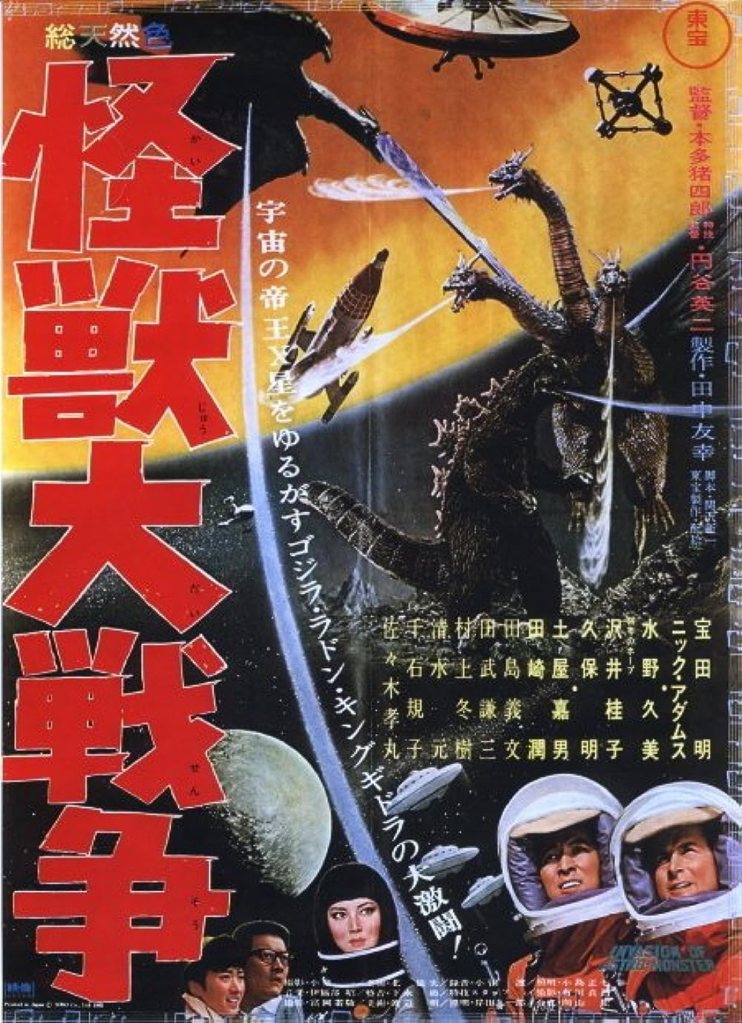
Over the last couple of Godzilla movies, a noticable swing toward showing the King Of The Monster’s in a more heroic light was emerging and with his sixth outing – the pulp-tastic sounding Invasion Of Astro-Monster – the good guy arc was all but complete. While it’s true that Godzilla is, at one point, still seen knocking over buildings like a multi-storey Mike Tyson, now it’s interspersed with family-friendly shots of the huge lizard throwing lefts and rights at the multiple mugs of returning nemesis King Ghidorah and, most infamous of all, dancing a jig after a victorious bout. While it may have been a million miles away from the character’s atomic horror origins, it proved to be something of tonal reset which firmly dictated which direction the character rampages in for the next decade. However, more alarming than Godzilla becoming a baby face was the huge leap into the realms of pulpy science fiction with space travel, rocky alien worlds and extraterrestrial invaders also crashing the party. But series creator, the legendary Ishiro Honda, was once again on hand to marshal the transition, essentially laying down a blueprint that the franchise – like a sex addict with a locked bathroom – would return to many times to come.

Set in the confusing year of 196X (whatever the hell that means) an outer space expedition to the far side of Jupiter is underway after a new planet, unhelpfully dubbed Planet X (noticing a pattern already?), has been discovered and as the world watches a rocketship hurtles towards the planet’s surface. Manned by the manly duo of Fiji and Glen, the astronauts, clad in spacesuits that look like they couldn’t keep a fart in let alone keep the pressures of space out, encounter a race of alien people called the Xiliens who dress like vinyl-clad cosmonaut fetishists with neck braces and who live in underground cities to avoid the dreaded creature know as “Monster Zero”.
To the human’s surprise, Monster Zero turns out to be King Ghidorah, who has choosen to trash Planet X like an 80s musician’s hotel room after being booted off Earth during his last appearance and thus the Xiliens’ request is simple: allow them to borrow Godzilla and Rodan (but no Mothra) like a Kaiju time share to drive off Ghidorah once more and in return they will hand over a cure for cancer.
The humans agree, but after the transaction takes place, it turns out it’s a double-cross (gasp! A duplicitous alien in a movie from the 60’s? No way!) and the Xiliens instead threaten to use all three monsters to destroy Japan using mind control. However, salvation may be at hand in the form of inventor, Tetsuo, who, aside from dating Fuji’s sister, has accidently created the very thing that could stop this invasion in its tracks. Elsewhere, Glen discovers to his dismay that, Namikawa, the hot chick he’s been smooching may be an alien plant – with the Xiliens’ infiltration being so deep and with a trio of rambunctious monsters under their thrall, can the humans triumph over such overwhelming odds?
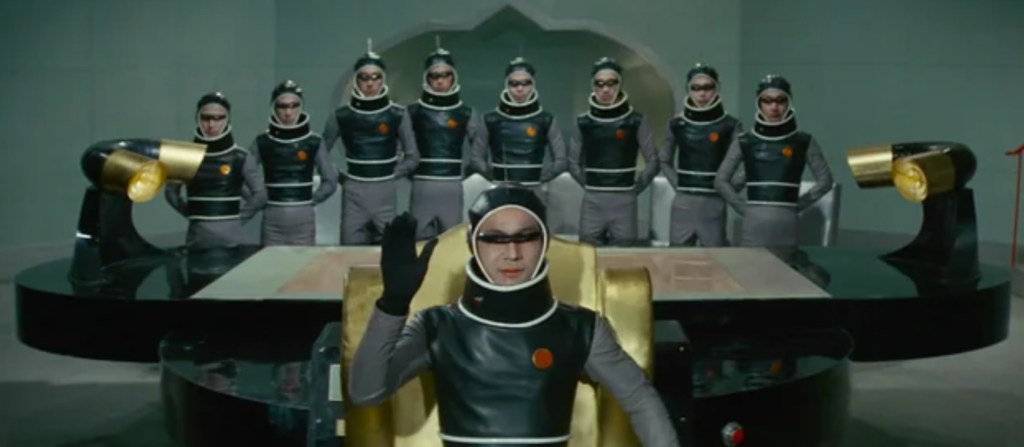
When you realise that five of the remaining nine movies that were to follow during Godzilla’s Showa era went and borrowed Astro-Monster’s plot almost exactly to the letter, it’s not out if the realms of reason to state that this entry in the Godzilla cannon, for better of worse, is technically the most influential of the series since the original. The scenario of having an alien species cast envious, War Of The Worlds style eyes on the lush blue marble we call home proved to be an easy short-cut for screenwriters unable to concoct original reasons to have Godzilla and his brobdingnagian buddies to continually pound areas of Japan into the Earth’s crust. However, in this instance, Honda, already had substantial expertise in matters of science fiction and mined this new status quo for plenty of opportunities to dip it’s car-sized toe into 60’s camp silliness whenever he could. Take the Xiliens, for example: if they don’t use names and instead label everything with numbers, why do they announce themselves as Xilians at all or call out that they have a Hydrogen Oxide Plant instead of saying something like facility VII or something. Elsewhere the alarmingly tight-suited villains prove to be an enemy that can be taken out merely with sound, but in their defence, Tetsuo’s sonic device is so shrill it could strip paint. Elsewhere, the bromance between Akira Takrada and Nick Adams’ Fuji and Glen shows surprising amounts of chemistry despite the fact that they’re blatantly speaking different languages under that heavy dubbing and its weirdly sweet to see the franchise’s first true American co-lead strut around like he owns the place and squint at the comely form of Kumi Mizuno from under a brylcreem quiff (Raymond Burr in the original Godzilla doesn’t count as he was only added to the U.S. print).

As for the film’s other cast, the movie makes up for a lack of new monsters by not only having the sci-fi stuff carry the load, but it also makes Godzilla and chums more larger than life characters that they already were by making them err on the side of cartoonish. Yes, the sight of the trio of monsters tearing up a major city may still be quaintly spectacular (arguably the best of the series’ early years), but the really memorable stuff is watching Godzilla exhibit very human traits like the legendary happy dance he performs after successfully giving Ghidora his first hiding.
Any flaws the movie has are mostly inherent in the restrictions of the genre itself, however, it does do a fine job of keeping the human melodrama ticking over nicely while we subconsciously wait for those REAL stars to arrive. Although I have to say compared to the three on one antics of the previous movie, this direct sequel skimps on monster mashery in comparison and the the lack of any original monsters showing is a tad annoying seeing as a big part of the fun of these kind of movies is getting to see what crazy designs Toho’s Kaiju factory are gonna come up with next. Also, while this isn’t exactly a fault that can be laid at the door of this movie, but you could argue that it heralded a definite lack of imagination for the future of the series as it opened the gates for all manner of invasion-happy but interchangeable aliens to hogpile onto the Earth to challenge Godzilla for the title.

As it stands, Invasion Of Astro-Monster is a high level monster movie romp and is indicative of how impressively adept Toho was getting at churning these things out; and yet despite it’s inclusion of flying saucers and funky sliver alien jumpsuits, the movie somehow really seem to add anything new except a meme-worthy victory celebration for the radioactive icon.
Godzilla’s maybe stomping over old ground, but he’s doing it exceptionally well…
🌟🌟🌟🌟
 We Have Issues
One comment