

While it’s tough to imagine it during his more sillier moments, Godzilla has always been a creature with one, googly eye on social issues, be it acting as a necessary metaphor for the atomic bomb, a representation of nature’s bludgeoning force or even a questionable anti-bullying advocate (what next, Freddy Krueger being a spokesperson for proper child care?). However, possibly his most overt platform was in 1971 when he became possibly the most violently destructive, eco warrior that ever lived when he literally went head to head with living pollution in Godzilla Vs. Hedorah.
As times were moving on and the legendary Kaiju stomped into a whole new decade, the main men at Toho figured that the franchise needed to keep up with the times, but even they wasn’t counting on what director Yoshimitsu Banno was going to deliver: a wildly uneven, eco conscious, psychedelic freak-out that mixed some of the goofiest moments of Godzilla’s career with some good, old fashioned, instances of mega-grim, childhood trauma.

After being assaulted by a trippy, hilariously unsubtle James Bond style theme and title sequence that’s mostly a list of poisonous carcinogens set to funky music, we find out that the latest threat to bother Japan isn’t either a threat from space or another dimension, but our very own carelessness given power to destroy us.
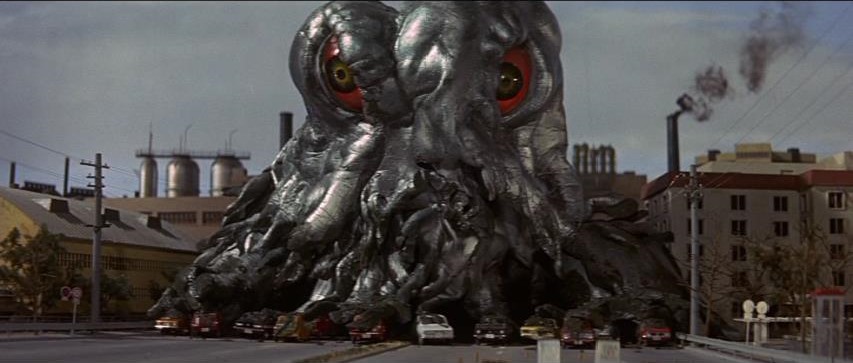
Enter Hedorah, a toxic slime creature who resembles a hundred foot tall tumour who sports the burning red eyes of a habitual stoner that has been formed from the many years of pollution an industrious Japan has pumped into the atmosphere. This gelatinous new Kaiju immediately starts laying waste (pun intended) to every living thing in its path from screaming teens to adorable kittens and adds to its already considerable size bu huffing on cloud belching smokestacks like they’re a custom vape. Dr. Toru Yano – a scientist given a Harvey Dent style facelift by Hedorah while it was in its infant, tadpole form – and his young son, Ken, desperately try to figure out how to disperse the caustic creature using science, but as they toil away, it’s down to Godzilla rock up to Hedorah’s pollution party and dismantle him the old way. However, the King Of The Monsters has never faced a foe quite like this new enemy before and finds that Hedorah has a formidable arsenal such as the emission of choking fumes, the ability to squirt blobs of toxic acid and fearsome laser beams that shoot out of the corners of its eyes, for some reason.
While the youth of Japan seem to think that gathering at the foot of Mount Fuji and having a full blown, far out, hippy protest will have some sort of effect, the army rush to carry out Dr. Yano’s plans to try and dry out Hedorah to weaken the polluted prick, but success hinges on whether Godzilla can manuever Hedorah into position at the right moment. Can he hope to succeed against a villain that was essentially created by decades of our own neglect?
While Godzilla Vs. Hedorah is an admirable, if overwhelmingly obvious attempt to get the youth of Japan to take notice of what harm pollution ws doing to the earth, I dare anyone to claim to know who exactly this movie is supposed to be aimed at. Featuring a tone that lurches about the place as violently as Lee Pace during stand up, the general mood of the piece is recognisable as something approaching a monster mash for all ages, however, just when you think that the flick may be too overly silly for adults (animated vignettes and Godzilla’s questionable method of travel which we’ll get to later) the movie then suddenly switches and actually comes fully loaded with some surprisingly upsetting imagery such as Hedorah choking people to death with his acidic smoke or a genuinely panicked Godzilla, blind and screeching in agony as he’s buried alive in a shallow grave of Hedorah’s toxic muck. However, whenever it isn’t lulling children in with those cute, animated segments and then traumatizing those same little tots by forcing them to watch women and children are being reduced to skeletons in Hedorah’s acidic wake, the film also panders to the peace and love generation as dopey beatniks remain convinced that their gyrations to psychedelic pop is going to change the world. To say that the finished product is iconsistent is an understatement and as a result the movie shoots itself in the foot more times than a quick draw specialist with a nervous tic.

Good points? As a Kaiju, Hedorah is somewhat ahead of his time, adding to his metaphor status with a habit of changing into multiple forms for any occasion that feels way more like the metamorphosis-happy Godzilla villains of the 90s than anything from the Showa era of movies. Also, he’s quite the legitimate threar with the climactic fight being surprisingly brutal with both creatures repeatedly trying to blind each other either with acid or their own bare hands and Godzilla clawing at his throat, desperate to breathe while carrying numerous scars and burns from this violent encounter. However, despite the knock down/drag out nature of the brawl, the fight itself suffers from pacing issues that makes it drag and a shift in tone so jarring, it delivers quite possibly the most infamous moment in Godzilla’s career. After rife begins to turn and Hedorah switches to his flying, manta ray form in order to to make a quick getaway, our humongous lead suddenly tucks his tail between his legs and uses his radioactive breath to fucking fly and gives chase while a jaunty march plays over the soundtrack; a peculiar talent he’s never even hinted at before or since! As confounding as it is amusingly bizarre, the scene ultimately turns out to be the perfect metaphor for the deranged swings in tone the movie frequently displays. Who the hell is going to take the film’s super serious message seriously when Godzilla is buzzing across the landscape like a bloody idiot; but conversely, the film is way too much of a gloomy bummer to take as a mindless giggle.

After a muted reception that no doubt came from Yoshimitsu Banno’s unorthodox vision, the film eventually ends with Godzilla wandering off into the sunrise, soberly mulling over endless disturbing footage of pollution while the lead child actor shrieks high pitched farewells at him as he trudged into the sea. To be honest, instead of looking like a triumphant victor, Godzilla looks more confused and depressed at the turn of events – chances are the audience will feel much the same way…
🌟🌟
 We Have Issues
Gets far better with repeat viewings. Aged well. Godzilla films can be many things, why not a strange art film?
LikeLike