

Since its kickoff in 1999 with Godzilla 2000, the Millenium Era of Godzilla movies had kept up a strict, unbroken run of keeping each entry their own thing, with the only other flick remaining cannon being Ishiro Honda’s 1954 original. This string of instances where a franchise of movies went out of their way to keep their metaphorical hands to themselves was in direct contrast to the Heisei Era, which famously went hell for leather to generate seven movies of nothing but continuity.
However, in 2003, that all changed with Godzilla: Tokyo S.O.S., the only true sequel in the entire run of of the Millennium era. Following on closely from the previous year’s Godzilla Against Mechagodzilla, in which the Japanese rather callously utilized the bones of the original 1954 Godzilla to build Kiryu, a massive robot who could save Japan from constant attack from raiding giant monsters, Tokyo S.O.S. would not only keep the thread going, but would also throw in Mothra to mix things up a little. And if there’s one thing Masaaki Tezuka’s Godzilla efforts could certainly use – it’s a desire to mix things up…

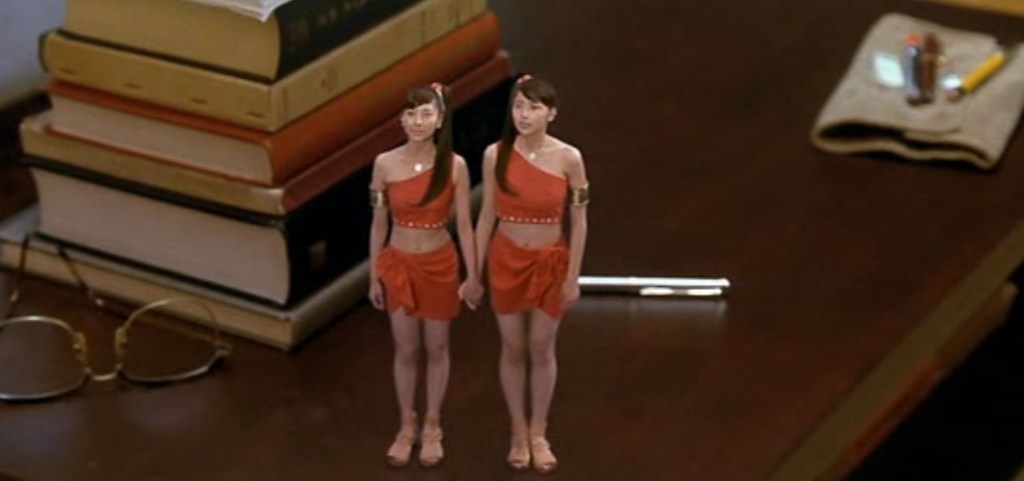
After the last, massive battle between Godzilla and MechaGodzilla (aka. Kiryu), the former was successfully driven away into the ocean while Kiryu was heavily damaged but still in one piece. A year later, we pick up the story as Kiryu is undergoing repairs at the “Mecha G” home base, however, when the remains of a massive Kaiju turtle are washed ashore (Don’t worry Gamera fans, it’s actually a cameoing Kamoebas from the film Space Amoeba), it becomes obvious that another attack from the King Of The Monsters is imminent. So loins are girded, sphincters are tightened and the rush is on to get Mechagodzilla ready to fight in time, but there’s an extra wrinkle this time as adorable furry bug God Mothra has decided to get involved and has sent her tiny, twin priestesses, the Shobijin, to show her displeasure at the original Godzilla’s bones being used in such a way. Pleading with the elderly Dr. Shin’ichi Chüjö – who had a run-in with Mothra back in 1961 – and his his Mecha G mechanic grandson Yoshitu, the diminutive spokeswomen claim that the dead Kaiju’s soul is in torment and wishes to be returned to the ocean to rest. If Japan does so, they vow that Mothra will defend the country if Godzilla inevitably chooses violence.
Cut to: Godzilla choosing violence as he emerges out of the sea with all the angry drive of a dad approaching a tampered with thermostat and while the politicians debate whether they should take Mothra’s offer seriously, Chüjö and his head strong, younger grandson try to make their decision for them.
However, with Kiryu’s original pilot Akane Yashiro in America for additional training, it’s up to a new crew to take MechaGodzilla into battle in a two-on-one battle for the ages.
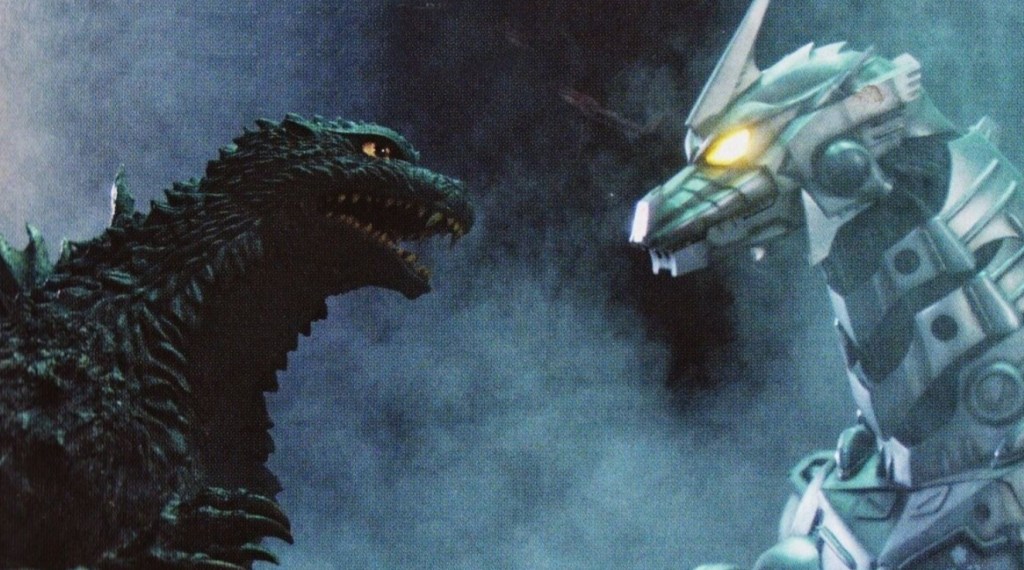
It’s ironic that the very concept that separates this Godzilla movie from the majority of others it what also bogs it down so much as you’d think that the spiritual nature of Mothra and her life cycle would be an interesting counterpoint to the technological origins of the gleaming Mecha of Kiryu. However, Tokyo S.O.S. not only shares the same director as its direct predecessor, but also the same style which may offer up some expansive, gigantic rumbles but seems to lack any genuine emotional weight. It’s not for the want of trying as Tezuka uses the 1961 Mothra (plus original actor Hiroshi Koizumi) as nostalgia orientated back story and while it’s a genuinely sweet gesture, the pairing of Mothra and Kiryu two prove to be an odd mix that never truly gel.
The problem is that the movie spends so much time either focusing on the trials and tribulations of technician Yoshito as he struggles to fit in with the brash, egotistical Mecha G pilots or establishing Mothra’s usual plot arc of self sacrifice and rebirth, that Godzilla himself is sort of relegated to the background like Val Kilmer in a Batman movie.
Sure, you could argue that in this movie, the Big G is more like Heath Ledger’s Joker or the shark from Jaws as he drifts in an out of the movie, affecting everyone and their decisions, but compared to those other movies, Godzilla seems less like a three dimentional monster and more like a big, green thug that arguably could be interchangeable with any other hulking brute in Toho’s back catalogue of Kaiju.
The human stuff is fine with the main dramatic stuff coming from Yoshito being torn between in his pride and devotion to the Mecha G project and his grandfather’s unwavering devotion to Mothra and the Shobijin while also experiencing a spot of Top Gun style bullying from a preening Mecha-pilot and you can’t claim that you don’t get a Kaiju bang for you Kaiju buck as the trio of Titans trash Tokyo with reckless abandon.
Once upon a time, I truly loathed both this and Godzilla Against MechaGodzilla, finding them too light and melodramatic to hold my interests, but ensuing years have found my stance softening – however, the real problem with Tokyo’s S.O.S. is that it’s one big story split in a way that renders both far less powerful than they could have been. Merged and re-edited into a two and a half hour super epic, we might have had an epic truly worth celebrating, but in it’s two, ninety minute forms it just feels too light and frothy to truly resonate.
However, if i have to give Tezuka credit for anything, it’s that even though his action scenes may feel a little Power Rangers-y, there’s no denying that he goes all out in trying to create the biggest spectacle possible. The details of the long, climactic battle are crisp and clean and there’s no lack of giant monsters being put through buildings or back body dropped like a super-sized ECW bout.
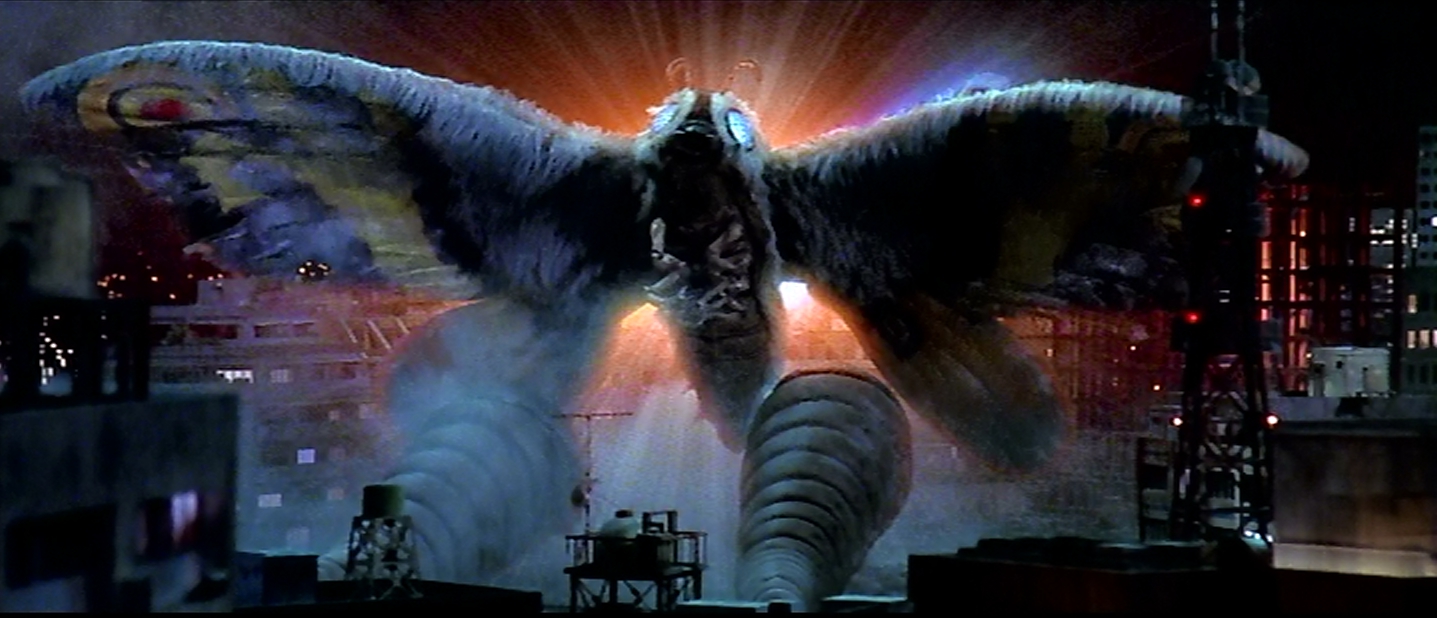
We’ve already Godzilla and his Mecha lookalike go at it before the year prior and the movie keeps coming up with new ways for the the old enemies to throw camper van-sized hands. However, while the addition of Mothra to the plot complicates matters, she proves to be something of a revelation during the fights. With her wings billowing like never before and looking more articulated than ever, she makes a visually stunning counterpoint to Godzilla’s rough scales or Kiryu’s shiny finish, even when an enraged King of the Monsters is beating the fairy dust out of his old fuzzy, flapping adversary. However, the real game changer is when a pair of Mothra Larvae hatch and enter the fray, gobbing silk everywhere they go and changing the beat of the action nicely.
While I can fully see why some might favor Tazaki’s more safe, populist style, Godzilla: Tokyo S.O.S., despite being fully invested in the character’s rich heritage, simply is lacking anything close to an edge, thus leading to S.O.S standing for: Slightly Ordinary, Sorry.
🌟🌟🌟
 We Have Issues
One comment