
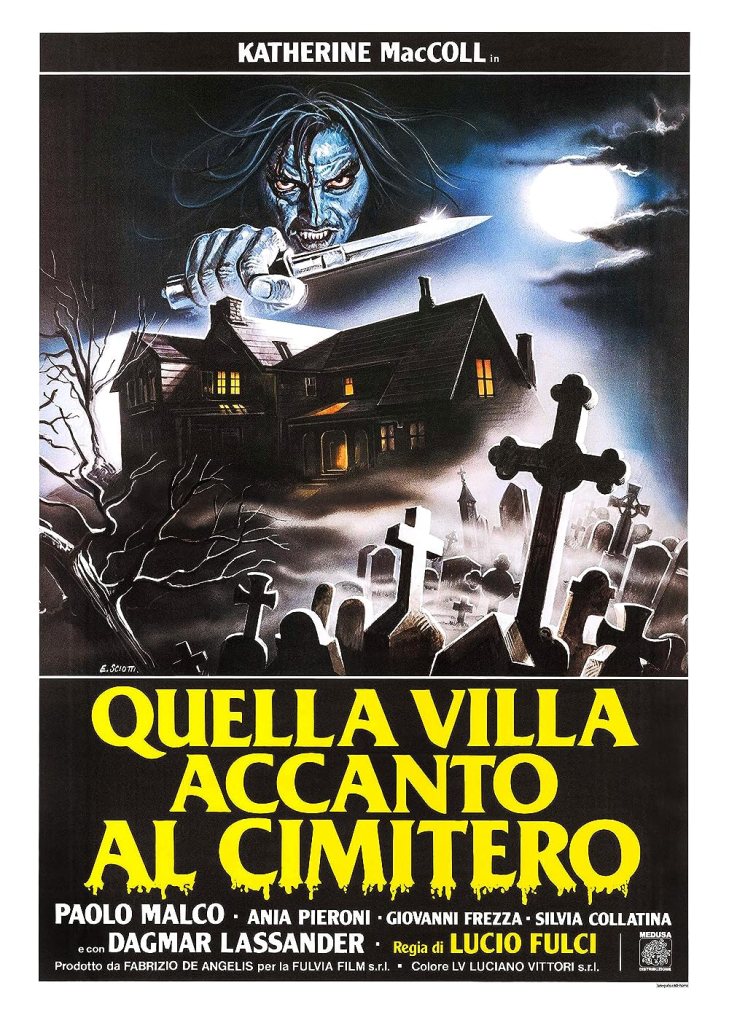
Lucio Fulci could hardly be described as the most lucid filmmaker of Italian horror, but even by his defiantly illogical standards, The House By The Cemetery is pretty fucking out there. In fact, when it came to putting together the third (and least) entry to his notoriously batshit Gates Of Hell trilogy, I wouldn’t be at all surprised if the initial meetings with the producers went a little something like this:
Producers: Well Lucio, what should your next movie be about? Zombies? Ghosts? Slashers?
Fulci: Yes.
Yup, not only is The House By The Cemetery a frenzied mish-mash of numerous horror tropes that the infamously eccentric director attempted to crush together whether they fit comfortably or not, but it’s one of the least coherent films the logic-phobic Fulci had ever made, happily matching gaping plot holes with other riotously chaotic releases of his, such as Manhattan Baby and Cat In The Brain. To try to make actual sense of the why’s and wherefore’s of the plot is surely a one way trip to migraine-ville, so sit back and let the crazy wash over you as we tentatively enter The House By The Cemetery.
Norman and Lucy Boyle have traveled from New York to New England with their young son, Bob and while Norman continues his study of old houses, the family will be living in “Oak Mansion”, a creaky old abode with a sinister past. Norman has got the job primarily because his ex-colleague suddenly went mad and murdered his mistress, but seems generally upbeat about things, even when he hears his temporary living quarters ominously referred to as “the Freudstein House, however, less enthusiastic is Lucy who is struggling to cope with various emotional issues that have been exasperated by the upheaval. Bob, on the other hand, is making the best with what he’s got and avoids his mother’s impatient mood swings by sneaking out and playing with his new friend, a young girl given to spouting doom laden warnings named Mae.
As time goes and Norman remains as stubbonly ignorant to his wife’s needs as a 60s era Reed Richards, bizarre happenings start to occur from banging and crashing coming from the boarded up basement, to the arrival of mysterious Babysitter Alice, who comes to the party equiped with a Billie Eilish’s eyebrows and a vacant faraway stare combo that raises more questions than it answers.
Soon the cause of the problems is revealed in the form of the malevolent, inhuman squatter lurking in the basement who turns out to be the maniacal Dr. Freudstein, an insane surgeon from the Victorian era who has been keeping himself alive by murdering people and transplanting bits of them onto himself in order to renew his cells (or something). Can this dysfunctional family manage to avoid being eviscerated by the not-so-good doctor while the plot randomly throws outlandish gore and random, ghost story, sub plots at them with reckless abandon?

I may have made this connection before, but I often feel that watching The House By The Cemetery is the closest thing you can get to being trapped in a Garth Marenghi novel as the movie launches everything at you from performances so wooden they require weather proofing to an obvious distain for logic so profound, it borders on pathological. Frankly, it seemed like Fulci, having nailed Lovecraftian fuckery with City Of The Living Dead and The Beyond, simply wanted to make the most ludicrously gothic movie he possibly could whether the bastard thing made sense or not. Hence we get this cluttered tale of a beared mansplaining machine and his fractured family as they square off against a creature so mindlessly random, he teeters on nightmarish genius. Simply put, Freudstein (talk about an on-the-nose moniker) is a basement dwelling maniac who has pimped his ride with other body parts for so long, his blood resembles maggoty Marmite and his featureless face looks like an overcooked baked potato – on top of that, one of his freshly transplanted hands is blatantly female and he has the unnerving habit of sobbing with the voice of a toddler.
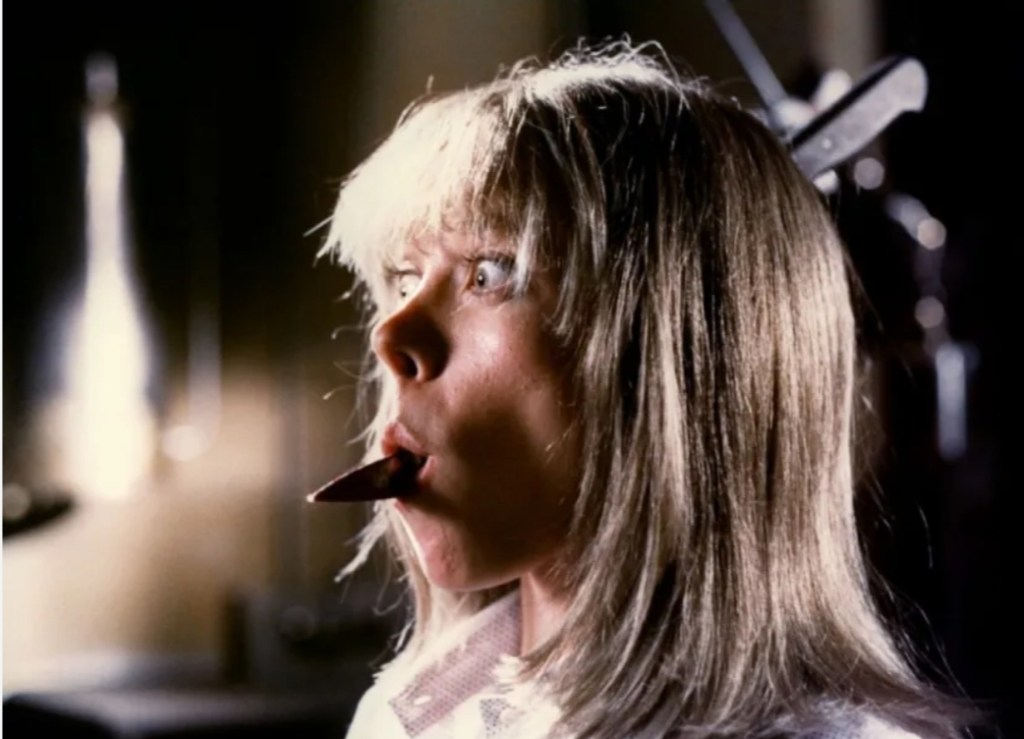
Simply put, he’s the sort of horror creation completely created with dream logic in mind and the rest of the movie obediently follows suit by being wilfully confusing at every turn. Take Alice for example, the blank eyed babysitter; the movie seems to be setting her up as some sort of inhuman accessory as her haughty behaviour mercilessly gaslights a fragile Lucy and she even mops up the gore left by one of Freudstein’s gruesome killings with no explanation whatsoever and yet later on, all of her strange personality traits suddenly vanish as it turns out that she seems to have no connection to Freudstein at all after goes at her neck with a knife.
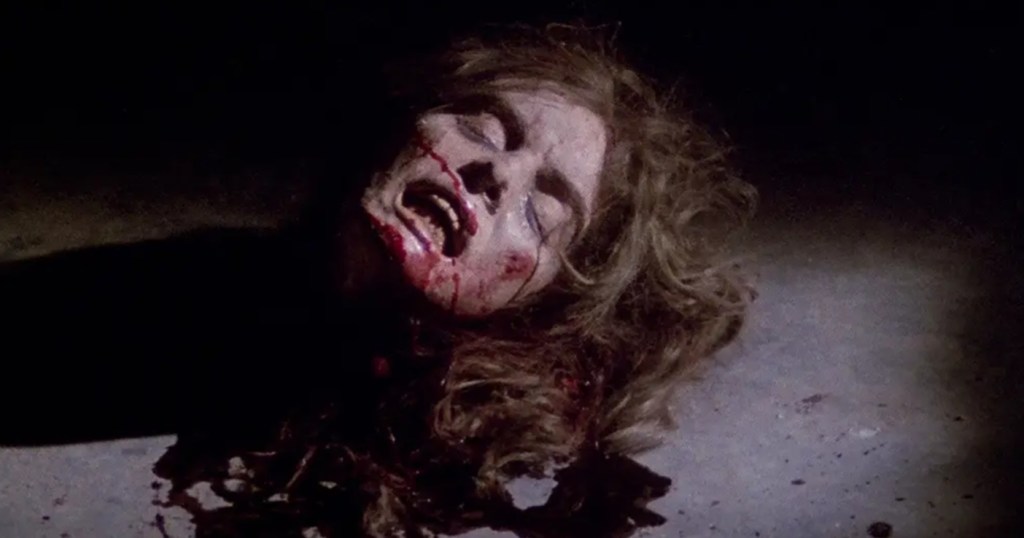
Elsewhere, Fulci idly toys with the supernatural with the fact that little Mae is the ghost of Freudstein’s daughter – something he doesn’t even try and make into a twist – and the notion that maybe all involved are doomed to end their lives, lying in a heap in Freudstein’s body part littered lair as people are constantly insisting that they’ve met Norman before. Is Fulci inferring that the Boyle’s are stuck in some cyclical nightmare, destined to be murdered again and again? I’m fucked if I know and I’m sure Fulci probably wasn’t that certain either, but it does mean that the director can go full force when unleashing his particular brand of rubber reality and one thing The House By The Cemetery certainly isn’t is predictable.
However, if you’re like me and remain convinced that Fulci is literally an unsung genius, there’s plenty to admire in the film’s unending stream of hallucinatory weirdness (out of nowhere bat attack, random bursts of orgasmic super-gore, trippy soundtrack), but on the other hand, if you believe that the man was not much more than a trashy hack (something I also think is pretty accurate – what, he can’t be both?) then the movie still remains a goldmine of unintentional laughs and comically dated chills.
However you approach The House By The Cemetery, it’s still mid-strength Fulci bolstered by the fact that its indirectly linked to the far more energetic movies that round out the Gates Of Hell trilogy.
Still, I have to give props to the ending that I think suggests that even Bob doesn’t survive the final assault, but instead gets to chill out with Mae in some otherworldly nether place where he’ll remain a child forever – or something.

If you’re not a member of the Fulci faithful, a trip to The House By The Cemetery may be a wasted journey, but to others, the movie remains every bit a muddled, disjointed and perversely fascinating jigsaw that resembles the jumbled, uneven form of Dr. Freudstein himself.
🌟🌟🌟
 We Have Issues