
Even filmmakers who created the modern blockbuster, changed populist cinema forever and arguably gave us more iconic moments on the big screen than any other carbon-based lifeforms working in film today have to start somewhere and for a fledgling Steven Spielberg, that place was television.
After cutting his teeth on some episodic television such as a Columbo, a young Spielberg finally got a shot to prove what he could really do with Duel, a small screen potboiler adapted from the works of Richard Matheson by the author himself. Thus the stage was set for the precocious director to take the old Charles H. Spurgeon quote, “Begin as you mean to go on”, and take it to ridiculously successful extremes as he forged not only arguably the greatest movie ever made for the small screen, but also one of the most sweat inducing, steering-wheel-bitingly tense thrillers that ever roared out of the 70s.

David Mann is a somewhat uptight, middle-aged, salesman who, long before the days of Zoom meetings, is driving through the Mojave Desert in his Plymouth Valliant sedan in order to make an important business trip. He seems like a perfectly normal fella – if a bit overly sensitive – but he’s about to spin find himself in the middle of a black top nightmare when he’s targeted by the mysterious driver of a huge, smoke belching, dilapidated Peterbilt tanker truck after an innocuous spot of frustration-formed road rage.
Whoever is driving the monstrous vehicle, they’ve seem to have taken umbridge with Mann’s very existence, be it his class, his demeanor, or just the slight fact that David had the nerve to get tired of the truck’s mischievous-yet-spiteful fuckery and had the temerity not to play anymore, and so the two find themselves locked into a progressively more vicious game of cat and mouse with the busty desert as their sweltering backdrop.
As an increasingly desperate Mann, tries to stay one step ahead of the machiavellian motorist who has marked him out for such torment, he’ll try (and fail) to outrun a truck that can somehow match him for speed, outwit a trucker who is far more wily than the rusted appearance of his vehicle lets on and trybat numerous times to discern the identity of his faceless attacker, but as the ordeal draws out for hours, David realises that if he’s ever going to be free from this nightmarish experience, such civil means of survival as notifying the police and composed rational thought are going to have to be left in his rearview mirror.
Can he survive, or is he destined to be crushed, both physically and mentally, by the meanest mothertrucker you ever did meet?

Not to trash TV movies of the 70s, but a lot of the time, even if they weren’t a thinly veiled pilot, they proved to be workmanlike productions that lacked the style, budget and time usually afforded to their silver screen cousins. However, someone obviously didn’t tell a young Spielberg, who took Matheson’s uber-taunt screenplay and turned it into a 95-minute masterclass in sustained tension and nerve jangling thrills.
Except for the dated opening credits, there’s nothing here that even suggests this was your average movie of the week as the hungry director (Hungry? Try fucking voracious!) goes all out in order to keep Duel looking as relentlessly cinematic as he can despite the majority of movie essentially featuring a sweaty Dennis Weaver looking in his rearview mirror while having a full-blown mental breakdown. For a start, a lesser director would presumably have covered most of the film from either inside the car and with standard, car chase set ups; however, Spielberg – possibly youthfully ignorant of any limitations – sticks the camera literally everywhere, putting you slap bang in the middle of the action by mounting shots either on or inside every square inch of both vehicles which also prevents Duel’s visual style from getting repetitive or stale. Elsewhere, both the writer and the director immediately recognise the importance of mystery, shifting out some of the expected exploitation type B-movie shenanigans of a killer trucker and instead embracing just how terrifying an unknowable enemy can truly be. At no point during the movie do we find out who the truck is, what hooks like or even what HUD fucking deal is as the movie instead makes the truck itself the face of villainy.

It roars like an animal, beltches smoke like a dragon and is inexplicably way too fast for a vehicle of its size and while the filmmakers thankfully stop short in hinting that there may be some sort of supernatural happening occuring, they still take great glee in infusing it’s bad guy with preternatural predatory skills. In fact, the scariest moment in the entire movie proves to be the most magnificently counterintuitive as we witness the truck driver temporarily hit pause on his campaign of terror to help push a stranded bus full of school kids back onto the road while a horrified Weaver looks on, finally comprehending that this lunatic is entirely focused on him and no one else.
As masterful as both Spielberg and Matheson are, a huge nod has to go to Duel’s leading man for selling the sustained terror marvelously. Be it shrieking in childlike despair when his radiator hose gives out during an agonising uphill chase or wracked with paranoia as he realises that he may be sharing a crowded roadside diner with his unknown harrasser. Matters are made all the more interesting by not only making Weaver’s motorist a painfully ordinary every guy (even his surname is an identity erasing Mann), but also having him be something of a penickity wimp. This ties neatly with familiar themes of lost masculinity (Straw Dogs) and a need to drop the air of civility in order to become primal enough to survive (The Hills Have Eyes) that’s hammered home even further by an opening conversation over the radio where a man frets about being a house husband.
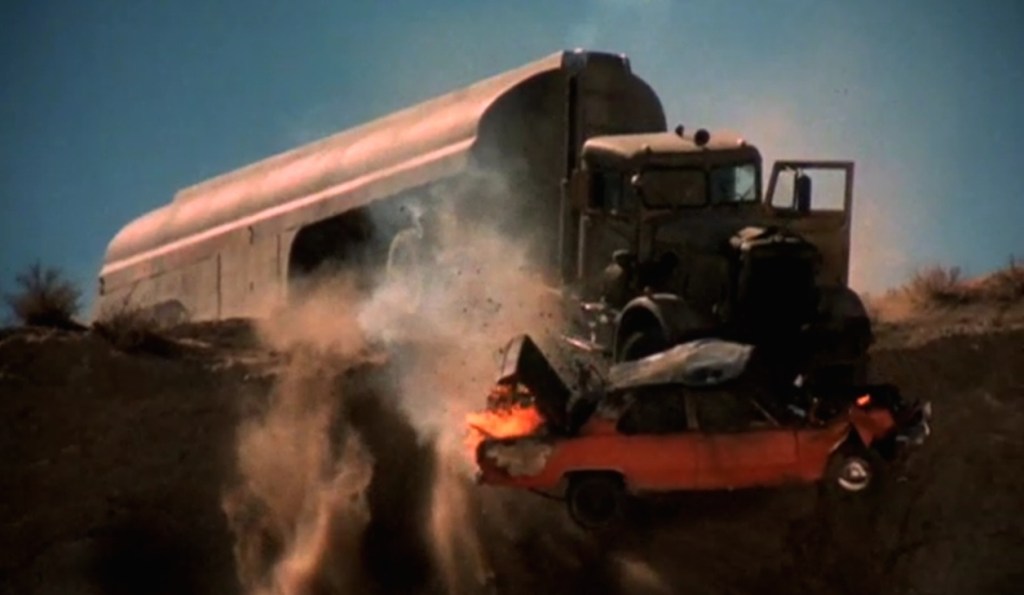
Loaded with so many heart-in-the-mouth moments, it’s probably loathed by cardiologists, possibly the most impressive thing about Duel is the sense of control that the young Spielberg holds over the thing, drawing things out to a ridiculous degree, yet never once does he let’s things become silly by jumping the shark – which obviously is ironic considering Spielberg was on the cusp of changing cinema by literally utilizing just that. A mean, lean, pulse pounding machine that proves to be far more than just the dry-run for Jaws as some people would have it, Duel stands steady on it’s own four tires as early proof of something we would all soon come to realise.
You just don’t truck with Spielberg.
🌟🌟🌟🌟🌟
 We Have Issues