

After his Halloween legacy trilogy, I think it’s safe to say that David Gordon Green is something of a controversial figure in the hallowed halls of modern horror. Even now, roughly a year after Halloween Ends asked us to swallow the sudden appearance of proto-Myers wannabe Corey Cunningham, I still find myself weirdly conflicted with a lot of decisions the director made that continue to balance of the knife edge between brave and stupid.
So it’s with a fair amount of curious trepidation that I approached the latest franchise Green and Blumhouse have chosen to resurrect, which turns out to be none other than the latest attempt to sequelize the notoriously resistant Exorcist franchise – something that’s bound to ruffle more feathers that a hurricane in an aviary. Now that he’s laid his hands on another stone cold classic, can the divisive director succeed in making us believers?

After an earthquake during a holiday in Haiti left his pregnant wife dying, photographer Victor Fielding has lost his faith and instead has devoted all of his being to being the best father he can be to his thirteen year old daughter, Angela. However after she goes missing after an after school trip to the woods with her best friend, Katherine, Victor and Katherine’a Baptist family goes through the whole gamut of emotions as gnawing panic, desperate finger point and anguish consume them for the next three days.
However, on the third day, the two girls are found, thirty miles away with burnt feet and no memory of their ordeal, being utterly convinced that they’ve only been missing a couple of hours.
The relief that the parents feel, however, is short lived when a case of exposure proves to be the least of the girl’s physical issues as both start exhibiting strange and increasingly violent behavior that includes extreme self-harm and a disconcerting habit of causing a blasphemous scene in church. After Victor reluctantly has Angela committed, he is approached by his well meaning neighbour, who offers him a familiar chance of salvation: a book detailing an actual possession of a teenage girl written by the child’s mother, Chris MacNeil.
After visiting her in an act of desperation, Victor finally has some clue with enormity of his situation and after clueing in Katherine’s family to what is going on. Various friends of both families of different religious gather to help in an exorcism to cure both kids of their demonic influence. But even in the face of such faith, the possession holds firm and the two girls make a horrific ultimatum: only one of them will survive this ordeal and it’s the parents who have to choose which one…
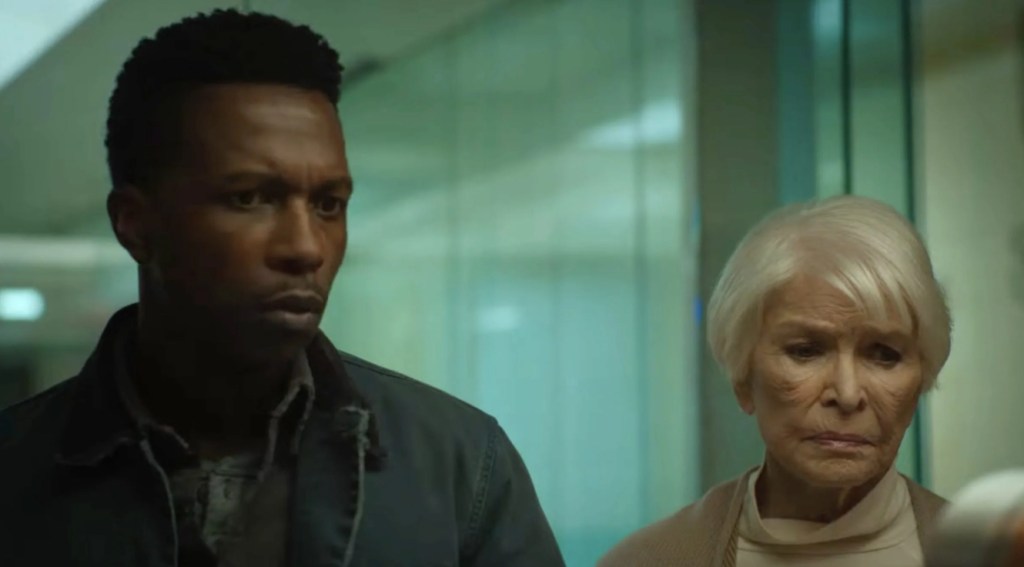
When you strip away all the pea soup, crucifix abusing and raspy voiced blasphemy, what’s made William Friedkin’s The Exorcist rightly regarded as one of the best to ever do it is its central themes of failing faith and defiant motherhood that proved to be incredibly affecting as well as undeniably haunting. What’s even more impressive is that the director weaved all these aspects into a story that never once felt patronising or spelt out in a overly conscious way. The Exorcist: Believer, unfortunately doesn’t have anywhere near such a steady hand on what it’s trying to convey, and instead frequently opts to sit you down like a child to lecture you on the nature of faith with some painfully on-the-nose preaching. In many ways, it’s frustratingingly reminiscent of the endless therapy speech that made a lot of the dialogue in Blumhouse’s Halloween trilogy so stilted and unnatural and as a result, Green’s carried over a couple of bad habits as he tackles another beloved horror institution. Yep, Ellen Burstyn returns as Chris MacNeil to make its official connections with the original irrefutable, but her appearance ends up being something of a red herring, much like Jamie Lee Curtis’ non-role in Halloween Kills. It proves to be especially frustrating when you realise that Believer starts off pretty damn strong as it fuses the nature of demonic possession with the far more close to home fears of a missing child. Its here that Green truly hits his stride, giving us another brooding, autumnal, small town America backdrop that allows the sickening worry of Leslie Odom Jr. distraught single parent to truly shine. While the family of the other missing girl is more of the typical, church going, God fearing, white bread family unit you usually get in these types of movies, they’re notably pushed to the side somewhat despite them suffering the exact same traumatic experience. Whether this is because the movie is trying to single out the religiously hypocritical father or it’s trying to equate the devotion of a single father to that of a seemingly picturesque, nuclear family, I’m not entirely sure and it’s here that The Exorcist: Believer reveals it’s most problematic trait – the second it becomes a full blown Exorcist film is ironically the exact moment it loses focus.

While it admittedly falls short of becoming nothing more than a hollow, box ticking exercise, there’s many an intriguing idea that’s either falls by the wayside or simply isn’t explored to it’s full potential. The concept of people from multiple faiths all converging like the Avengers to expel a demon from a couple of teenagers is an exceedingly wholesome one, and one I’d argue fits nicely in the remit of Friedkin’s original vision, but the fact that they all answer the call and immediately start working like a well-oiled machine feels way too convenient, even in a film where heads get turned a gruesome 180 and vomit defies gravity to pool on the ceiling.
Far more likely to work on those more familiar with more modern possession sessions such as The Pope’s Exorcist or Prey For The Devil than those raised on the timeless original, The Exorcist: Believer buries most of its best ideas under murky logic, sketchy plotting and some weird visual effects that look like they’d be more at home in Poltergeist II that they do in the Exorcist franchise.

However, to give the devil his due, Green provides some legitimately memorable images (the sight of the two possessed girls tied to chairs, impossibly arching their backs to be cheek to ravaged cheek us a doozy) and in the world of famously dodgy Exorcist sequels, it’s an incredibly safe bet to say it’s not even in the top three of worst Exorcist sequels ever made (even Tommy Wiseau working from a script of Neil Breen have a better than average shot at besting Exorcist II: The Heretic) and with The Exorcist: Deceiver already blessed (or cursed) with a release date, we’ve still got at least one more meeting with Puzazu whether we like it or not. But once again, Green has provided a legacy sequel that, while servicably watchable, will no doubt provide multitudes of angry debate, rather than have us all worship it as one.
🌟🌟🌟
 We Have Issues