
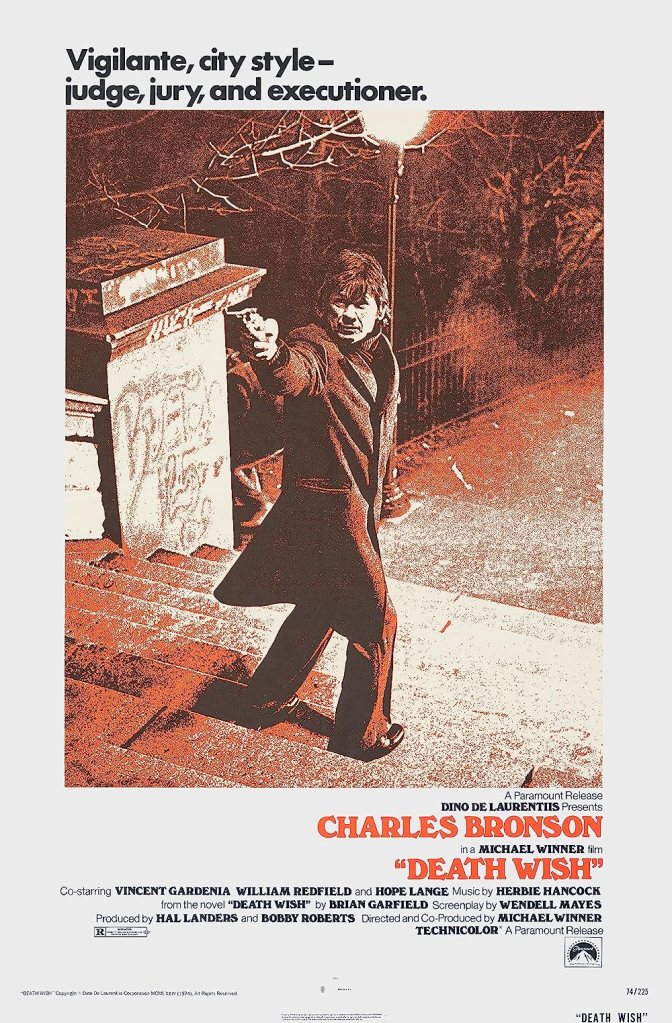
It’s strange how the progression of a franchise can colour your perception of the original movie. Take Michael Winner’s Death Wish for example; a 1970s ode to brutal, vigilante justice that spawned a series of sequels that demanded that you cheer as stone-faced, angel of justice, Paul Kersey pumped multiple bullets into every rapist, murderer and mugger he comes across in an attempt to feel more in control in a wake of slaughtered loved ones failed by society’s laws. In fairly short order, the franchise became a grotesque parody of itself as Kersey went from flawed avenger to full on action heroics, and yet, to give the devil it’s due, a rewatch of Winner’s original revealed to be a far more thoughtful beast that I had originally remembered.
Had my advancing years put me more in line with Kersey’s feelings about the law, or had i just been thinking of the sequels whenever a dismissed Death Wish as a mindless, right wing, wet dream? Time to take aim and find out.

Architect Paul Kersey and his wife Joanna reluctantly return to the urban hell of 70s New York after spending an idyllic vacation on a beach in Hawaii, but as he engages in idle watercooler chat about rocketing crime rates at his job, the brutal reality of this social situation will literally kick his door down. Followed home by a trio of crazed thugs after a visit to the grocery store, Joanna and their adult daughter, Carol, are attacked in there home with the latter being sexually assaulted and the former being beaten into oblivion.
Upon finding out, Paul rushes to the hospital to find his son-in-law, Jack, wringing his hands in worry with good cause – not only had Joanna died from her injuries mere minutes before, but the trauma of the assault has turned Carol virtually insane in an instant as she alternates between catatonia and hysterical screaming fits. Jack deals with this trauma by whinging, wringing his hands and signing Carol off on any doctor who’ll pump her full of sedatives, yet Paul handles his incredible loss with an eerie calm.
Unwilling to fall before the crushing feeling of helplessness, Paul finds himself walking the streets with a sock full of quarters in order to confront criminals, but after a business trip to Tuscon, Arizona rekindles his familiarity with handguns, Keresy returns to Manhattan with a chilling new past time in mind – to walk the streets at night, waiting for muggers to try their luck only to give them a closely grouped cluster of bullet holes for their troubles.
As he continues his grim task, the press dub him the rather unoriginal moniker of “The Vigilante” and he becomes something of an urban legend, but as he single handedly causes violent muggings to decrease, Inspector Frank Ochoa is under pressure by his superiors to perform an impossible task: halt the killings while somehow avoiding making The Vigilante a martyr.

To make things clear, I’ve never had an issue with heroes taking the law into their own hands on screen. As a child of the 80s, my peripheral vision was constantly filled with clentch-jawed good guys blowing away all manner of low lifes and scumbags for their own personal gain. Usually, films like Commando felt as tangible as a video game as Schwarzenegger machine gunned his way through an entire army in order to rescue his daughter, but when things start getting political, I always tended to get a little uncomfortable. There’s a fine line between the ethics of a film like Dirty Harry and a movie like Sylvester Stallone’s Cobra, which both see cop bend the law to catch gibbering, mass-murdering psychos and it usually comes down to the psychology of the main character. While Harry Callaghan tries to stick to a law that constantly fails him until he’s forced to toss his badge away and blow a satisfyingly huge hole through the Scorpio Killer, you get the feeling that Marion Coberetti would probably blow the head off a jay walker if the law allowed it. It’s this vague toeing of the ethics line that ultimately makes the impressively grotty Death Wish so tolerable, as the progession Paul Keresy from a liberal architect, to urban vigilante is surprisingly gradual. We find that Winner isn’t afraid to a show Kersey’s transition to cold-blooded executioner as being somewhat painful, with the man vomiting after his first kill due to the sheer adrenaline of the situation.
Throughout it all, the leathery, unmoving visage of Charles Bronson escorts us through this odyssey of vigilantism and while he’s utterly perfect when dispensing lead tinged justice with the business end of a nickle plated Colt revolver, the man’s stoicism and almost inhuman practicality makes the death of his wife and the rape of his daughter seem as big as irritant as his newspaper not being delivered or his milk going off. Still, both he and Winner are to be lightly commended about trying to add some ambiguity in there with Kersey going after random thugs rather than the lazy, action movie, wish fulfillment of targeting the actual thugs who did the deed (one of whom is disturbingly played by the god of cool befuddlement himself, Jeff Goldblum) and instead takes his rage out on random goons.

However, the cracks start to show when you realise that Michael Winner can’t quite decide whether he wants to make a provocative, hard hitting drama about social issues or just go hell for leather and make a slick exploitation film and this is where the rather predictable problems begin. For a start, he unfairly stacks his argument in a way that makes it impossible to not back Kersey on his cordite-scented crusade thanks to an excruciatingly (and unnecessarily) long rape sequence that would seem more at home in the likes of I Spit On Your Grave than a glossy, studio picture. Another thing the movie does to weight its argument is by making the gang who originally perpetrates the horrible act a baying clutch of mad dogs and to try and find flaw in an argument this exaggerated is an act of futility. Even a nun would likely agree that the world would be a better place if this string of maniacs stalking New York were all bestowed a nine millimeter lobotomy and matters aren’t exactly helped by the whining excuses of Kersey’s spineless son-in-law.
While the ending sees Kersey ultimately banished from New York by the mayor’s office in order to keep the threat of the Vigilante alive, brings the movie closer to something reminiscent of Dirty Harry’s debate spewing climax, it’s a scene much earlier that fully reveals Winner’s point of view. Watching our “hero” get won over to the view of vigilantism after a life of liberalism (his father was a victim of a hunting accident) thanks to a cowboy stunt show and NRA-style pep talk from a Arizona land developer who has bull horns mounted on his car simply puts the movie into vague propaganda territory.

Still, as uncomfortable and grimy as Death Wish is, it’s still one of the better examples of its ilk from an era notorious for its staggering crime rate and its dubious heroes.
🌟🌟🌟
 We Have Issues