

“That’s quite a view.”
If the First World War was erroneously said to be the war to end all wars, then surely Steven Spielberg’s Saving Private Ryan was an attempt to be the Second World War movie to end all Second World War movies as it took cinema’s history of turning WWII into a string of boy’s own adventure films to task and gave us a harrowing vision of battle that only those who had actually seen combat could relate to.
Lest we forget, Spielberg himself had turned obliterating Nazis into something of a summer blockbuster art form thanks to the antics of one Indiana Jones, but after making Schindler’s List a couple of years earlier, the older, wiser auteur simply considered it irresponsible to treat such harrowing events with such a glib nature.
In an attempt to drive this point home, Saving Private Ryan dropped us into possibly the most visceral battle scene ever conceived that used the Normandy landings to drive home that this wasn’t jovial antics of Hogan’s Heroes; however, this devastating opening is often praised at the expense of the rest of the movie, so once the guns and mortars of D-Day have stopped, how does Saving Private Ryan truly fare?
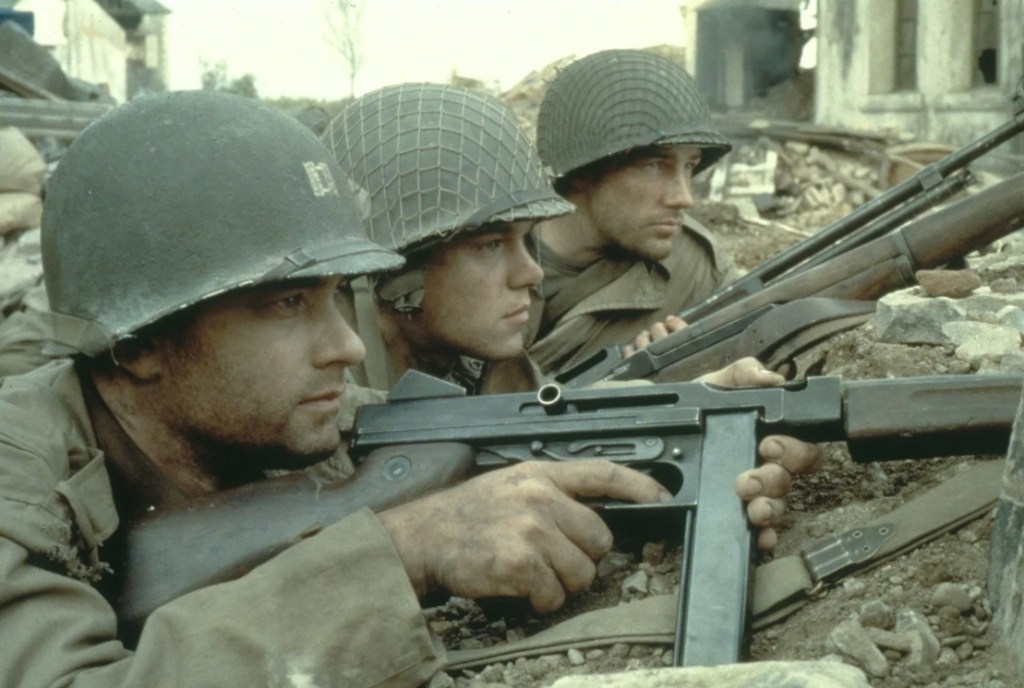
It’s 1944 and the invasion of Omaha Beach is about to get underway, but after hundreds of men are shockingly chopped into meat by machine gun fire and explosions, but in the aftermath we focus on a single body lying in the bloody surf – that of a Private Ryan. It seems that Ryan is one of four brothers, three of whom have been killed in the war and so an order goes out: the surviving brother, a James F. Ryan, is to be found and brought home.
The mission is given to Captain John H. Miller and a small squad who are tasked to travel across nazi-occupied French territory and locate the missing Private, however, their opinions about the validity of this mercy mission differ greatly, something that’s brought into sharper focus when members of their team start being claimed by enemy fire.
But while the hard bitten Hovarth, the compassionate Carpazo, the wisecracking Mellish, gifted sniper Jackson, idealistic medic Wade and the cynical Reiben all struggle to fulfil their orders under near impossible parameters, combat novice staff sergeant Upham gets a front seat view at the true effects of war.
After a string of incidents that sees the group deal with false alarms, snipers, german prisoners and tests of their very humanity, Ryan is mercifully found, but the young private refuses to leave his fellow soldiers in the face of an iminent German assault and so Miller has to weigh up the pros and cons of the mission to decide if one man’s life is worth more or less than the safety of his own men.
Obviously, no review of Saving Private Ryan is complete without a gushing ode to the frankly horrific opening that takes the hell-on-earth trauma of Omaha Beach and practically pushes your face into it. Undoubtedly the most influential, modern battle sequence ever committed to celluloid, its effects not only keenly felt in every subsequent war movie, but even in other media such as the Call Of Duty series of games, Spielberg gives us a savage sequence utterly stuffed with snapshots of young men literally torn to bits. Soldiers drown from the weight of their equipment as they’re forced to jump over the side of their boats due to concentrated machine gun fire. Miller drags a wounded man out of the ocean only to find that an explosion has vaporized him from below the waist. A shell-shocked man wanders as if inna daze as he scours the beach for his missing arm. Surrendering German troops are shot down in cold blood by chucking Americans. Simply put, this wasn’t the slick adventure of something like The Great Escape or Kelly’s Heroes where a shot soldier would simply scream and fall over, this was about as close to real warfare as you could get without actually enlisting and to watch it in a cinema actually caused me to duck at numerous moments.
But what of the rest of the movie? Well, while that opening is virtually impossible to match, the rest of Saving Private Ryan takes the usual man on a mission tropes of the Second World War movie and give them the kind of pathos usually seen in other, more thoughtful war films like All Quiet On The Western Front and even the Vietnam movies of the 80s. Some may go as far to describe the bulk of the movie as episodic, with the soldiers wandering into various stock, war movie scenarios on their way to carry out their man-based mission. There’s the standard sniper segment which sees one of their number cut down after displaying an act of compassion and a heated debate over what is to be done over a German prisoner after another of their number takes a fatal bullet, but while these moments may seem over familiar, but Spielberg’s harsh eye and a platoon-full of great performances give these tried and true tropes fresh coat of mud.

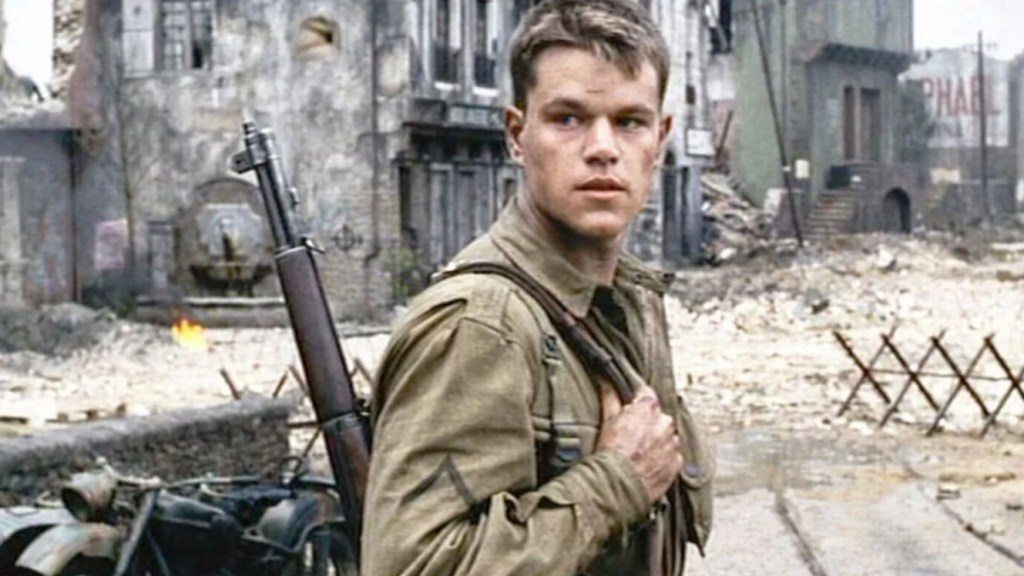
Tom Hanks, arguably Hollywood’s most prolific everyman at the time, works overtime to bring that presence to the pragmatic, PTSD suffering Captain as he struggles to hold together his fracturing men in the face of their heroic, yet illogical job. The rest of his crew contains the standard selection of architypes these movies usually have all played by faces both new (is that Vin Diesel?) and established (Tom Sizemore pretty much went on played the same character in Pearl Harbour), but its Matt Damon’s Ryan who proves to be the whole lynchpin of the film as he has to be believably virtuous to convince Miller and his men to stay and fight with him in the stunning climax.
While the movie offers plenty of quiet, character moments for the movie to muse over – Upham translates an Edith Piaf song to his brothers-in-arms; Ryan tells stories of his brothers in a moment of bittersweet recollection; Miller finally reveals his profession to his men in an attempt to shake them out of a wave of bloodlust – it’s the movie’s big finish that’s always sold it to me. Without the true life framing of D-Day to anchor it, the final scenes see a sustained battle between outnumbered American forces and a superior German force that, in it’s own way, matches the traumatic opening.
Spielberg truly comes into his element here, producing a sustained action sequence that somehow balances the gravity of everything that’s come before and still is a terrible triumph of action cinema. The director’s talent of juggling multiple characters with clear geography while dropping in memorable smaller, haunting moments is unparalleled. A tank rises over a mound roaring like a resident of Jurassic Park, Private Jackson wields his sniper rifle like a surgeon while a giant gun barrel slowly creaks toward his position, a 20.mm gun reduces the human body into guacamole and Mellish’s life and death struggle proves to be every bit as upsetting as anything seen within the movie’s first twenty minutes.

One of Spielberg’s many, outstanding contributions to cinema history, Saving Private Ryan brings both gravity and brutality when touching upon the heroism and horror of war.
🌟🌟🌟🌟🌟
 We Have Issues