
Writer Alex Garland has never been afraid to ruffle more feathers than someone who massages poultry for a living, but it’s in his directorial career that we find his most devastating work. When he isn’t bringing up uncomfortable questions concerning the nature of humanity with films like Ex Machina and Annihilation, he’s raising concerning points about the patriarchy in tbe disconcerting folk horror, Men.
Well, now he’s back, and he’s taken aim at possibly his most controversial and incendiary topic yet as he now presents a chilling “what if” that sees the United States Of America at war with itself in the ferocious Civil War.
Has Garland and studio A24 (finally entering the blockbuster arena after years of navel gazing, indie horror) bitten off more than they can chew, or will their horribly prescient vision cause the world to pause and take notice?

In a hopefully alternate future, the United States of America finds itself not very united any more when civil war breaks out in response to the President’s dictatorship stretching to a third term. With the unlikely union of Texas and California joining forces to push though all the way to Washington DC where someone will hopefully put a bullet in the out of control Commander in Chief.
In this dystopian chaos, we find hardened combat photographer Lee Smith and her colleague, Joel, on a mission to make it all the way the DC to shoot inside the capital and get one final interview from POTUS. On their way, they pick up rookie photographer, Jessie, who idolizes Lee and wants to emulate her career, and their mentor, veteran reporter Sammy, who wants to be dropped off at the front lines at Charlottesville Virginia.
Soon they get on their way in their car emblazoned with “PRESS” on the side, but as the forge a path from New York to the White House, their journey is fraught with numerous stops along the way. When they aren’t tagging along, photographing various instances of urban warfare, or ducking the bullets of a random sniper, Lee’s hard exterior gradually softens as she takes Jessie under her wing and teaches her the finer points of snapping world shaking images while in mortal danger.
However, after a run in with a clutch of extremist militia that ends with tragic consequences, the group is further rocked by the news that the Western Forces are on the verge of storming DC after a bunch of rival generals surrender, leaving the city wide open, which means their window is rapidly shrinking.
Sprinting and snapping in the wake of WF soldiers as they get ever closer to their goal, the photojournalists strive to keep up as things get more and more frenetic, but even if they reach their goal, will any quote be worth the carnage they’ve seen?

So, at the expense of Founding like virtually every other review of Civil War you’re likely to read, Alex Garland’s fictional dive into future history feels uncomfortably similar to the kind of actual news reports we’ve seen coming out the States over the last few years. This is, of course, by design, even though Garland is careful not to tread on too many toes as he weaves his sobering tale of an America literally at war with itself.
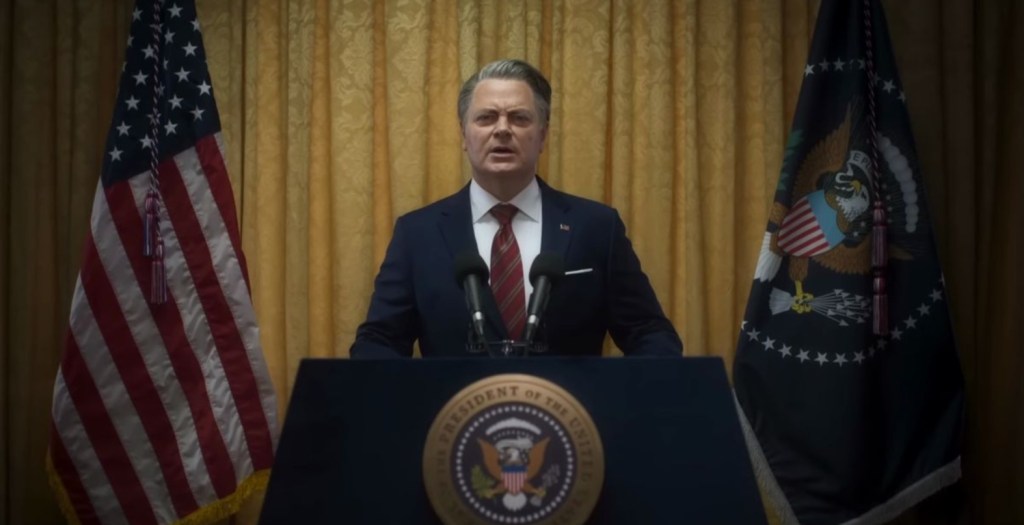
Those hoping for the director’s vision to viciously lance into actual US politics may be a bit let down that Garland’s script keeps things somewhat vague, skipping over the actual events that lead to the schism in the first place and dropping us into a world where the conflict has been raging for a while. Similarly, Civil War is careful not to point too many direct fingers at certain states or people, making the two states that’s combined the normally politically opposing Texas and California and while a bit of back story into Nick Offerman’s nameless President might have been nice, it doesn’t detract from the story that Garland is trying to tell.
That story is the tale of a gaggle of impartial journalists embarking on a road trip that exposes America as a war torn hell hole that troublingly resembles the bombed-out shells of cities we’re seeing on the news on a nightly basis and while the ultimate message of “war is bad” may be laughably simple, the optics of an America coated with shelled-out buildings and skies dotted with criss crossing tracer fire prove to be truly startling stuff.
At the centre of all this is Kirsten Dunst’s hard-faced photojournalist, who finds that a career spent shooting atrocities in other countries has left her incredibly jaded about the same thing happening on home soil and while the movie avoids any need for grandstanding monologues, her steely silence speaks volumes. In fact, it’s truly impressive how much the actress does while showing so little and it’s counterbalanced nicely by Cailee Spaeny’s eager novice who is thrown together with he idol after they survive a suicide bombing in New York City.
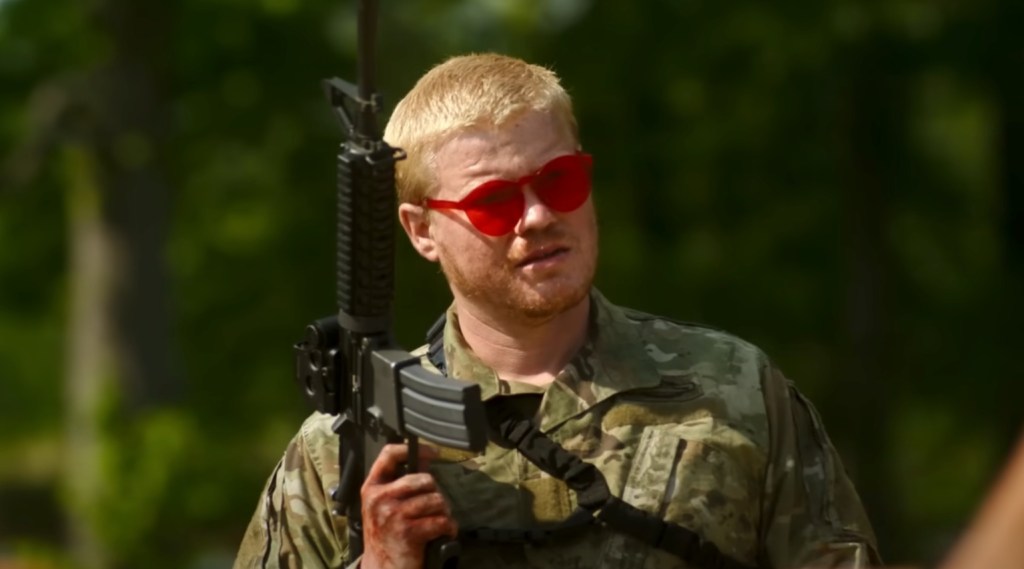
Capable support is provided by Wagner Moura’s determined Joel and Stephen McKinley Henderson, but what sticks in the mind most is the episodic moments that truly undermine how terrifying – and how bizarre – the situation really is. Moments of black humour where the group pass through a town that’s seemingly trying to ignore a literal war on their doorstep (“We usually try and stay out of it.”) are spiced up with moments of genuine terror, like when we’re forced to confront a cameoing Jesse Plements as a dead-eyed, gun pointing militant (“What kind of American are you? You don’t know?”).
However, the real draw here is the sheer weight that Garland infuses every set piece with, mocking the kind of empty spectacle the likes of Roland Emmerich would try to strive for every time he detonated an American landmark for kicks. When missiles are fired at the Lincoln Memorial, the effect is as devastating emotionally as it is literal and while the climactic storming of the White House may remind some of the final stage of the second Call Of Duty: Modern Warfare game, this fictional battle carries the same amount of gravity as the ending of Katheryn Bigelow’s Zero Dark Thirty – which is utterly remarkable when you consider that it’s all made up.
Essentially the war film meeting The Twight Zone, this is an attempt to legitimise the blockbuster in a way that should be able to ride on the coat tails of the similarly grim and mature Oppenheimer, and as a result, Civil War is an utterly petrifying, yet completely fascinating experience that demands to be seen, if only to ensure that it never happens in real life.
🌟🌟🌟🌟
 We Have Issues