
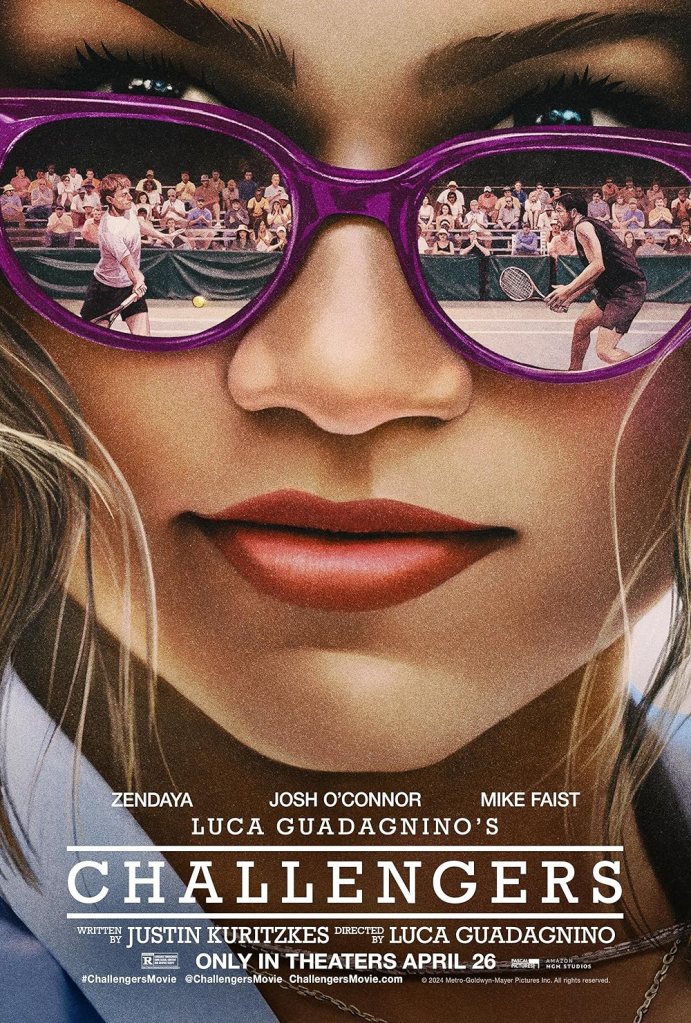
Two opponents stand opposite each other, separated only by distance and a single net. One of them serves and the two embark on an intense back and forth, belting a bright yellow tennis ball between each other with unerring accuracy and dizzying speeds. Whether you realise it or not, these two tennis players are locked into an intense relationship where they have to understand each other totally in order to gain the advantage and win the set and in many ways, it mirrors a real relationship – or at least that’s what director Luca Guadagnino obviously thinks with his newest film, Challengers.
Guadagnino has always focused on intense relationships that exist outside the norm with such films as Call Me By Your Name and the cannibal love story Bones And All, but with his newest offering, he may have used the sport of tennis to deliver his most edge of the seat “love story” of all.

As Challengers begins, we are introduced to three people who have spent the majority of their lives conditioning themselves to be the best they can be at the sport they love.
The first is Art Donaldson, a world class tennis player who is struggling regain his confidence after coming back from an injury; but the power behind his throne proves to be his wife, Tashi Duncan, herself an immensely talanted tennis player who shifted into coaching after her promising career was ended via a nasty knee injury. Tashi is something of a merciless perfectionist, pushing her spouse to be the best in any way she can in a way that redefines the term control freak.
In an effort to regain his winning ways after getting trounced by opponents that are obviously beneath him, Tashi bows to end Art’s losing streak by entering him as a wild card in a lower level tournament to get him back up to speed, but in doing so, she puts both of them back in the life of their former mutual friend, Patrick Zweig, who has entered the tournament simply to make ends meet.
The more charismatic Patrick has fallen on hard times, coasting by on his natural talent and never achieving his full potential and there’s a fair amount of bad blood that bubbles between the three due to an immensely complex personal history that they all share.
As the two meet in the final, we ricochet back and forth through their entwined pasts to see exactly how tangled their three-way relationship is and as points are conceded and ground is gained, we see how this trio have lived rent-free in each other’s skulls for well over a decade.
But what makes each of these players tick, What are their individual endgames and what will the collateral damage be once the final serve is delivered?

Literally placing its overhand smash right on the white line dividing a love story from a sports film, Challengers isn’t so much concerned with the sort of win/loss record that the genre usual obsesses over as it is casting an intense eye over what makes its trio of main characters tick. Zipping back and forth between the present – where Art and Patrick both engage in a tournament final that, while having no real professional repercussions, is a gargantuan personal crossroads for both of them – and numerous instances in their tumultuous history, the deliberately jumbled timeline cunningly resembles a tennis ball itself as it rapidly crisscrosses the net, almost too fast to follow.
While it may initially feel needlessly complicated, this form of convoluted storytelling ultimately aids Guadagnino in spilling the salacious tea as it allows him to drip feed the various emotional back hands exactly during the point when the film needs them both. As a result, your brain is helpfully nourished as you work to keep score a d as a result, you are simultaneously drawn into the story as if you’re somehow part of this tumultuous trio.
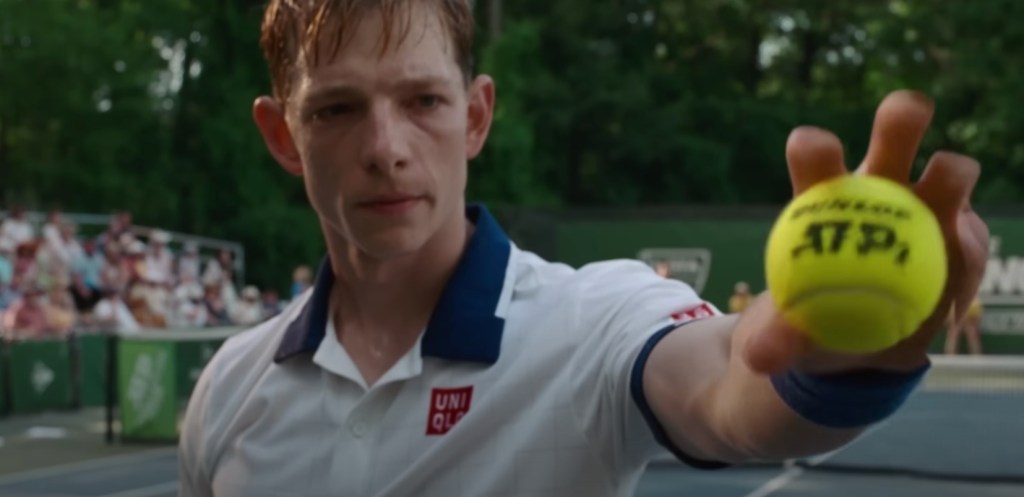
It also helps that the three main characters are each layered characters who not only are all incredibly different from one another, but are all played by a threesome of hungry actors who seem to be as desperate to make their mark as their characters are. First we have Mike Faist as Art, arguably the least complicated of the three, who may be less naturally talented that his former best friend, but the fact that he’s somewhat easily led means that Tashi has managed to sculpt him into a decorated world contender. On the flipside of that coin is Josh O’Connor’s Patrick, who is more confident, more independent, but also has succumbed to his demons thanks to is distain of following by the rules and the two spark off each other magnificently either as friends or foes.
However, taking the reigns in her first “adult” role (technically she still plays a school kid in Euphoria) is Zendaya who clutches the role of Tashi like her life depended it and turns in the extremely complex performance of her life. Turning Tashi into a machiavellian schemer who success as a coach comes from her ability to manipulate those in her orbit, it would have been easy for the character to lazily drift into the standard “bitch” tropes, but the actress, and the script, delicately ensures that her actions, while often harsh, have a point even when she draws excellence from her husband by uncomfortably manipulative methods.
But while the relationship aspects are fairly intense, Guadagnino, makes sure the tennis scenes match up to them by utilising every visual trick in the book to ensure it’s as emotionally exhausting as the drama. Whether having the ball blast right past our faces, installing a camera in the player’s rackets or even having us get a POV from the ball itself, the director brings that jarring visual flair he showed in his remake of Suspiria into the sports film while Trent Reznor and Atticus Ross’ pounding soundtrack jumps in intermittently to drive the points home. However, Guadagnino never forgets the emotion at play here, locking in on the player’s faces as thick drips of swear pour off them in slo-mo and Tashi glares expectantly from the sidelines, anxious to see her plans succeed.
It’s all deliriously exciting stuff and the film marvelously muddies the waters to unpredictable effect by never once demonising the people involved. Art may be not much more than a puppet to Tashi’s whims, but it’s something he seems to have genuinely wanted, while Patrick may be charming, but he’s also self centred and has admittedly pissed his talent up the wall. Finally, Tasha may be a punishing, controlling influence who attempts to get the best results from shockingly ruthless means, but she’s willing to risk everything she has in order for everything to succeed.

A love story and a sports story quite unlike any other, Challengers proves that it’s got what it takes to clear the net with style and tension to spare.
🌟🌟🌟🌟
 We Have Issues