
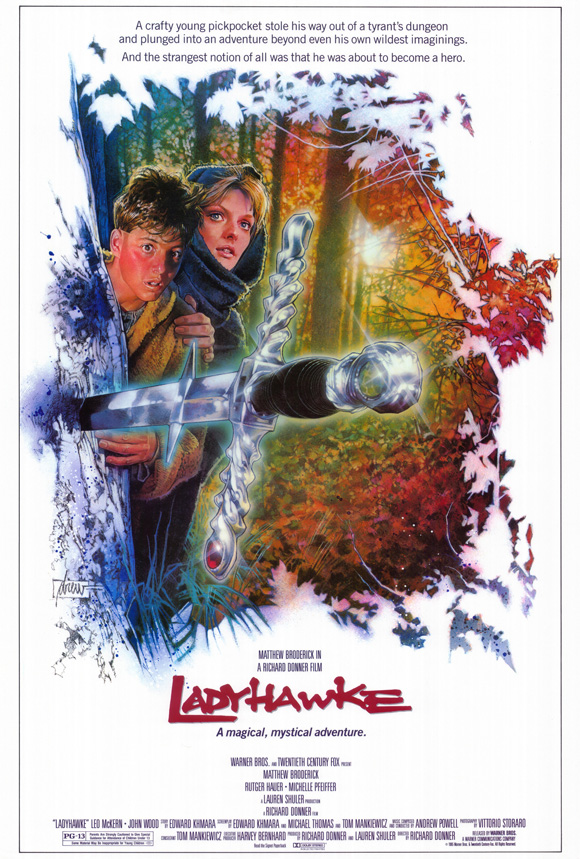
There’s something about fantasy films that were made in the 1980s that just hits a little different. While the decades prior tended to fall back on the awesomely dependable talents of Ray Harryhausen and the decades since tend to skew closer to the like of either Tolkien or Rowling – the 80s saw a bizarrely varied clutch of fantasy flicks that ranged from the R-rated likes of Conan The Barbarian, Deathstalker and The Sword And The Sorcerer while veering into more family friendly fare such as Labyrinth, Krull or The Dark Crystal. And that’s not even accounting such oddities as Dragonslayer, Excalibur or Legend.
Oh. And then there’s whatever the hell Hawk The Slayer was…
Anyway, lost somewhere in the shuffle was Ladyhawke, which presumably was the latest attempt by celebrated director Richard Donner to prove to the world that there wasn’t a single genre he couldn’t lick. However, while other entries in his filmography boasts such beloved titles as The Omen, Superman: The Movie, Lethal Weapon and The Goonies, Ladyhawke solidly languishs amidst the realms of the cult. What mysterious curse afflicts this tale of love, honor and animal forms?
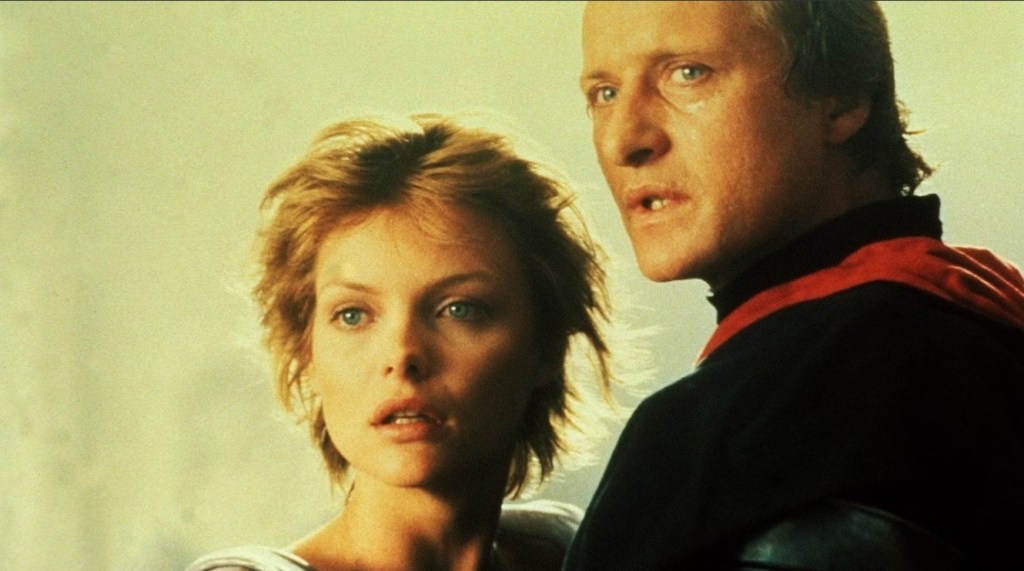
In a deep, dank cell, located in the region of Medieval Italy, we witness a young thief by the name of Phillipe “The Mouse” Gaston escape from the supposedly inescapable dungeons of Aquila and tears off into the surrounding countryside with his youthful ego supercharged beyond belief. However, the Bishop of Aquila isn’t about to have the infallible legend of his dungeons besmirched by some young punk, so he sends his guards out to silence the thief once and for all.
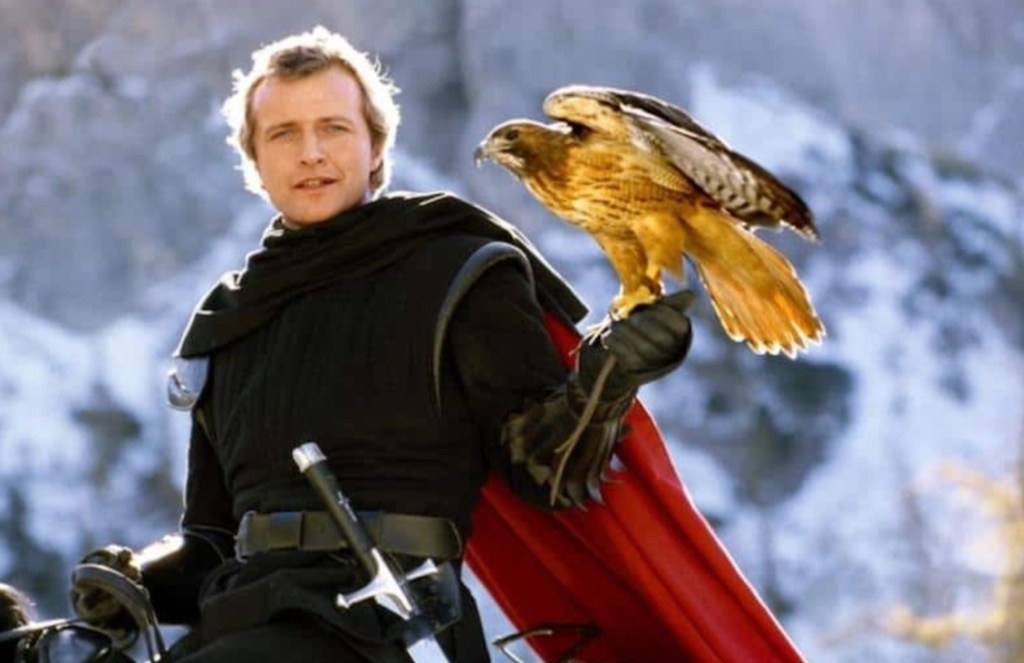
Luckily for Phillipe, he just happens to fall in with the enigmatic Etienne Navarre, the former captain of the Bishop’s guard and the owner of an oddly faithful hawk who has vowed to kill his old boss for some past, heartbreaking slight. However, after awkwardly spending time with the cold, vengeful swordsman, Phillipe starts to notice a few strange things.
For example, when the sun sets, Etienne seems to disappear without a trace, while a beautiful woman tends to appear who seems to have a connection with a large, black wolf who sudden growls about the area. What with this being a fantasy film and all, it soon becomes obvious to us (even if it takes Phillipe a little while to catch up) that a curse is in effect that has been cast in order to keep these two lovers apart.
By day, Etienne’s beloved Isabeau d’Anjou turns into a hawk, but when she becomes human at nightfall, Etienne turns into that wolf who’s been sneaking around the place. Can the two – with Phillipe’s help – manage to break the Bishop’s curse, or will Etienne’s thirst for vengence ruin everything?

There are people I’ve met during my time on this planet who absolutely adore Richard Donner’s picturesque fantasy romance. They cite that the very nature of the plot that sees its lovers separated just heaves with tragic yearning, they claim that Matthew Broderick’s endlessly mischievous Phillpe brings a spot of Ferris Bueller style modernism and the even insist that the distinctive score provided by The Alan Parsons Project’s Andrew Powell is the best thing since musical sliced bread.
I, however, am not one of these people and while I fully understand why these people are drawn to Ladyhawke’s more romantic or original aspects, I found that Donner’s foray into a world of dashing swordplay and magical curses ends up falling into the same, strange category as Ridley Scott’s epically eccentric Legend. Now, that’s not to say that Ladyhawke is a poorly made film – far from it. In his attempts to make it stand out from the crowd, some of Donner’s choices just turned me off to the whole deal.
Firstly, the good of the movie chiefly come from that cracking central conceit that keeps its central lovers so tantalisingly close, yet utterly unable to truly be with one another and the film’s use of the hawk and the wolf as their alter egoes just sells it all the more. What also helps is that glacial sex appeal of Rutger Hauer and the flawless beauty of Michelle Pfeiffer really sell all of that pent up longing that practically ebbs out of the screen like waves of deeply horny radiation. Secondly, Donner is simply just too good a director for Ladyhawke to simply be unpalatable and with the Italian setting and pinkish filter constantly turning the sky a telling tint of rose, it certainly feels different from a lot of its fanciful peers.
However, two things managed to scupper my full enjoyment of what is, essentially, a furry’s wet dream (c’mon, their lover spends 12 hours as an animal – they love that stuff!) and the first is the fact that both Donner and Matthew Broderick both seem to be pushing to make Phillipe a full-on medieval/fantasy version of Ferris Bueller that, when he isn’t barely evading capture thanks to his wits/skill/luck, he’s keeping an open dialogue going with God to give you a semblance of his fourth wall breaking shtick from his infamous class-cutting classic. It isn’t awful, but it sure is distracting and it frequently pulled me out of the film when it should have been hooking me in like an avid fisherman – but while Broderick’s shenanigans are at least understandable, there’s a far greater enemy on the horizon that isn’t John Wood’s villainous Bishop.
I’m most likely going to catch shit for this as it certainly has its admirers; but I genuinely believe that Ladyhawke has one of the most annoying scores for fantasy movie that I’ve ever heard. I’m sure that Andrew Powell’s work for The Alan Parsons Project was exemplary, but his eccentric choice of music here just didn’t vibe with me at all as it was too cheerful to fully harness the more emotional or darker parts of the story. It’s not even like I have an issue with score that don’t conform to expected norms either, as Queen rocking out on Flash Gordon, Toto’s score for Dune and Phillip Glass’ work on Candyman are so special precisely because do something markedly different – but to me, Powell’s work here just sounds like a temp score that forgot to remove…
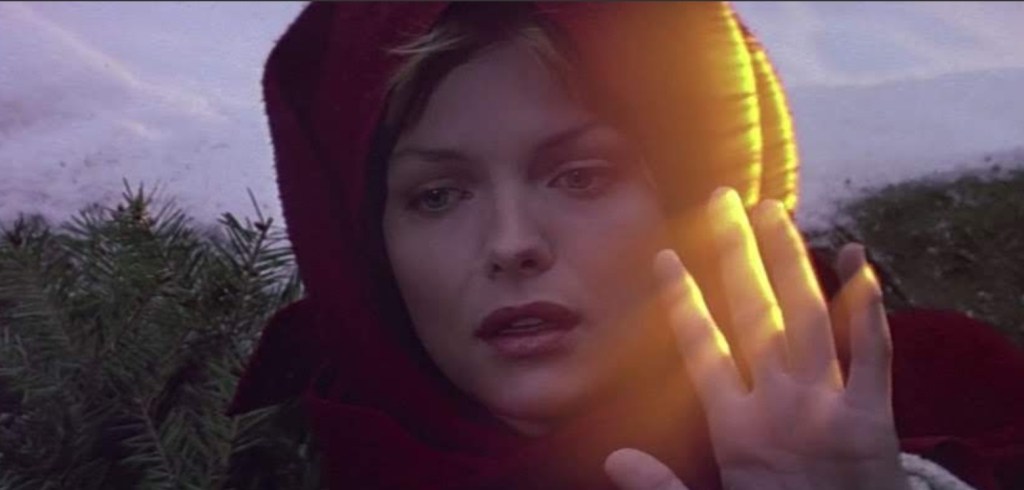
While I’d be hard pushed to describe Ladyhawke as anything close to a failure, when compared to some of his other work, it’s kind of lacking. After all, The Omen, Lethal Weapon and Superman remain some of the greatest ever examples of their respective genres – Ladyhawke wasn’t even the greatest fantasy film released in 1985…
🌟🌟🌟
 We Have Issues