Part of the reason I love horror so much is that it’s just so goddamn pliable. If you want to watch a slow burning, intelligent creep-fest then the genre has you covered just as much as those who fancy relaxing to a movie that sees over-sexualized bimbos get bloodily deconstructed down into piles of body parts – but when you push through what’s on the surface, you see what Horror’s really good at.
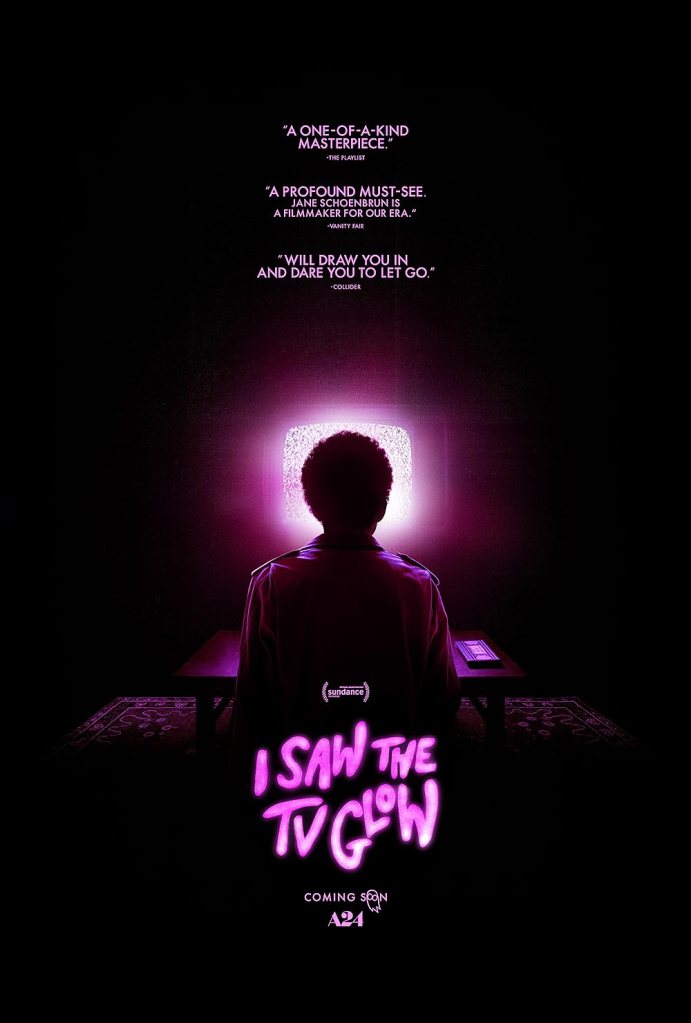
Some may roll their eyes at yet another person gushing about the genre’s limber nature to tackle social themes while it tries to scare the shit out of you, but it’s been an invaluable tool for decades when it comes to processing the fears and anxieties of its audience. This brings us to I Saw The TV Glow, a horror-adjacent, Lynchian trip-fest from Jane Schoenbrun that takes the themes of gender identity and the denial of the self and interweaves it with the incredibly random subject of those young adult tv shows from the 90s.

It’s 1996 and supremely isolated and introverted seventh grader Owen bumps into sullen ninth grader Maddy while their parents go do their civic duty an cast their votes at the local polling station. Striking up an awkward repport, the two bond when Maddy starts telling Owen about her favorite show, a young adult series called The Pink Opaque that sees two telepathic girls fighting evil from both sides of their county. His interest peaked, Owen is dismayed that his controlling father won’t let him break his strict bedtime to watch it but in a rare moment of bravery and defiance, he claims he’s going for a sleep over at a friend’s house, but instead sneaks over to Maddy’s instead to watch his first episode. The result on his young psyche is seismic and within a single episode, he’s hooked.
However, after we skip ahead two years, we find that Owen’s life hasn’t improved that much. His obsession with the show has increased despite his father’s derisive comment that “it’s for girls” and seems to be getting stronger since his mother has become terminally ill but his strict bedtime curfew still prohibits him from watching The Pink Opaque “live”, so Maddy tapes it for him and leaves it for him to Collect so he can watch it in private.
But after a long overdue chat with his friend, he finds that Maddy not only is a lesbian and has been ostracized at school, she’s planning to run away from this town in order to start again and extends an offer to Owen to come away with her. However, Owen’s fear of leaving his safe space once again strikes like a bolt of lightning and in the aftermath, Maddy goes missing and by coincidence, The Pink Opaque is cancelled at the end of its fifth season.
For the next eight years, Owen continues to live in that closed off state of anxiety that’s seeming sustained his life, but when Maddy suddenly reappears with an unbelievable explanation about who they both really are, his carefully maintained armour starts to crack spectacularly…

At the top of the page I described I Saw The TV Glow as being horror adjacent primarily because of two reasons. Firstly, as I also mentioned before, its frankly magnificent tone is highly reminiscent of David Lynch that creates a heightened state of unease that is constantly oppressive and dread inducing, but never tips into the realms of full-on horror tropes. Secondly, its themes of body horror and the fear of self initially hint of other realities and even a Videodrome-esque state of living where the real world may now no longer even exist for our troubled lead, but rather than going full Lovecraft, Schoenbrun instead ultimately digs a lot deeper than rubber realities and cult TV shows.
On the surface, the director weaves an intriguing story that riffs on heavily on the type of shows that sprung up in the wake of such gateway horror television as Buffy The Vampire or Goosebumps, which is artfully lampooned by the in-movie show, The Pink Opaque (a really satisfying phrase to say) that comes complete with fittingly goofy lore that hooks our leads with the kind of intensity that usually speaks to those with less-than-stella lives. As someone who adored the likes of Buffy The Vampire Slayer back in day, Schoenbrun nails the aesthetic perfectly and thus we get a fascinatingly weird experience that threatens to go into full blown Lovecrafian body horror that even comes complete with that vibrant pink light that movies like From Beyond, The Color Out Of Space and Glorious have seemingly insisted is the colour of choice for body warping, reality shredding shenanigans.
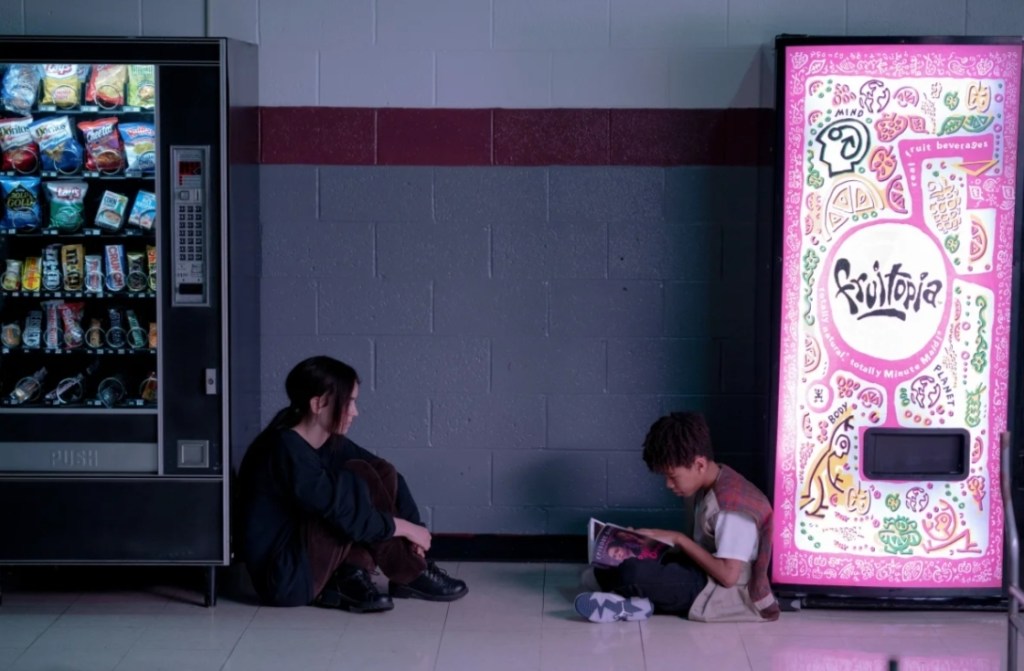
However, as the film reaches the point where other movies would go all out in a phantasmagoric blow out that sees Owen and Maddy explore the hold that bonds them so tightly to The Pink Opaque, Schoenbrun does something vastly more intriguing – they pulls back.
While some will undoubtedly be drawn to I Saw The TV Glow primarily for it’s near-perfect love letter to 90s teen shows such as Buffy, Roswell and Dark Angel (anyone remember that one?), but if that’s the case, they may also find themself feeling unnecessarily let down by the final third, which shifts away from more obvious sci-fi horror in order to take aim at a far more personal topic.
Not to give too much away, but I Saw The TV Glow proves to be an incredibly powerful Trans allegory that draws direct lines between the sense of muted unreality and emotional desolation that can occur when you deny your true self thanks to being terrified of the ramifications, and the experiences that Owen is going through as he continues to thwart his own growth. What’s even more impressive is that Schoenbrun juggles their themes to encompass all eventualities depending on the viewer. Does the movie end on a devastating note that sees Owen suffering long term trauma from his denial? Are the more supernatural aspects actually real and there’s a whiff of hope? Or is the truth somewhere between the two as reality and fantasy blur like the striking images that Schoenbrun frazzles your retinas with as they mix sudden fourth wall breaks, stylized dialogue and even pink text being scrawled on the screen to heighten the sensory overload.
Both Justice (Dungeons & Dragons) Smith and Bridgette (Bill & Ted Face The Music) Lundy-Paine are magnificent with the former nailing tragic, sullen lines as “This isn’t the Midnight Realm. This is the suburbs.” as the cost of repression positively leaks out of his very vocal chords in the form of an androgynous whimper.

While I’ll freely admit, the fan of Lovecraftian horror in me was hoping it would take that aspect a whole lot further, what Schoenbrun has achieved here is genuinely affecting and will stay in your brain long after, like the flickering afterglow of a cathode tube.
🌟🌟🌟🌟
 We Have Issues