Sitting snuggly like a malignant tumour somewhere between the fleshy divide of the thriller and horror genre is that string of cinematic pulse pounders that seemed to delight in making the average person utterly paranoid about letting anyone into their inner circle lest they prove to be a manipulative, murdering suitcase. At one point they were fucking everywhere. You couldn’t hire a nanny because of The Hand That Rocks The Cadle, you couldn’t get a flatmate because of Single White Female and you certainly can’t get a boyfriend otherwise they’d turn out to be Mark Wahlberg from Fear.
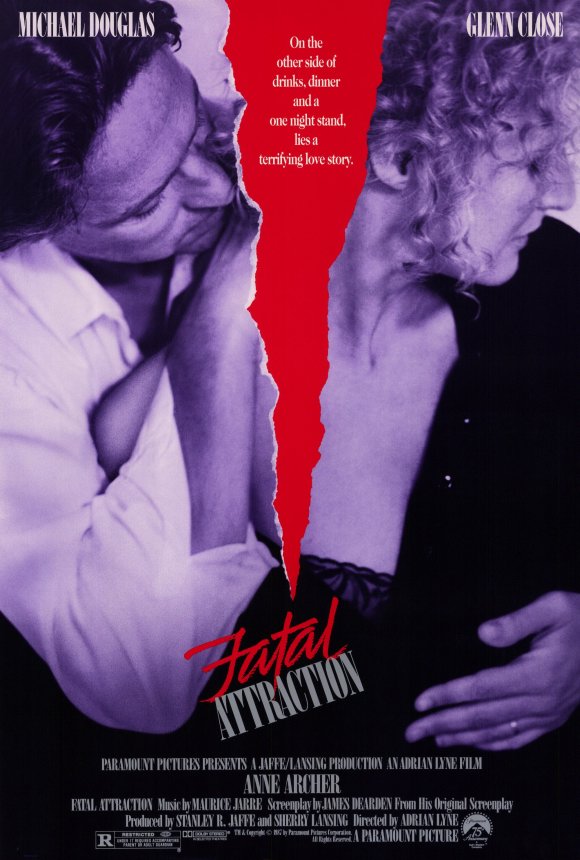
However, the mack daddy of this anxiety-inducing trend was probably Fatal Attraction; a movie that not only put the fear of god into anyone with wandering penis syndrome, but actually penetrated the public consciousness by adding the term “bunny boiler” to the global lexicon when describing the phenomenon of the psycho girlfriend. It’s time to change your phone number and move house, because we’re about to feel some Fatal Attraction.
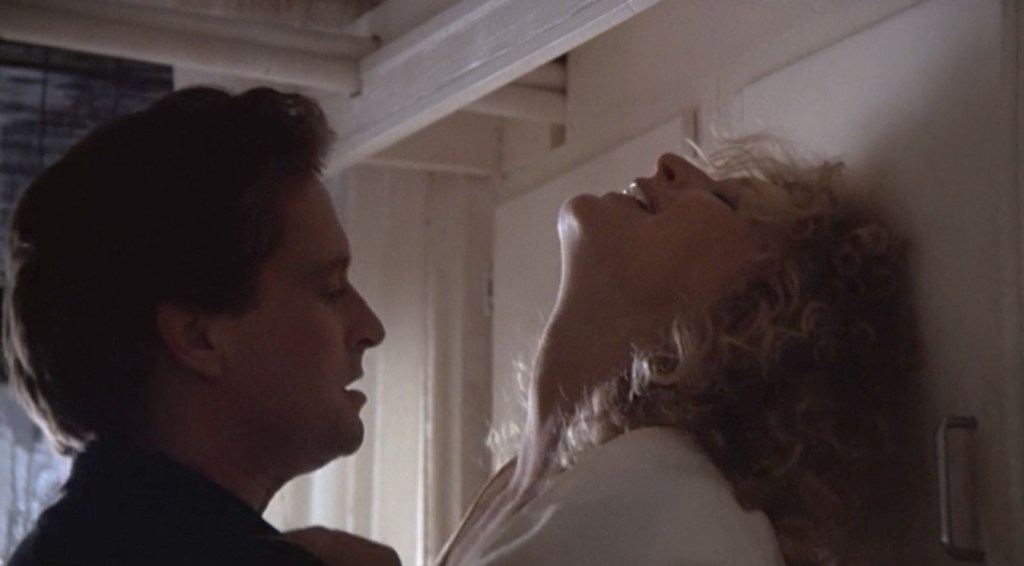
Suited, lantern-jawed attorney, Daniel Gallagher seems to have it all: a loving wife, a chubby-cheeked kid and a high powered job, but something else he seems to possess is a libido the size of a blue whale, and so after a chance meeting with the intelligent and charismatic editor, Alexandra Forrester, at a work function, sparks begin to fly. While Dan’s family are away for the weekend, he takes it upon himself to meet up with Alex at her place and inevitably some sweaty, trash-the-apartment sex ensues.
However, the agreement that this fling is only to be a one night stand immediately starts to feel a little shaky when Alex convinces Dan to spend the following day with her, but when the time eventually comes for him to return to his life, Alex starts to show something of a disturbed streak that gets out of hand terrifyingly quickly when she slashes her wrists in order to get Dan to stay.
After patching her up and staying with her until she’s stable (poor choice of words, I guess), Dan finally goes back to his family and tries to forget that his transgression ever happened, but it soon becomes obvious that Akex has no intention of being swept under the rug as just another fling.
In fairly short order, Dan’s life starts to noticably fray at the edges as Alex embarks on ever more frantic attempts to crowbar her way back into her life and her claim that she’s pregnant with his child means she pretty much has him over a barrel.
However, as this incredibly tense game of psycho-chess escalates to include property damage, breaking and entering, animal abuse, assault and even a spot of kidnapping, it soon becomes clear that this is one relationship that can only end in blood.
Essentially the first of Michael Douglas’ Should’ve Kept It In Your Pants Trilogy, which repeatedly showed us that the actor may have the worst taste in woman of any cinematic man who ever lived, you would expect Adrian Lyne’s Fatal Attraction to be mired in dated outlooks and highly questionable sexual politics. Certainly to modern audiences who seem to prefer their lead characters to be a little more moral, the tale of a man who cheats on his wife and is then immediately declared the victim could prove to be more than a little problematic. However, while this probably was the case with most of the people (read: dudes) who watched the film back in 1988 and took it as more of a cautionary tale, watching it with fresh eyes now made me see the film in a whole new light.
Essentially, Fatal Attraction proves to be a character study of two entwined people who neither prove to be what you’d traditionally consider the “good guy”, but neither can be
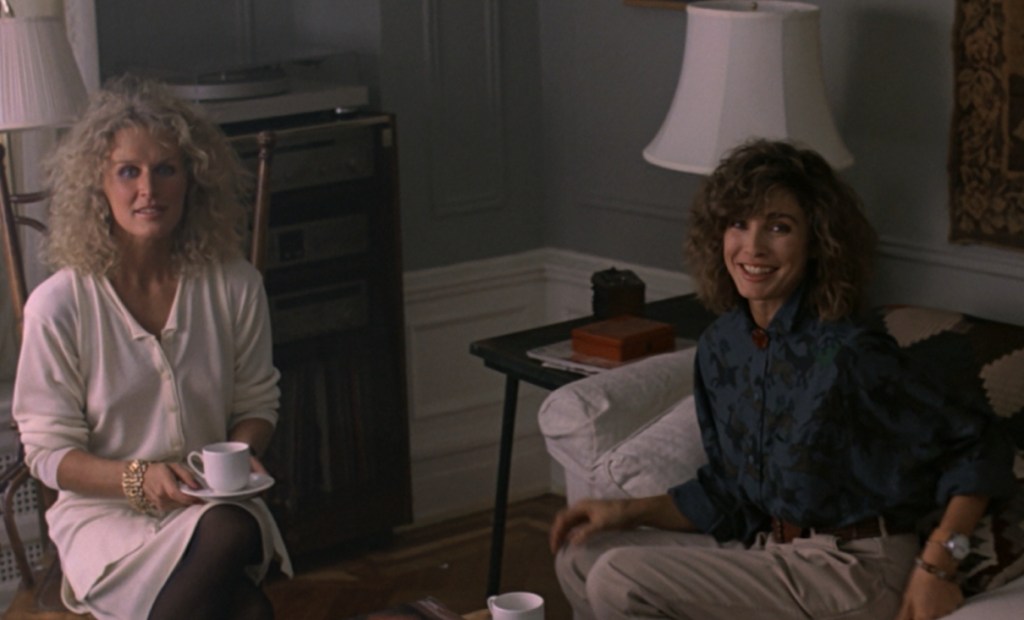
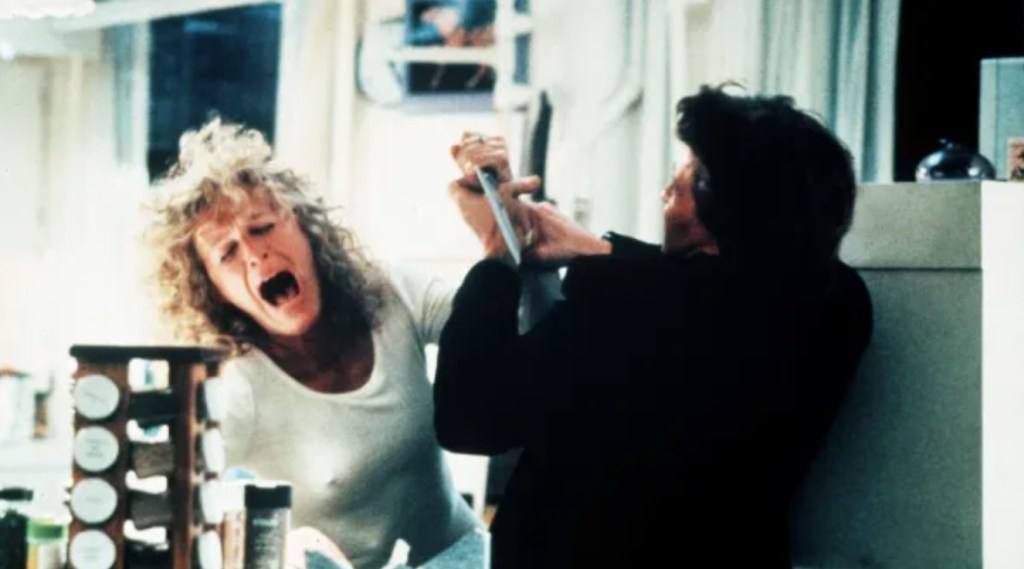
completely condemned to be fully “bad” either and the result of watching two devastatingly fuck up people collide – erogenous zones first. Obviously, Glen Close’s Alex is far far the more flawed of the two – you don’t slash your wrists on a whim or boil a family pet alive without a couple of wires being loose – but Glen Close masterful decision to play Alex without the usual eye bulging that comes with the territory hints that she’s just as vunerable as she is dangerous. This being the 80s, Lyne is far to preoccupied with keeping the story moving and looking like high class porn than to give Alex any kind of origin story or explanation, but then he also realises that in doing so would probably dull Alex’s capability to terrify the shit out of us, but Close gives her performance enough layers to suggest that something has happened to make her like this and she simply didn’t just emerge into Dan’s life as a fully formed, horny angel of death.
Conversely, anyone who sees Dan fully as the victim is blatantly refusing to see the big picture. For a start, Douglas’ history as being cast as various toxic “heroes” means that writing Dan off as the good guy is virtually impossible and the actor’s ability to flesh out flawed and almost sleazy leading men also suggest there’s parts to this story that aren’t spelt out. For example, the sheer ease and the assumption that there are “rules” to one night stands hints that this isn’t the first time he’s “played away” from his wife and the adolescent conversations he has with his buddy strongly support the theory. Plus, Douglas’ performance alludes to the fact that he simply doesn’t have a shred of remorse for either Alex or Anne Archer’s devoted spouse until things start getting a little too real and the scenes where he turns to violence are just as upsetting as some of the twisted shit his lover/nemesis gets up to.
While I doubt that Adrian Lyne ever meant for Fatal Attraction to be seen in such black and white shades as right and wrong (notice we never get a happily ever after coda that suggests that Dan was ever forgiven other than an ambiguous final shot of a family portrait), it’s fascinating to speculate the kind of water cooler conversations the film elicited the week after its release. Yes, Alex is the aggressor and the finale tips marvelously into full horror with waving knives, freakish imagery and even a magnificently cheap, back-from-the-dead jump scare complete with a last second save, but there’s no debating that none of this would’ve happened if Douglas hadn’t lead with his dick with no thought to his family.
And thus we simultaneously find Fatal Attraction’s real victims and possibly Lyne’s most important stroke. While a more modern film might have tried to give Dan a motive to cheat on a picturesque family, such as a nagging wife or a brattish kid, the movie understands that all the reason a certain kind of man needs to sleep with someone else is simply because he wants to.
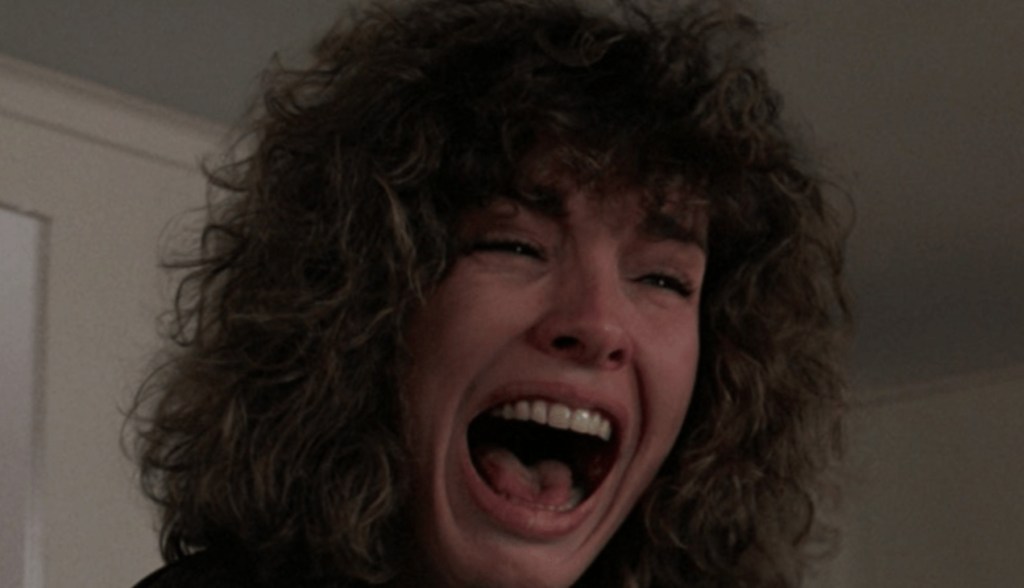
While pretenders to its psycho-killer throne (a misnomer in itself as Alex never actually kills a single human) prove to be far less complex, Fatal Attraction uses its impressively horny ambiguity to aim uncomfortable, yet important questions at an audience expecting excitingly tawdry thrills.
🌟🌟🌟🌟
 We Have Issues
For my very first intro to the quite distinctively lovely and talented Glenn Close, Fatal Attraction was indeed one of my most profound cinema experiences and particularly as I was just entering legal adulthood. I can always see the point, certainly in Glenn’s personal reflections of playing Alex, on the freedom for whom we should actually feel sorry for being much more flexible in films like this. Allowances for sympathy were for me personally very appreciable in my later viewings of Single White Female and The Cable Guy. A broken human being, despite their dangerous deeds, can in such thrillers make a much more effective villain than an all-out-evil villain. Even Ray Liotta’s performance in Unlawful Entry achieved that much for me through one specific scene with the prostitute in the car. So I will always praise Glenn for how she established that significance and, no disrespect intended to Cher, I felt that Glenn should have won the Oscar that year for Fatal Attraction. Thank you for your review.
LikeLiked by 1 person