

Anime is a remarkable genre that can virtually handle any subject you throw at it, be it esoteric fantasy movies, goofy sex comedies with more gurning than a fleet of Carry On movies, or brain busting horror that relentlessly push the boundaries of acceptable behavior – however, the most natural state the art of Japanese animation sees to adopt (for me at least) is science fiction that tends to lean on impressively meticulously designed future tech and hysterical cautions that mankind is going too far. I probably believe this thanks entirely to Katsuhiro Ôtomo’s 1988 masterpiece, Akira, which I still maintain is the greatest thing to ever emerge from the medium (with no disrespect to Hayao Miyazaki), but in 1991, Ôtomo went back to sci-fi to script Roujin Z, an entirely different take on how mankind’s growing dependence of technology was only managing to separate us from our loved ones an ourselves. However, anyone expecting vicious telekinetics, political dystopia and cool-as-fuck motorcycles might have been taken aback at the plot of Ôtomo’s latest offering. The future is here – and it’s elderly?

In early 21st century Japan, some boffins working for the Ministry of Public Welfare have managed to whip up revelatory new way to care for the elderly in the form of the Z-001, a fully computerised and automated hospital bed that not only administers food and gives baths, but it also removes the patient’s waste by sucking it out from them while keeping them transfixed with their favourite TV programmes. Nuclear powered and gifted with a capacity to learn, project leader Takeshi Terada proudly wheels out his groundbreaking tech, “volunteering” Kijuro Takazawa, a withered, 87 year old terminally ill man, to test out the Z-001 in front of a clapping crowd.
One person who proves to be horrified by this outcome is young nursing student Haruko who has been caring for him as his health deteriorates and one night, after the Z-001 somehow manages to transcribe his thoughts into a computer signal and beams his pitiful cries of help to his former carer, she resolves to saving from spending his last days alone and afraid. However, after enlisting her friends and a group of elderly computer hackers at her hospital’s geriatric ward to help break the Z-001’s programing, they only manage in making the wonder bed become almost self-aware.
Trying to soothe it’s patient/host by speaking to him in his late wife’s voice, the Z-001 goes on a benevolent rampage, absorbing other materials into itself to build on its abilities in a mission to get poor old Takazawa to a beach he has fond memories of. However, the Ministry of Public Welfare aren’t overly thrilled to see their new invention tear across the city with a little old man strapped on the front – however, when it gets out that unscrupulous programmer Yoshihiko Hasegawa has been using experimental weapons tech in the creation of something that was supposed to care for the elderly.
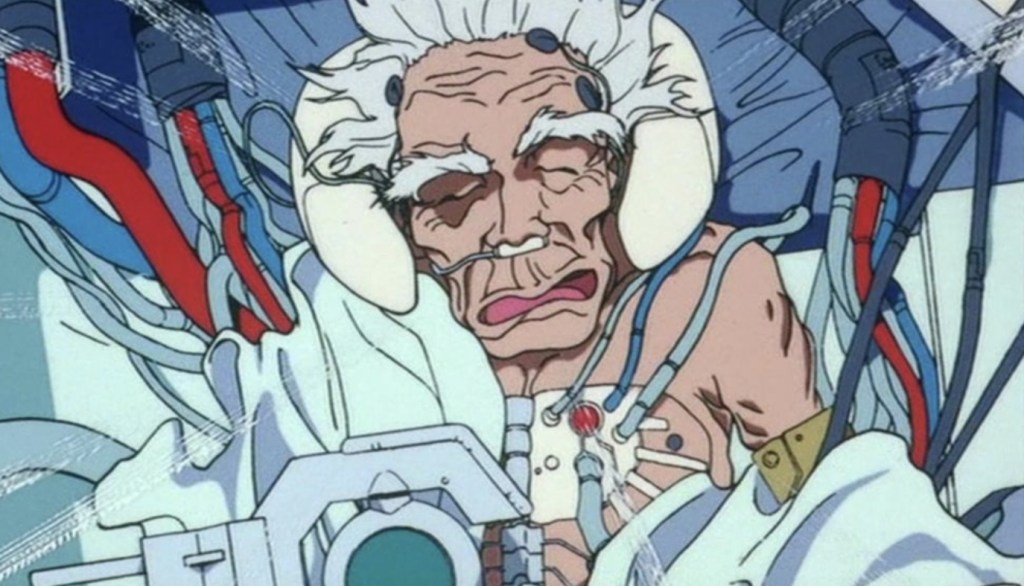
While Ôtomo’s name was plastered all over the advertising for this movie and the character, animation and set design is fairly reminiscent of Akira, it’s very important to point out that not only is Roujin Z directed by someone else (a very capable Hiroyuki Kitakubo), but it’s also a pretty pointed satire rather than a slice of mind frying sci-fi and the more you can separate this film from Ôtomo’s seminal work, the more beneficial you’ll find it.
For a start, Roujin Z is one of movies that may display a bonkers final third that goes full rock ’em, sock ’em robots with a pair of brawling mecha, but it’s made all the more effective by how restrained the world this movie is set in before well-meaning hospital beds start cannibalising cars for new parts. A lot of other examples of Anime delight in swiping away normality as quick as it can to splash your face with trippy visuals and frenzied world building, but Kitakubo and Ôtomo work hard to present a fully thought out, three dimensional sense of normality that sits somewhere between a world we recognise and a fantastical realm of super-tech.
Of course, the main thread here, other than Ôtomo’s usual fascination with humans dicking too far into technology, is the way we treat the old, presumably because their sagging skin, bent over frames and copious amounts of ear hair uncomfortably remind us of our own mortality.

However, while a beaming Takeshi Terada claims that the Z-001 will revolutionise the way we treat the elderly and infirmed as they lie in bed thanks to all its poop sucking hoses and various bells and whistles, when it comes to actually caring for the old and not just shoving them to tbe side, it actually seems more like incredibly cruel abuse. Yes, the “old people deserve respect” message is a time honored one and one that deserves repeating, some might find it a little simplistic for a genre that constantly strives for deeper and more intangible goals, however the film neatly avoids wandering into preachy territory by having the young and the old collaborate to rescue the hapless Takazawa.
It also helps that the filmmakers aren’t too precious about the dignity of its characters and watching all the indignities that a barely awake Takazawa endures as he’s strapped to the front of a careering robot as it whizzes about on tram lines is just as funny as his weak pleas for help are tragic. Similarly, the patients of the geriatric ward aren’t exactly the shy type either (as a loose pair of pyjama bottoms proves) as they prove to be capable and talented at their craft despite similarly shoved to the side by society. But the final piece of the puzzle proves to be the sight of watching idealistic nurse Haruko, fighting tooth and nail to save her near comatose, former charge. However, while the overall message gets a little fuzzy once the mecha start wrasslin’ (So is the Z-001 actually a help or a hinderence in the end?), it still proves to deliver some cool set pieces even though the introduction of the military (e.g. “evil”) version if the Z-001 may seem overly simplistic. Still, we get to view some beautifully animated (hand animated, mind you – the 80s/90s truly were a golden age for the medium) action sequences that come loaded with detail and weight.

While some who have come looking for more expansive sci-fi may find Roujin Z a bit too twee, but by choosing such a odd topic to hang a futurist epic on, Kitakubo and Ôtomo give their absurd tale a human touch that includes a strong beating heart to go along with all the droopy jowls, wrinkled faces and big machines indulging in some good old fashioned mecha sturm and drang.
🌟🌟🌟🌟
 We Have Issues
This one is a true hidden gem. Wish it would get a proper Blu ray release. I wonder it hasn’t.
LikeLike