I guess the world post Avengers: Endgame has been a little rough on everybody what with all the crazy shit that’s happened to society since Tony Stark snapped some fingers charged by the power cosmic. Of course there’s been global plague, political upheaval, fires, strikes and the MCU’s batting average has dropped significantly – but something else that’s taken quite a dip in the years hence is the turnout from directors Joe and Anthony Russo.
Once their last Avengers movie conservatively made all the money in the world, the siblings and their writing team of Christopher Markus and Stephen McFeely founded the production company, AGBO, but since then, the movie’s they’ve made haven’t exactly reached the high quality of their Marvel era. However, with The Electric State, an absolutely gargantuan production courtesy of Netflix (their most expensive ever, apparently), can the team finally manage to deliver some of the spark that brought them to the blockbuster table in the first place?

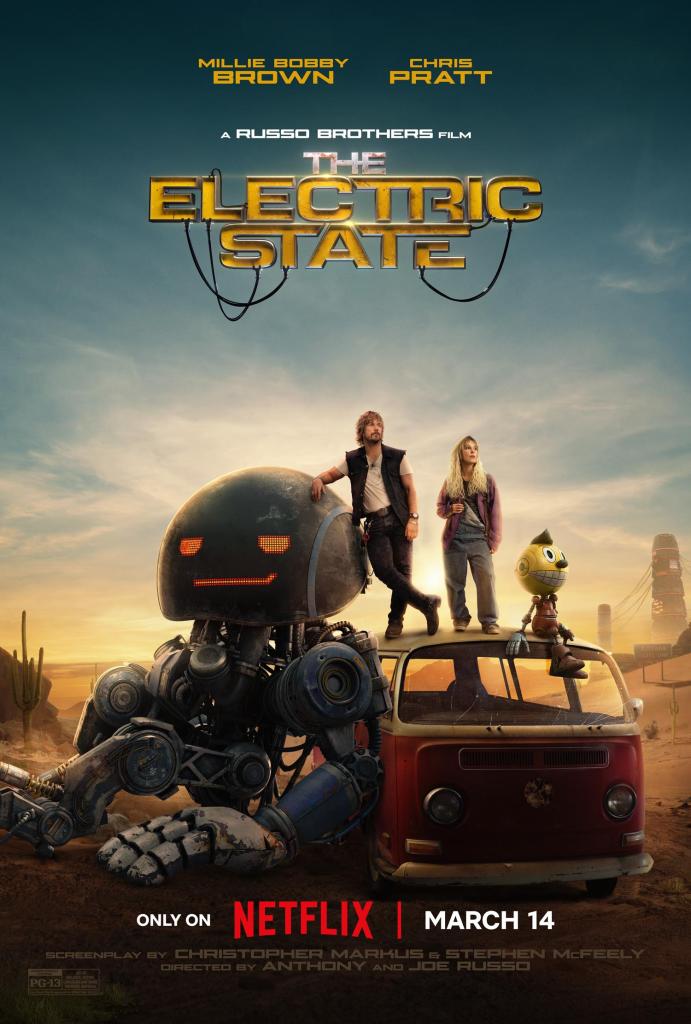
In an alternate 1990s which has mankind served by infinite variations of helper robots, but somehow has then still using PCs to send Emails, the standard war between humans and robots errupt when the latter starts to demand robot rights. To give our mecha enemies their due credit, they almost win, but when futurist Ethan Skate CEO of Sentre, manages to come up with a fleet of human operated robo-drones, they close the gap between the two species completely and soon the uprising is called off. Exiled to live in a walled off section of the desert, these former mascots and worker droids are forbidden to ever return, but in the interim, Skate manages to turn his drone headsets into VR technology that allow humans to multitask while being able to exist in a constant downtime.
In this world we find Michelle, a young girl who found herself a ward of the state when her parents and her genius younger brother were all killed in a car accident. However, one night she finds a robot in the shape of her brother’s favorite cartoon character, Cosmo, breaking into her house, but after the initial panic has died down, this humungous-headed mecha manages to get a shocking piece of info over with his extraordinarily limited vocabulary. He’s actually Michelle’s brother, Christopher.
Embarking on a quest to figure out exactly what the hell us going on, Michelle finds that the truth may lie with the Exclusion Zone and soon teams up with scummy smuggler, Keats and his robo-buddy Herman, to gain access. However, while she has to avoid vicious scavenger ‘bots and avoid the guntotting drone of Bradbury, a grizzled bountyhunter who gained the nom de plume “The Butcher” during the war, can she glfind out what she needs to once in the presence of the robot’s leader, Mr. Peanut?

While The Electric State is far more watchable than most of the more hysterical reviews would have you believe, after watching the movie I do understand a lot of the rancor. For a start, Netflix spending $320 million on a movie made for streaming is objectively nothing more than utterly grotesque, especially when the majority of that cash is up on the screen which will no doubt mainly be viewed on phone screens or tablets. Weirder yet, the movie boasts themes of togetherness and unity that begs us to put down our personal devices that separate us from reality and spend more time forming connections with other humans; yet it’s debuting on a streaming platform that had me ignoring my wife for two hours while I watched it in bed. Simply put, while The Electric State has its good points, the very issue of it’s existence bizarrely goes against everything that cinema is supposed to stand for which is doubly odd when you realise that the Russos were responsible for one of the most famous, cultural highpoints of cinema in recent years with the portals sequence from Endgame.
Anyway, while I could spend the whole review ranting about the whys and wherefores of that worrisome budget and the effect it could have on cinema in general, I’d kinda be remiss in my duties if I didn’t start chatting about the movie itself and despite the fact that The Electric State suffers from from odd plotting and a serious case of derivative syndrome, it’s actually a decent watch. The expansive CGI, futuristic vistas and battle scenes mean that the majority of that bloated budget is thankfully all there on the screen to see (it had fucking better) and the robot designs are both eccentric and cool. That’s because the film is based on the maudlin, dystopian child’s book that’s inspires the look – if not the perky, quippy tone – of the movie and the Russos lean hard into the whacky look of sentient robots who look like monocled peanuts, magicians or giant mecha cats. In fact, the eccentricity of The Electric State is by far the most watchable aspect of the film as the filmmakers dive deep into a vast array of visual gags and bizarre dialogue in order to mine the flick for every bit of humour it can and its visual ingenuity – that stretches to a magician droid who comes with his own stage and curtain built in, a barber droid obsessed with hair and Herman’s Russian doll ability to climb into ever larger versions of himself – helps dull the blow of everything that doesn’t work.

However, even though the Russos defiantly push the Spielbergian (or even a spot of old school Robert Zemeckis thanks to an agressive, Alan Silvestri score) feel as hard as it can go, the end product weirdly feels that Neill Blomkamp has somehow been roped in to direct a Disney film – and I’m not entirely sure whether that’s a compliment or not. The story shoots for emotion, but only rarely nails it and the result sometimes has the air of a movie about artificial intelligence that’s actually been mostly written by AI; but matters are made even worse thanks to the relentless pillaging the script does of films like Ready Player One and The Creator. Call me naive, but surely a movie that cost so much should have a few more original ideas lodged in its programming that’s just relying on some killer visuals.
Both Millie Bobby Brown and Chris Pratt do ok as the fleshy humans of the cast as the former does her usual plucky heroine thing while the latter looks like a Han Solo has a thing for 80s rock, but you can’t help be impressed by a rather expansive cameo and voice actor list that contains Stanley Tucci, Giancarlo Esposito, Ke Huy Quan, Jason Alexander, Coleman Domingo, Woody Harrelson, Anthony Mackie, Jenny Slate and Brian Cox to just name a few.
But again, it’s all still way too patchy and familiar an experience to justify that mystifying price tag and I’m not surprised that the brothers are returning to the comforting bossom of Marvel for their next two Avengers extravaganzas which hopefully should see all involved back on track.

While a perfectly reasonable sci-fi fantasy on the surface, once you dig into the making of The Electric State, numerous, baffling questions start to mount that genuinely call you to question whether or not this film needed to be made the way it was. After all, making a vastly expensive, sci-fi blockbuster, jam packed with flashy visuals that isn’t going to get a major release in cinemas is just too confounding an issue to let go. Electric or not, it’s still most definitely a state.
🌟🌟🌟
 We Have Issues