

There’s a condition that states that some people just get addicted to war. Be it the constant adrenaline rush of being in a war zone leading to civilian life being too quiet, or the fact that some people just get institutionalised to the order and rigour of military life that the unending dangers of war is preferable to a 9 to 5 and weekends off. I only bring this up because after delivering the traumatising effects of a very real feeling “what if” scenario with Civil War, director Alex Garland is once again re-entering the war genre for a second time in a row with Warfare.
However, this time he’s not alone and helping switch from terrifying fiction to hard fact is Ray Mendoza, a former Navy SEAL who also was the military advisor on Garland’s previous film; but before you wonder why exactly the director of Ex Machina and Annihilation would need help on his latest directing endeavour, it pays to remember that the events depicted in Warfare were based on Mendoza’s own experiences during the Iraq war. So if you thought Civil War was intense, Warfare is about to well and truly ring your bell.

The year is 2006 and in the midst of the Iraq war Navy SEAL platoon Alpha one and Alpha two are sent into the city of Ramadi undercover of nightfall in order to secure positions for an upcoming mission. The team select houses that will give them the best vantage point they can and sneak in, quietly shoving the two families living there into a single room while they set up for the day and once the sun comes up, Alpha one has communications officer Ray Mendoza monitors the surrounding neighbourhood via air support while sniper Elliott Miller keeps his scope trained on the market place across the street as Erik, the officer in charge keeps an eye on the rest of his men. However, hours of sweaty boredom soon start to get tense when the same people are spotted lurking again and again, sneaking telling glances at the building where Alpha one has set up base which kind of gives us the sinking feeling that something big is about to go down.
That big something is kicked off when a grenade suddenly pops through a hole in the wall and while the resulting explosion and the gunfire that follows it brutally redecorates the room, no one is hurt other than an injury sustained to Elliott’s hand. An armoured transport is called in to medically evacuate the SEAL and when it arrives, the team all brace themselves and take up positions to escort their hurt teammate to the vehicle, but the thing about war is that even the most hardened training can’t help you prevent the unexpected – only to be able to keep your head when it happens.
“It” proves to be a sizable IED that not only fucks up Elliott, but it shreds the legs of Petty Officer Sam, leaving Alpha team one stranded in an extremely hostile situation with two grieviously wounded members. Thus begins a tense, super-focused examination of men under fire as they are forced to wait for evacuation while bullets whizz around them like hornets and aid is still many streets away.
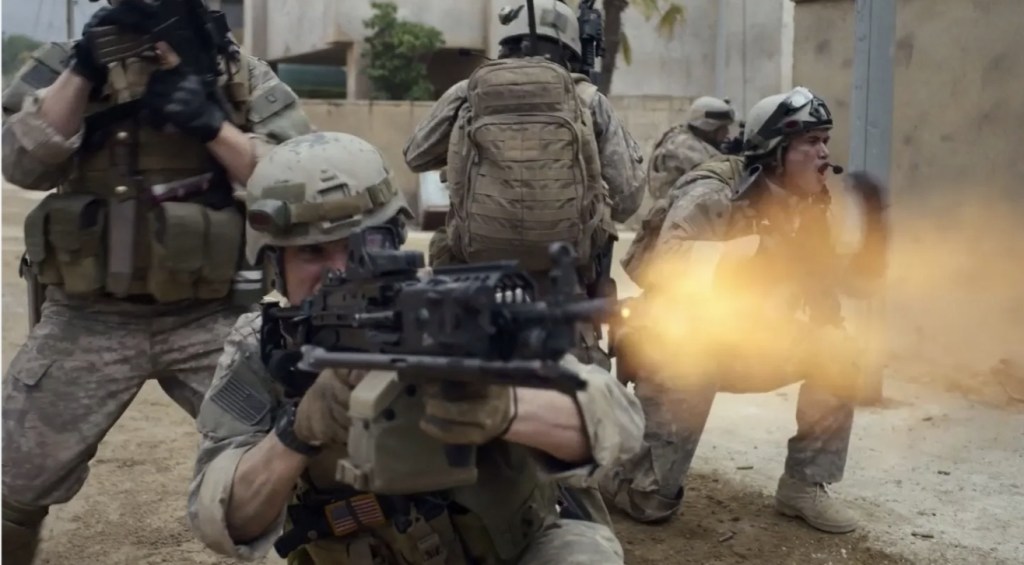
I feel that many modern day war movies that are set primarily within an active fire zone are fairly misunderstood. Anyone coming to a movie that is primarily trying to legitimately pluck you from your cushioned cinema seat and hurl you into sheer chaos, always seem to complain that such films are not politically balanced enough and is entirely biased toward the American troops; but while it’s a fair point, that’s not what Mendoza and Garland are trying to achieve with Warfare at all. With the opening claim that everything that occurs is based on memory, the filmmakers are primarily concerned about concentrating solely on the attack without overexplaining the global events and political consequences that led them there to begin with. There’s no scenes with a member of the cast pontificating about the folly of war, there’s no one questioning what they’re doing in Iraq and the movie doesn’t shoehorn in a native character to humanise the enemy – all the film wants you to experience is what the men went through and nothing else.
To some, this course of action simply isn’t anti-war enough, but Mendoza and Garland deliver their brutal au contraire with possibly the most tense and taunt 90 minutes you’re likely to experience all year, simply stating that the most expedient way of showing you how horrible war is is by giving it to you unburdened by anything else other than the terrifying and EXTREMELY LOUD things that are battering your senses for the duration.

In many respects, Warfare is just Ridley Scott’s Black Hawk Down stripped down to its barest assets as American troops have to try and use their training to survive an unseen enemy sending unending flurries of gunfire their way. The movie takes the minimalist approach of survival horror and gives us practically zero backstory on its characters beyond an overexcited viewing of the music video of Call On Me by Eric Pryde and from there proceeds refuse to add much else. It’s all about the moment, you see; we only experience (in real time) what the soldiers experienced in the moment and the frantic under stylized filmmaking only heightens the urgency that hangs in the air like dust after an airstrike. Thanks to this, the cast are less actors and more “reactors” as various familiar faces, including Will Poulter, Joseph Quinn and Michael Gandolfini, show up to get stuck in in the blood and bullet casings – but it’s really Mendoza’s recollections and the sound mix guys who prove to be the MVPs here.
For a start, the film hammers home to two main facts about war with the first being that it’s fucking scary, but with a refreshing lack of jingoistic flag waving, the only real foothold he have is the brotherhood between these men in peril. Even that old fallback of someone pep talking with the reliable “remember your training” speech is nowhere to be seen as these guys make all too human mistakes in the heat of battle. Someone holds the morphine jab the wrong way round, another relinquishs command after being unable to focus after a particularly nasty blast and numerous people absentmindedly bumb the severely lacerated legs of the wounded as they walk by. It’s all very human and vitally relatable when most of us wouldn’t have the first clue what it’s like to experience such things – however, that doesn’t stop the sound guys from trying.
Repeatedly trying their best to up those cinema-related deafness numbers single-handedly, if you aren’t flinching at least every five minutes then you need a better cinema, because not only does Warfare deliver what will probably be the most effective jump scare of 2025 (seriously, it’s something else), but other moments, like jets performing roaring flybys as “a show of force” are as devestating as they are impressive. Just make sure you’ve had a bowel movement before hand in case of any “brown noise” incidents.
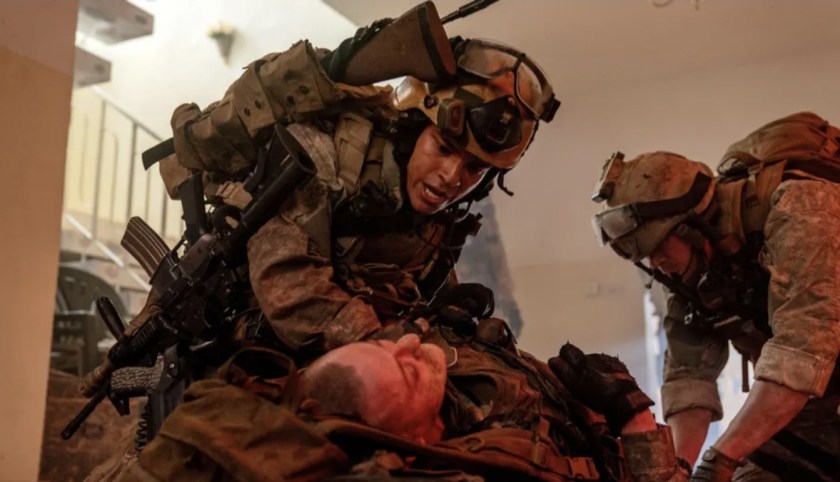
No fat, no bullshit, just a bunch of soldiers trying to get rescued in real time; Warfare may not be particularly layered or thoughtful, but as a pure, second by second example of pulse pounding cinema, Garland’s second, gritty war movie in two years slams an exclamation point on on-screen warfare with the force of tank barrage.
🌟🌟🌟🌟
 We Have Issues