
When you cast your mind back, the arrival of Stranger Things managed to change the game in quite a few ways. Not least of all it started the careers of Millie Bobby Brown, Finn Wolfhard, Joseph Quinn and Maya Hawke; launched David Harbour into the big time and gave Winona Ryder the comeback we all hoped she’s get – but is also cemented the stranglehold that streaming leviathan Netflix had on popular entertainment and also proved just how successful playing to unrelenting nostalgia can be which arguably led to the inexorable rise of legacy sequels.
Of course, we’re getting ahead of ourselves here, as back in 2016, none of these things seemed particularly important yet, but as I embark on a long, overdue rewatch before the whole thing wraps up for good, it’s good to remember just how much of an oddity the show was before it became a genuine success story and promptly turned the world as we knew it… upside down.
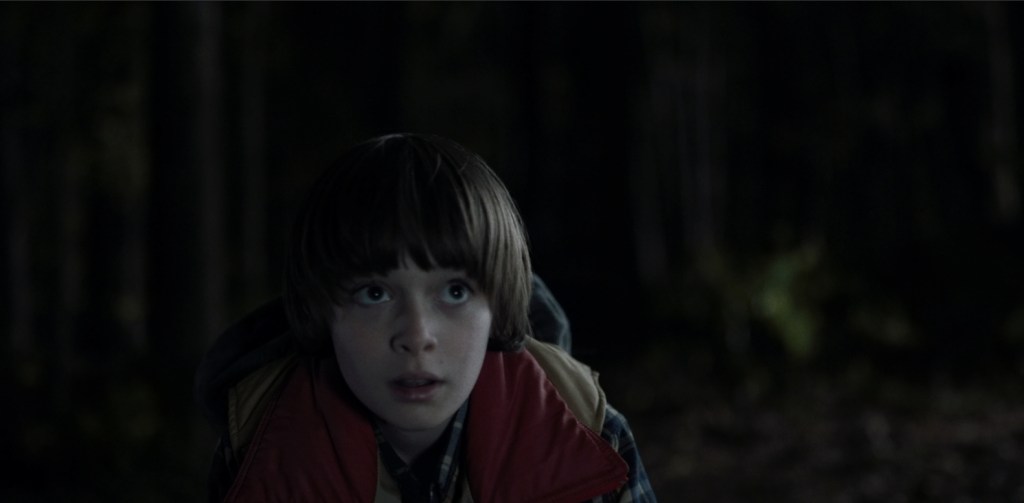
Welcome to the town of Hawkins, Indiana – a typical American burg that has everything you could possibly ask for in a community; including a secret goverment research lab where some worrying sci-fi shit seems yo be going down. The date is November 6, 1983 and before the strange series of events that are due to hit the townspeople, we peek in on a group of misfit kids who have been in a basement playing Dungeons & Dragons for ten straight hours. The group is made up of the sensitive Will, the excitable Dustin, the forthright Lucas and their unofficial leader, Mike and after Mike mother reminds them that they have school tomorrow, the boys split up on their bikes to head home.
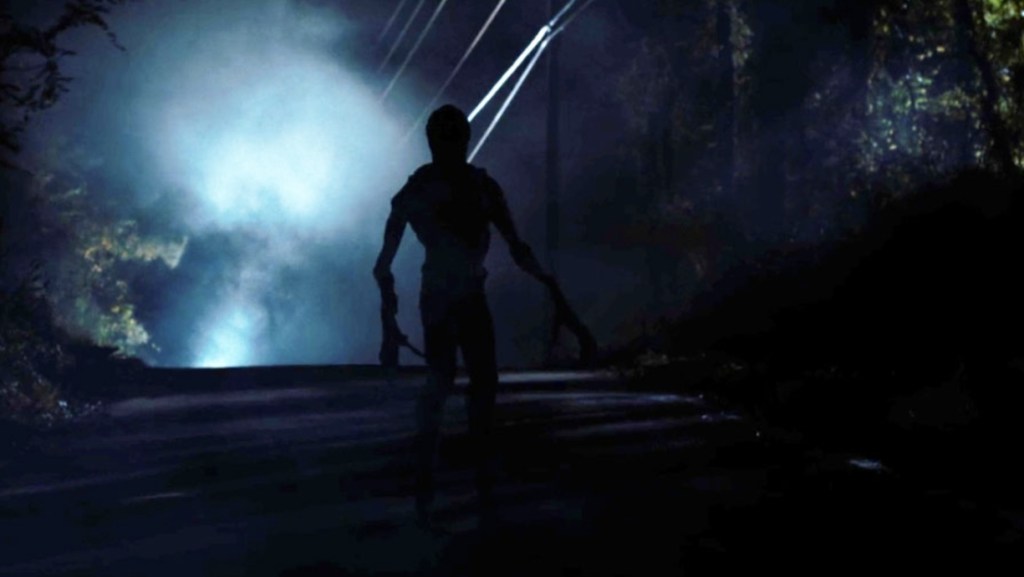
However, after encountering the mysterious creature we saw earlier in the secret lab, Will goes missing, which understandably freaks out his worried mother Joyce and his brother Jonathan who go running to washed up local Chief of Police, Jim Hopper who begrudgingly sets up a search party.
Of course, we know this is no ordinary missing child case (if there is such a thing) and not only has that research centre disgorged some sort of inhuman being into Hawkins, but a blank-faced, shaven headed girl with the number “011” tattooed on her arm is discovered by the owner of a restaurant who quickly calls the authorities. However, it soon becomes apparent that there’s some sort of shifty conspiracy in effect when the “authorities” show up and teoay his kindness by putting a bullet in his brain.
As life goes on in Hawkins as Mike’s sister, Nancy dates popular kid, Steve Harrington and Mike, Lucas and Dustin try in vain to avoid bullies, Joyce gets a disturbing, but distorted phone call from what sounds like her son calling for help. What inhuman infortunes are slowly befalling the town and what does the girl with the eleven tattoo on her arm have to do with it?
Ignoring what we all know about what happens throughout its run, it’s always fascinating to go back to the humble beginnings of a hit show to see how dialled back everything used to be, but even though the first episode is incredibly restrained in comparison, the elements that hooked so many people are all present and correct. Simply put, with its intelligent cinematography, 80s setting, populist sci-fi leanings and strong horror undertones, the Duffer Brothers had managed to take the styles of both Steven Spielberg and John Carpenter and fuse them into a story that feels massively influenced by the works of Stephen King. In the first episode alone there are huge visual references to such things as The Thing, It, E T., Firestarter, The Goonies and Stand By Me, but while it feels like Christmas to anyone who likes spotting this shit, the most important thing about Stranger Things is that for all of its shameless trope usage, it still manages to feel both remarkably fresh and incredibly familiar at the same time. Take the kids for example – yes, they initially act like every single gaggle of precocious kids you’ve ever seen in every 80s set movie you’ve ever seen, but the fact that Dustin actor Gaten Matarazzo actually has cleidocranial dysplasia, Mike actor Finn Wolfhard has incredibly distinctive features and Will actor Noah Schapp has a bowl cut so severe it looks like it could deflect a bullet gives them a weird sort of awkwardness that feels nicely genuine. Similarly, David Harbour’s Hopper and Winona Ryder’s Joyce feel instantly far more fleshed out than you’d expect mostly because both actors seem willing to go all in with making their characters as relatable as humanly possible. As he’s been proving ever since, Harbour has a knack for finding pathos within towering lugs who seemingly have checked out on life and Ryder (the show’s first true proof of its unending dedication to paying as many dues to the 80s as it can) wisely utilises those famous large eyes and jittery nature to make you truly feel Joyce’s pain as her son suddenly turns up missing.

And yet, beyond the main characters, Stranger Things strives to make even the slightest of its sizable cast memorable. The relationship between Nancy and the luxuriously haired Steve is thinly sketched (so far) but loaded with promise and even Mike’s parents have their own little vibe what with his dad blatently being a clueless jackass.
However, solid characterization is obviously a good thing, but Stranger Things’ winning hand proves to be that it has no problem playing the long game with its more sci-fi elements as it drip-feeds the weird shit in order to create maximum intrigue. Alienesque creature attacks, goverment intrigue, Lovecraftian slime corridors, copious hazmat suits and Matthew Modine going full silver fox all invoke the type of mystery conjured up in the 90s by The X-Files, but the fact that it holds back so much means even though we’ve only just arrived in this world, we’re desperate to find out more about it. Of course, the most provocative piece of the puzzle is Millie Bobby Brown’s Eleven, who with her big eyes, hospital gown and ability to move things with her mind gives out vague memories of Tetsuo from the Anime classic Akira. Little would we know that this shivering little girl would soon become a hugely iconic image, but despite a shock twist that sees a kindly restaurant owner eat a hollow point in order to show how much this secret lab ain’t fuckin’ around, Eleven is still a tantalising enigma at this point.

However, when it comes to the success of Stranger Things, you can’t help but acknowledge that Netflix’s release schedule helped immensely because nothing helps a slow burn speed up than having every episode released on the same day a day it meant that the show could move at the perfect pace for younger viewers who would rather boil their own heads than wait a whole week to see what happens next. Not to take away anything from the Duffer Brothers and a fantastically solid first episode, but when you talk about shows being at the right place at the right time, Stranger Things transported itself onto a winner.
🌟🌟🌟🌟
 We Have Issues
Stranger Things is probably the best reminder in this century of how refreshing some familiar sci-fi tropes for a new series can most significantly pay off. In that sense, it certainly was in the right place at the right time. Thank you for your review of its first episode.
LikeLiked by 1 person