
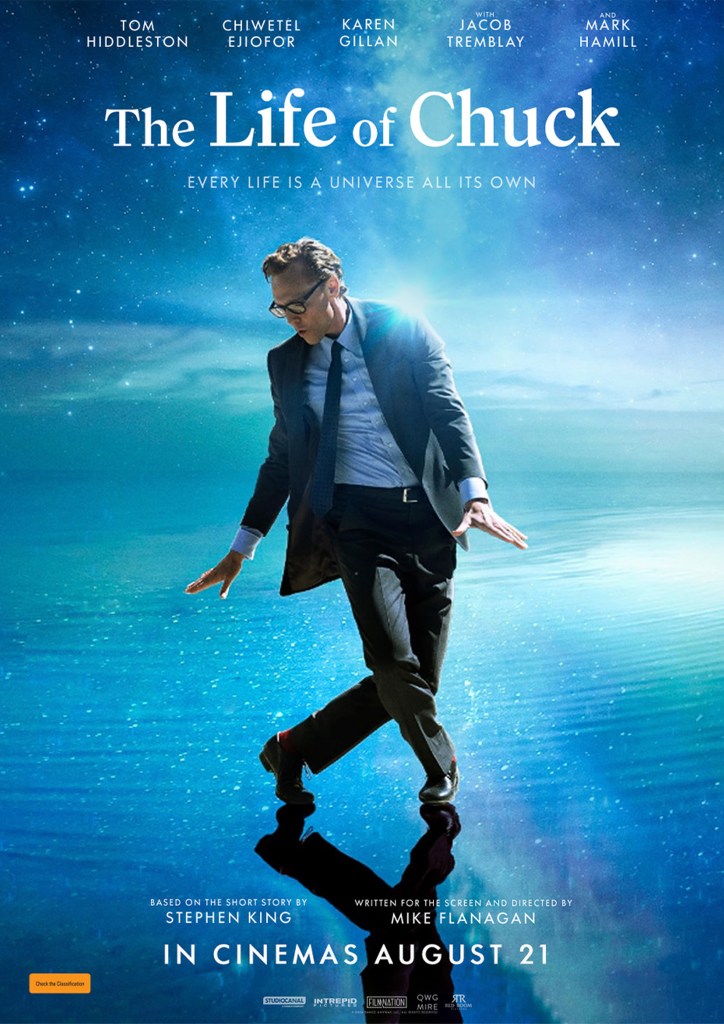

After adaptions of Stephen King’s work that’s included such films as The Shawshank Redemption, The Green Mile and Stand By Me, it’s still amazing that people are still surprised that he’s written about subjects other than shape-shifting clowns, rabid Saint Bernards and obsessive fans. Well, thanks once again to Mike Flanagan, movie lovers are about to get another timely reminder in the form of The Life Of Chuck, a big fat attempt at life-afirming cinema that attempts to project all of the author’s most complex talents to the screen.
Based on the novella found within the short story collection “Let It Bleed”, we find a tale on the more tender end of King’s spectrum that still manages to sneak in some otherworldly secrets among a comfortingly familiar cast. But while King’s horror stuff has proved to be tough to nail in the past, his more whimsical material is a whole other kettle of fish to get right as the supernatural stuff and the human element prove to be a delicate balance indeed.
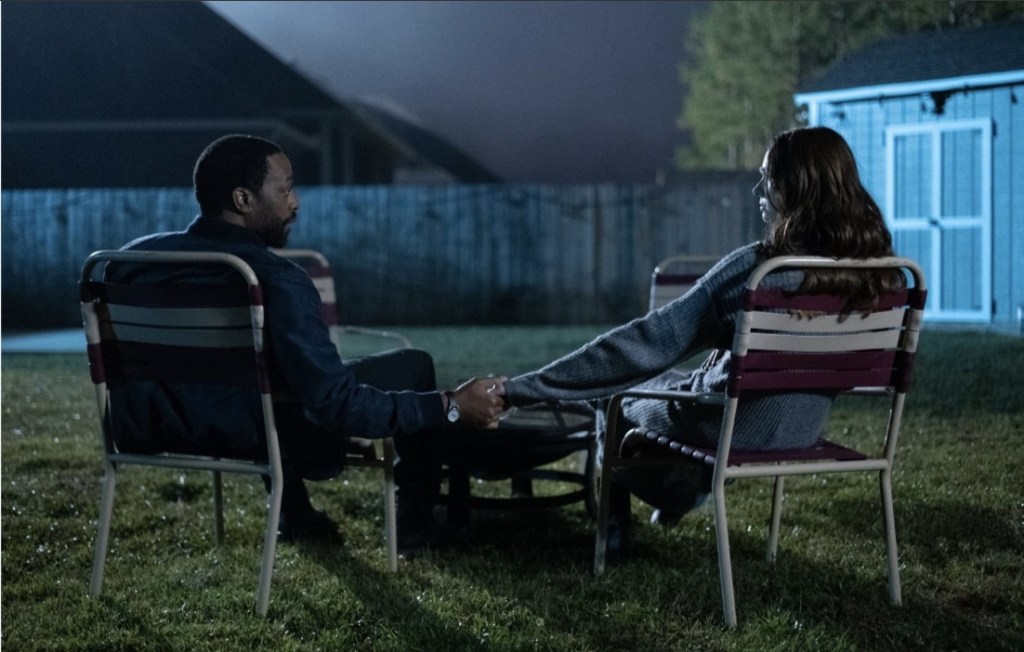
Told in three chapters that proceeds to each take a step back in time, we start with Act Three: Thanks Chuck in which a school teacher, Marty Anderson is witnessing the world seemingly going through it’s death throes. But among the natural disasters, numerous suicides and the fact that pornhub has bitten the dust when the Internet shut down for the final time, Marty notices a strange thing: numerous billboards and TV channels seem to be wishing some random accountant named Charles Krantz a happy retirement after 39 years. As things rapid get ever more bleak, Marty rushes to be with his ex-wife, meeting with various people sharing their thoughts along the way, but as the end gets near, the adverts for this mysterious Chuck get all the more prevalent.
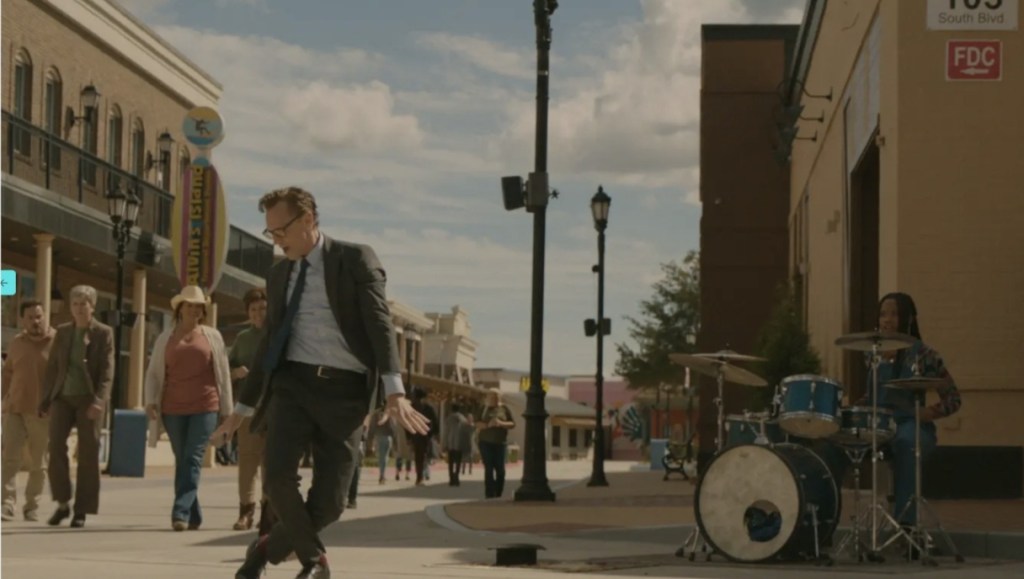
In the second Act, Buskers Forever, we zip back nine months to meet Chuck himself, an unassuming accountant who is out of town at a conference. But as he’s going about his business, he comes across a busker who is tapping out a beat with her drum kit that gives him the urge to start dancing in time to the rhythm leading to a magical moment. But as we move further back to the final (re: first) act, I Contain Multitudes, we watch Chuck as he’s brought up by his grandparents after his parents and unborn sister are killed in a car accident.
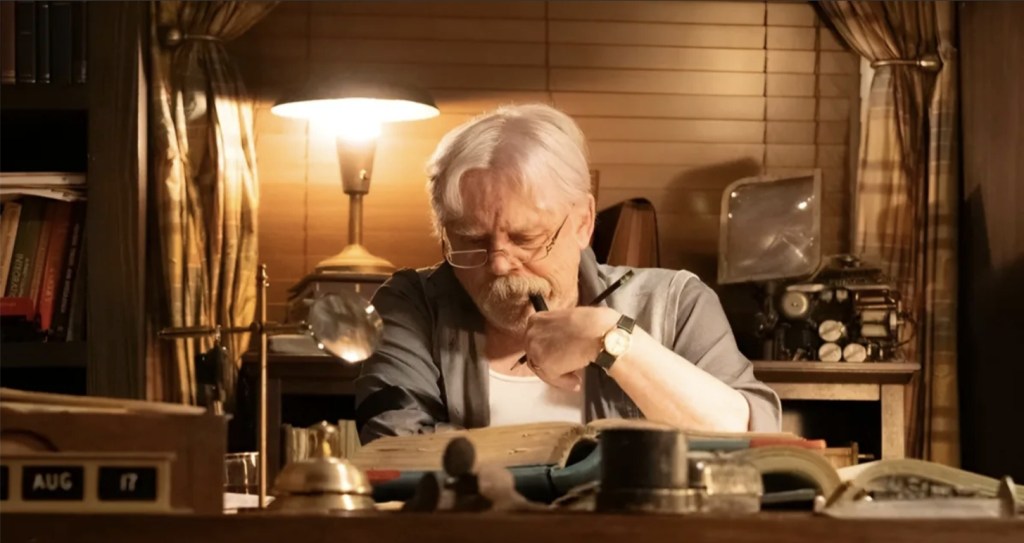
We watch him through the years learning to love dance through his lively grandmother and he learns the magic of math from his accountant grandfather and as he gets older, he takes up dance lessons during his formative years at high school. However, while his grandparents are loving and kind, Chuck can’t shake the mystery of the locked cupola that his grandfather forbids him to enter. What lurks within it and how is any of this relevant to what we saw play out in Act Three?
Once again I find myself writing a review that sees me having to navigate around a central twist or reveal to try and preserve the surprise of a movie that’s genuinely trying to move you. However, twists, turns and game changing reveals isn’t what makes The Life Of Chuck special, it’s the huge, unprotected, uncynical heart that Mike Flanagan has on display here, which usually isn’t actually a good fit for me. Personally, I find movies that attempt to be life-affirming, with all their joyous highs and crushing lows the most manipulative movie genre of all (I mean, film in general is supposed to be manipulative, but…) and even though I can recognise the artistry at work in films such as E.T. or Forrest Gump, the set up for a bittersweet ending that sends you back out into the lobby in floods of tears just isn’t my major preference. However, whether it’s because of King, or Flanagan, The Life Of Chuck managed to hit somewhat differently.
For a while there, no one other than Frank Darabont had been able to truly nail the sheer detail of the charactization that King brings to the beings that live, breathe and very often die within his books and it’s that very lack of detail that’s provide some of the more lacklustre examples of the author’s work. However, as evidenced in the likes of Doctor Sleep and Gerald’s Game, Mike Flanagan gets King’s style arguably better than anyone who has came before him. While filmmakers as diverse as Darabont, Rob Reiner, Brian De Palma, Stanley Kubrick and Osgood Perkins have translate the writer through the prism of their own styles, Flanagan somehow manages to transition the author’s prose virtually unfiltered, which can prove to be next to impossible when the author takes his stories on weird tangents.
Speaking of weird weird tangents, I seem to be on one now, so I’d best get to the point; The Life Of Chuck proves to be a wonderfully moving experience that handles huge themes like mortality and the worth of one’s life in ways that are both refreshingly light and relatably matter of fact. Realising (much like Darabont did with Shawshank) that the best way to realise King’s is to use it – so to speak – with a god-like narration that sets the scene thanks to Nick Offerman’s voice over. From here the movie delivers a sizable ensemble of character actors to form a giant mosaic of a man’s life that includes roles and cameos from everyone including Chiwetel Ejiofor, Karen Gillan, Mark Hamill, Kate Segal, Matthew Lillard, Mia Sara, Carl Lumbly, David Dastmalchian and even Nightmare On Elm Street’s Heather Langenkamp. Even Chuck himself is technically part of his own ensemble as the role requires the equal spacing out of Tom Hiddleston, Jacob Tremblay and Benjamin Pajak who all contribute (and dance) to creating the titular character in various ways.
Is it a tad self indulgent? Well, aren’t all bittersweet weepies self indulgent in some way? Bit while some may find the narration, the mystery of the opening act (which mercifully isn’t over explained, leaving it to you to work it out) and long, extended periods of dancing a bit too on the nose and others may find the very King-like addition of a “haunted” cupola that contains devestating visions a little out of place. However, while other directors stumble over the author’s random use of the supernatural in his more down to earth stories, Flanagan embraces it, making it another layer of the unexplainable that adds to the whole wonder of the piece. While I responded most favorably to the first act in which Flanagan seems to be grooming us all for the most relaxed and dignified armageddon you’ve ever seen (or is it?), the various pieces of the various sections all manage to lock together to form something that feels surprisingly warm for something that could be described as vaguely experimental – but when a filmmaker trusts his muse as much as Flanagan trusts King, then you can’t help but get magic.

In the past, especially in his Netflix endeavors, I sometimes find that Flanagan leads with his heart a little bit too much when he tackles horror, but in an arena that positively begs for it, the director admirably holds back on the saccharine, chosing not to over explain things and letting the characters bring the emotion in ways that gradually sneaks up and overwhelms you organically rather with slapping you in the face with tragedy. So check your cynicism at the door, embrace life and enjoy a movie that genuinely contains multitudes.
🌟🌟🌟🌟
 We Have Issues