
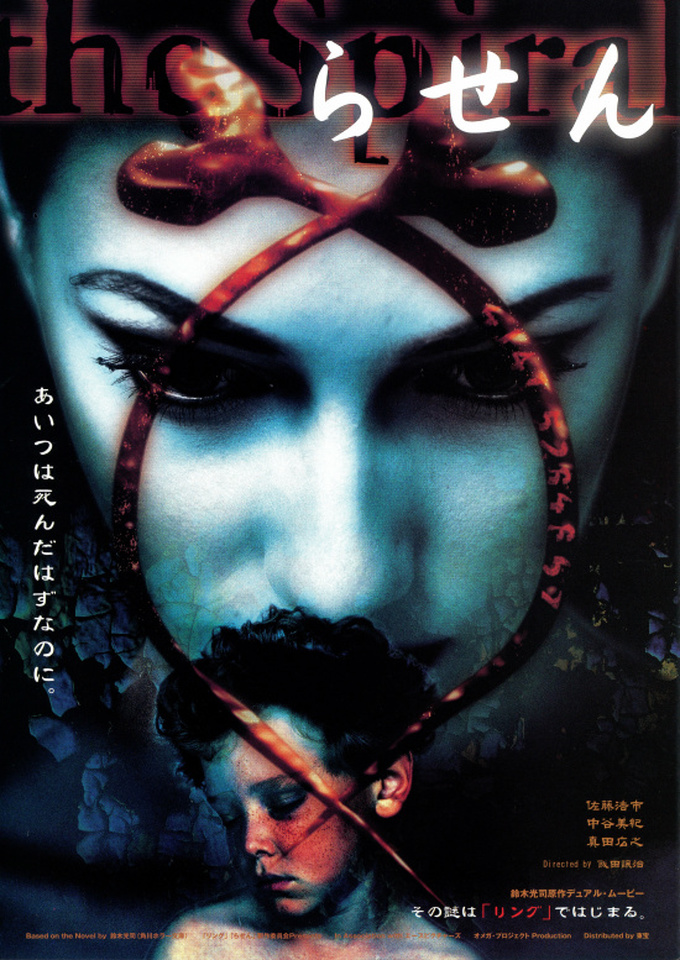

Sequels tend to be fairly straightforward affairs, right? Follow up an earlier film with a continuing storyline that delivers all the things you liked about the first installment while adding enough other stuff to keep things fresh – I mean, it’s not hard; well, not on paper, anyway. Well, no one thought to tell the makers of Ring, the classic, 1998 exercise in J-horror that did for televisions and girls with long black hair what Jaws did for the backstroke. As the Ring series was already a successful novel, the rather surprising decision was made to make both Ring and it’s sequel Spiral with the same production team, but with different directors and writers and then release them both in cinemas at the same time.
The result was fairly telling; Hideo Nakata’s Ring became a massive hit and led the charge of Japanese inspired frights into the West, while George lida’s Spiral crashed, burned and soon became the “forgotten” Ring sequel after getting replaced by Nakata’s more official Ring 2 and sprawling franchises and US remakes beckoned. But what of Spiral? Did it deserve its ignominious fate or does what goes around, comes around?
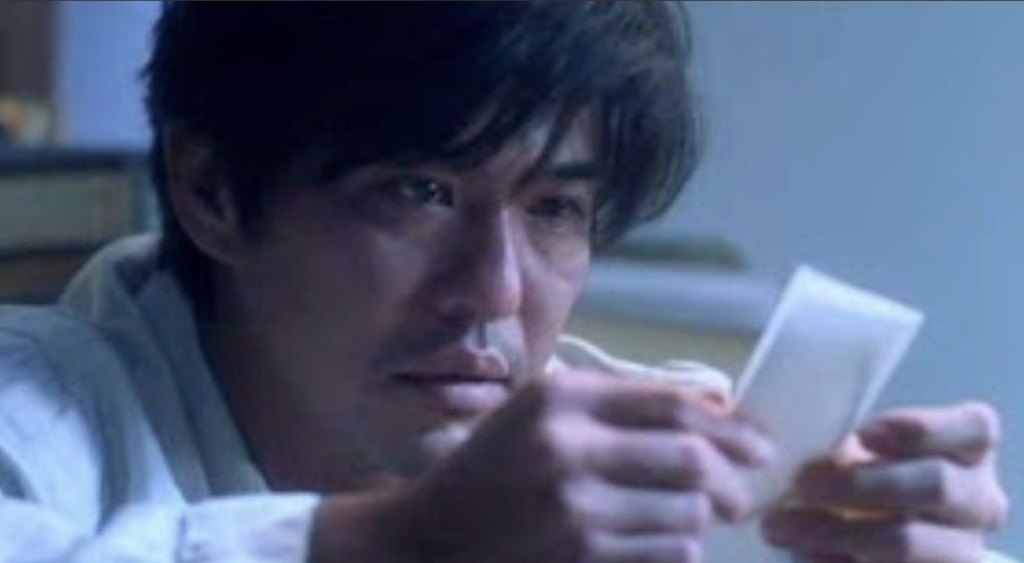
In the wake of the events of Ring, the body of Ryūji Takayama is delivered to be examined much to the surprise of pathologist Mitsuo Andō who once considered the man his friend and his rival, but while carving up a former acquaintance is jarring enough, the fact that he discovers a secret note within Takayama’s stomach makes matters infinitely weirder. To be fair, Andō isn’t exactly on an emotionally even keel at the moment anyway due to the tragic fact that his young son drowned and he’s been contemplating suicide ever since.
After managing to decipher the note, Andō soon finds himself up to his neck in urban legends concerning an alleged cursed videotape once when watch, will bring about your death in seven days and is soon suffering startling visions. Before you know it, he’s fully in detective mode as he tries to figure out the riddle of everything that’s occurring and after quizing Takayama’s student, Mai Takano about the kind of man he was, Andō manages to work his way backwards and soon not only learns of the legend of the murdered Sadako, but actually gets his hands on the fabled and highly dangerous videotape.
He watches it of course, and as expected, weird happenings occur as the seven days rapidly count down, but as dusturbing new details involving Takayama’s ex-wife come to light that suggest she’s wasn’t as successful at beating the curse as we once thought, we soon discover that Sadako’s long standing rage has somehow changed the rules and now seems focused on matters other than stopping the hearts of thrill-seeking tape watchers. With her curse now taking the form of a virus, Sadako seems to have a new agenda, but what can a mourning pathologist possibly do to help her?

Why there’s some obvious examples why releasing a film and it’s own sequel at the exact same time is probably a bad idea, my job isn’t to review bizarre marketing decisions, it’s to cast a critical eye over the actual films themselves. However, even taking the head scratching details of its release into account, it soon becomes apparent that there’s a fairly obvious reason that Spiral became virtually forgotten while it’s simultaneous predecessor became the leading light of an entire sub-genre.
If we were to compare Ring and Spiral to their source material, it’s actually the second film that remains the closer adaptation to Koji Suzuki’s series; however, Hideo Nakata and scripter Hiroshi Takahashi’s adaption not only gave us a morbid, slow and dread laden mystery that wormed its way under the skin, it also dropped it’s reserved composure in the last reel to deliver some of the most iconic visuals in Japanese horror history. The images on the videotape, the rush to break the curse, the sight of Sadako emerging from the TV – all of it help changed the face of global horror as the 90s slasher boon burnt itself out and needed something entirely new to replace all the sharp implements and glib humour. In comparison, Spiral simply can’t hope to compare mainly because Iida simply hasn’t quite got the same knack as Nakata for creating imagery that stubbonly haunts you like a ghost you once owed money to. Worse yet, the plot that sees Sadako plotting from beyond the grave to resurrect herself via some bizarre scientific/supernatural honey trap may be official cannon in the books, but it all seems like a huge miscalculation when compared to Nakata’s movie and just isn’t that scary in comparison.

Further more, it inadvertently seeks to undo a lot of the cool shit that Ring took creative liberties with. For a start, it seems to have spent some time at the Alien³ School Of Killing Previous Leads off-screen by rudely annihilating both Reiko Asakawa and her young son in a car crash and then from there it also features Sadako’s ghost as a thinking, plotting entity with completely different powers rather than the mute, rage-demon with that hateful gaze burning through that hair. Lastly, it even does away with the cursed videotape plot and instead has Sabako’s rage mutate to get transmitted via a virus that causes a tumor to form on your heart and while this concept should be scarier, it somehow doesn’t hold a candle to the creeping dread of obsolete, haunted tech.
While you can’t exactly blame Spiral for choosing to ignore the iconic moments presented in the “earlier” movie (this is exactly why we make sequels after the first film, guys), it does manage to provide a few cool details while getting completely eclipsed. For a start, having Kōichi Satō’s lead be practially crippled with grief throughout manages to evoke a suitably maudlin mood throughout and while the majority of Ring’s cast is a no-show, getting Hiroyuki Sananda back despite his character’s iconic death is always good value for money. Again, while there’s nothing here to truly match the sheer horror of witnessing Sadako emerge from that TV screen, Iida still manages to weave some creepy bits in like a sliced-up Takayama trying to engaged his former rival in a conversation mid autopsy or the shock reveal of the identity of a body discovered stuffed inside a makeshift hiding place.

However, it just can’t hope to match up to the raw chills of the original and it’s rather far-out, rebirth ending just feels weird rather than shocking. As a result, Spiral suffered the indignity of being replaced by the more conventional Ring 2 only a year later and it’s commercial success pretty much consigned the ignored follow-up to the cinematic equivalent of getting bashed in the head and flung into its own well to be forgotten. However, while the debate of which Ring sequel is actually better is a conversation for another time, one thing about Spiral is simply not up for debate: it’s predecessor runs rings around it.
🌟🌟
 We Have Issues