
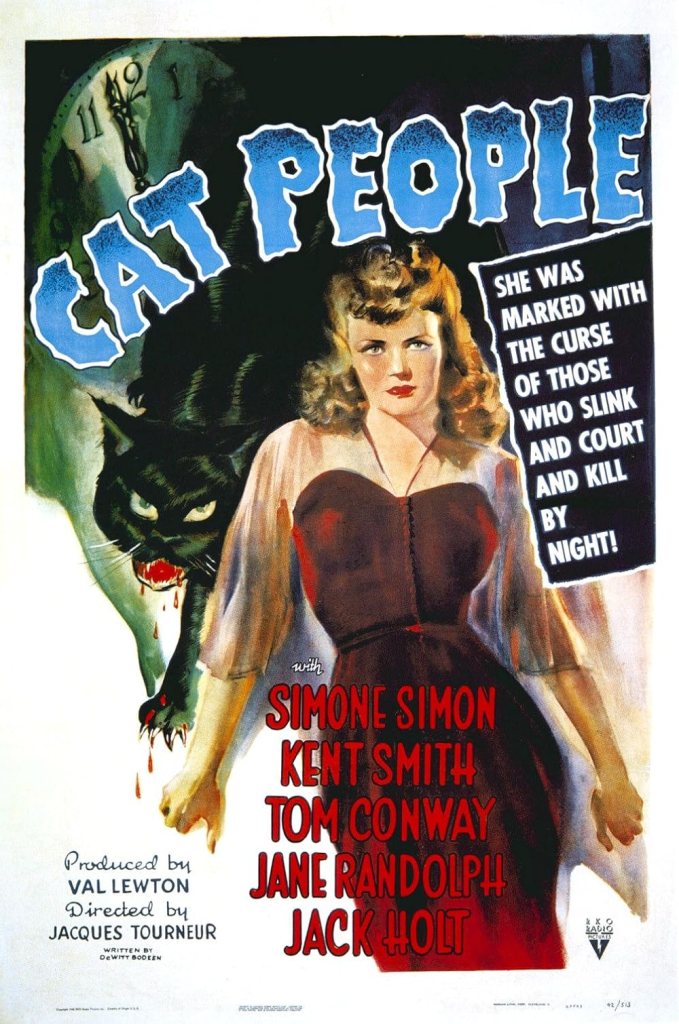

For anyone who complains that horror has gotten too political as every second release seems to be an allegory for some aspect of modern life, they may well do themselves a favor and cast an eye back further down the timeline. No, further back than that. Yes, I know folks such as David Cronenberg were doing it as early as the 70s and George Romero was picking at sizable social scabs as far back as the 60s, but the glorious truth is that filmmakers have always been using horror as a handy metaphor for everything from the Cold War, to mortality, to even the restrained sexual urges of a buttoned down society.
In fact, that last one in particular proves to be especially relevant while viewing Jacques Tourneur’s sublime 1942 classic, Cat People, which tackles some surprisingly risqué material in that impressively subtle way the 40s handled everything. However, beyond the metaphors, we also discover a movie that may have helped create the visual language that still drives the genre to this day and the result is a genuine classic that’s bound to make enthusiasts purr.
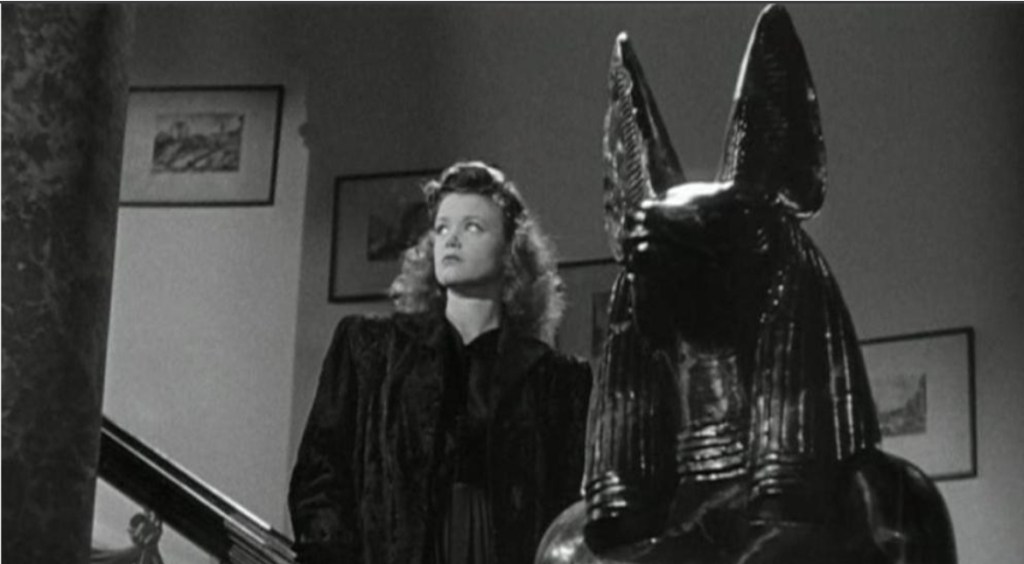
At the Central Park Zoo, we find a Serbian-born, fashion illustrator furiously scribbling in an art pad as she tries to get inspiration from a panther as it paces restlessly in its cage. This woman is Irena Dubrovna and there’s something about her that catches the eye of young, marine engineeer about town, Oliver Reed (no, really) who is inexorably drawn to her as she flings her scrapped sketches on the ground. Obviously, rampant littering isn’t one of Ollie’s turn offs, and before you know it, the two have sparked up quite the relationship, but before things end up getting too serious, Irena has some ground rules to lay down.
Due to a childhood hoovering up and absorbing the medieval culture of her people, Irena has some major hang ups concerning relationships in general and is particularly caught up with the legend of the “Cat People”, wicked, sinful shapeshifters that were all but exterminated or flushed out of her native land. However, this doesn’t seem to faze the eternally happy-go-lucky Oliver who seems to be willfully ignoring the old red flag or two. For a start, it seems that animals don’t like Irena that much – and by that I mean they really don’t like her; and on more than one occasion she’s found gazing longingly at that caged panther at the zoo. Still, that doesn’t stop the two from rushing into marriage, but while Oliver initially understands about her reluctance to consummate their union, her belief that she’s somehow connected to the Cat People from her country’s past simply won’t leave her.
But despite warnings that Oliver should never get her angry or jealous, his close relationship with work mate Alice soon starts to fire Irena up and she soon starts stalking this competition for her husband. But it Irena simply messed up by the stories from her homeland, or does she really have a dark, buried, supernatural secret lurking within her?
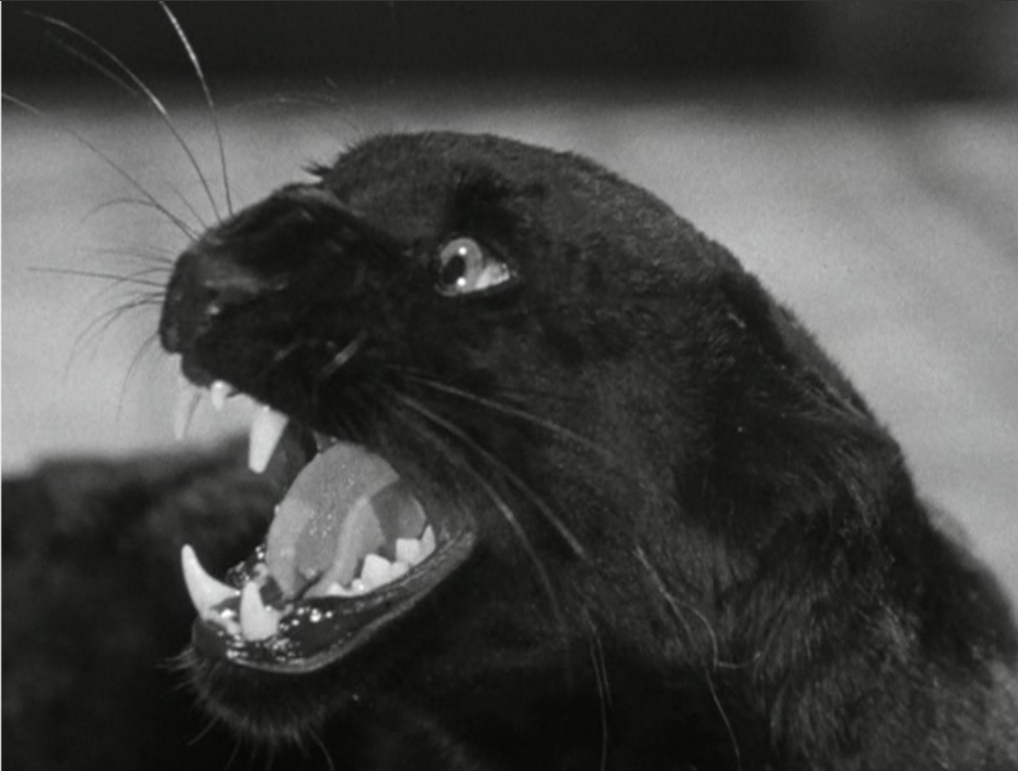
While Cat People is practically overloaded with virtues (all of which we’ll try to cover), surely the main one is the fact that the film is so evocative of so many things, you can choose to throw any number of allegories at it and chances are they’ll stick like kitty claws in your favorite sofa. One of the main ones is that Irena’s condition could be read as one of many things that is only being represented by the fear that she may suddenly transmogrify into a hissing panther at an inopportune moment. The main one is sex and that severe hang ups about the act has been caused by an upbringing that could be described as religious even if it does predominantly feature stabbing cats. To embrace her husband carnally would be to embrace the wicked sin of her ancestors and thus we get that puritanical denial of the flesh that always causes some sort of freak out somewhere. However, another reading of the film could actually suggest that the Cat People are actually a sly way to suggest that Irena is actually a lesbian who hasn’t actually come to terms with her sexuality, which is strongly hinted at when a strange, sultry woman approaches her after her wedding and addresses Irena as “moja sestra” (my sister). However, yet another take on it is that it’s a pointed view on the way women suffering from a perceived mental issue was treated back in the day and how callous it could get. It’s certainly bolstered by Ollie’s claim that until Irena came along, he’d had a perfect life and thus has no idea to actually deal with real life when it comes calling. Similarly, when smug psychiatric Dr. Louis Judd comes along and starts suggesting marriage annulments and even having Irena sent away to an asylum for his own lustful ends.
Of course, while it’s all eventually revealed that (surprise, surprise) Irena actually does have the ability to transform into a rampaging feline, possibly the most refreshing thing about Tourneur’s movie is that despite her monstrous secret, it’s plain as houses that Irena is the hero here and while she’s not exactly being bothered by angry villagers with pitchforks and torches, she is suffering at the hands of extraordinarily careless partners. In fact, looking with modern eyes at the way Oliver and his blatent “work wife”, Alice absent mindedly mishandle virtually every aspect of Irena’s “psychosis” it becomes abundantly clear who we should be siding with – and obviously it’s the tragic and ultimately doomed Cat Person.
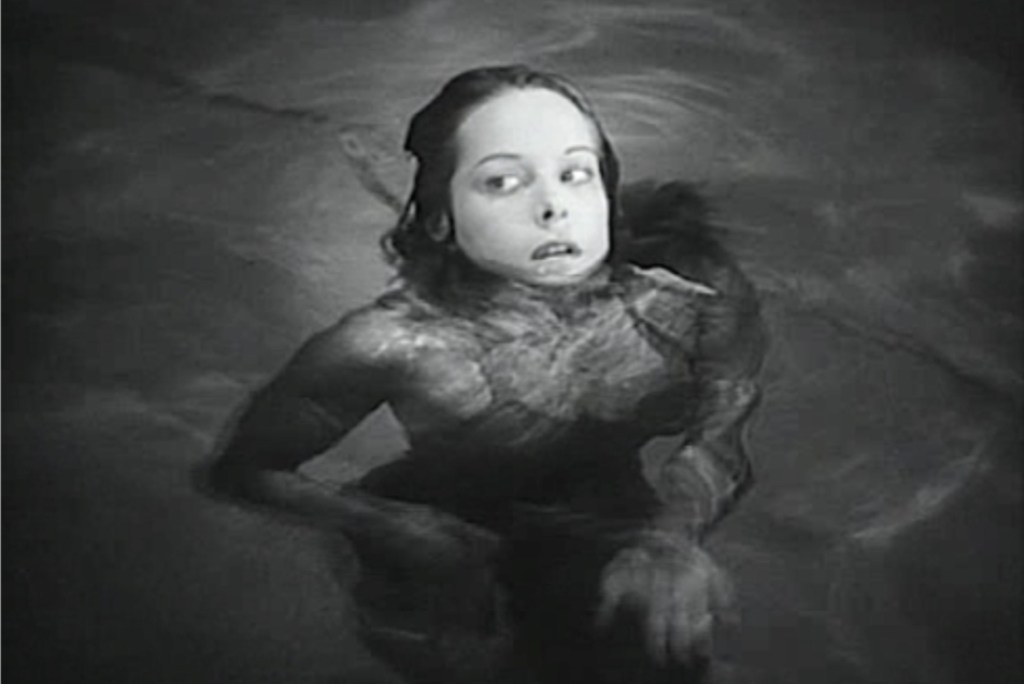
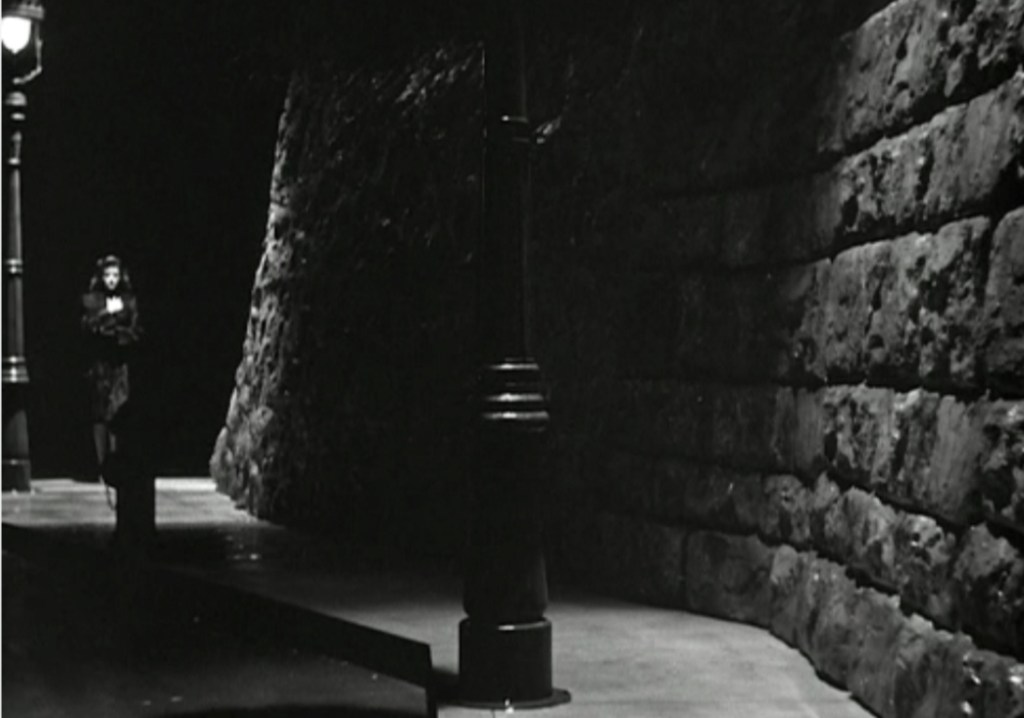
However, while I could go on about the different ways you can read the film all day, I’d be failing in my duties if I didn’t take time out to point out just how skillful a horror film Cat People really is. While Jacques Tourneur’s genre credentials would be pretty damn solid even without Cat People, (Night Of The Demon and I Walked With Zombie aren’t to be sneezed at), the way the director counteracts budgetary and technical limitations with shadow and ambience is truly breathtaking with a lot of the creepy setpieces obviously having a huge influence to this very day. A sequence where Jane Randolph’s Alice is stalked by Simone Simon’s jealous Irena is broken up with a strikingly modern feeling jump scare when a bus suddenly pulls into frame. Later, matters get even more unnerving when Alice is stalked once more in a swimming pool and as she floats in the middle, we catch ambient growls and moving shadows as something circles the pool, terrifying it’s intended prey. The fact that all this is achieved with suggestion and without a single, Wolf Man style transformation may mean that those with shorter attention spans may wonder what the fuss is about – however those in the know will find it as irresistible as catnip.
While it’s criminal that this film isn’t recognised more for how influential it actually is, Cat People delivers a fascinating, tragic story concerning a very different way to get pussy whipped and will have you supporting women’s rights and wrongs. It’ll probably leave you feline good too – but that’s neither here nor there.
🌟🌟🌟🌟

 We Have Issues