
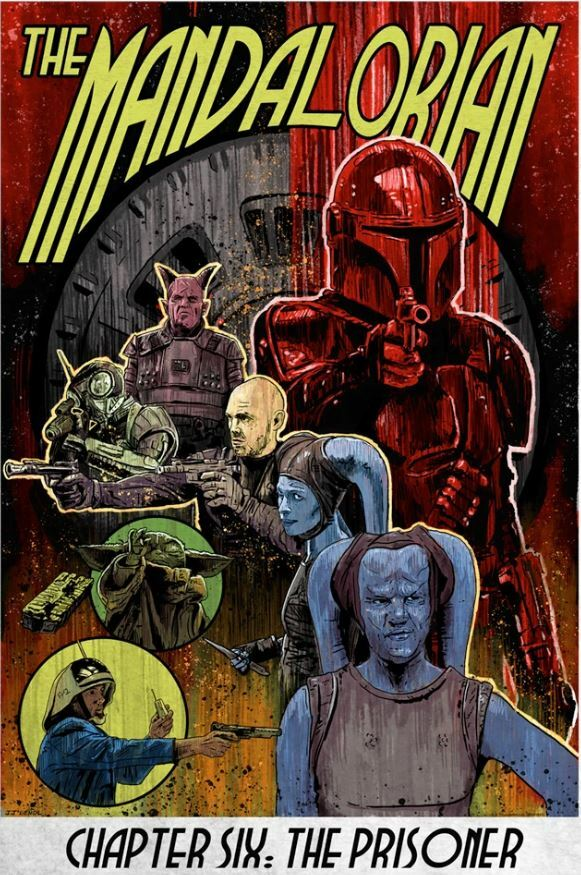

With Chapter 6, The Mandalorian continues to explore its episodic, almost anthology-like structure. Coming off the more nostalgic but uneven Chapter 5, this episode feels like a course correction in some ways, leaning into a darker, more contained story. It reinforces both the strengths and the limitations of the show’s gaming side-mission approach and filming approach, delivering a tense and stylish instalment that doesn’t significantly advance the overall narrative that suffers from
By this point in the season, audiences were fully comfortable with the show’s rhythm. The central arc of protecting the child at all costs in consistent, but individual episodes were free to experiment within that framework. The Prisoner takes advantage of that flexibility by presenting what is essentially a space-set heist thriller, complete with a morally ambiguous crew and a claustrophobic setting. It’s a compelling concept, even if it ultimately feels somewhat self-contained.
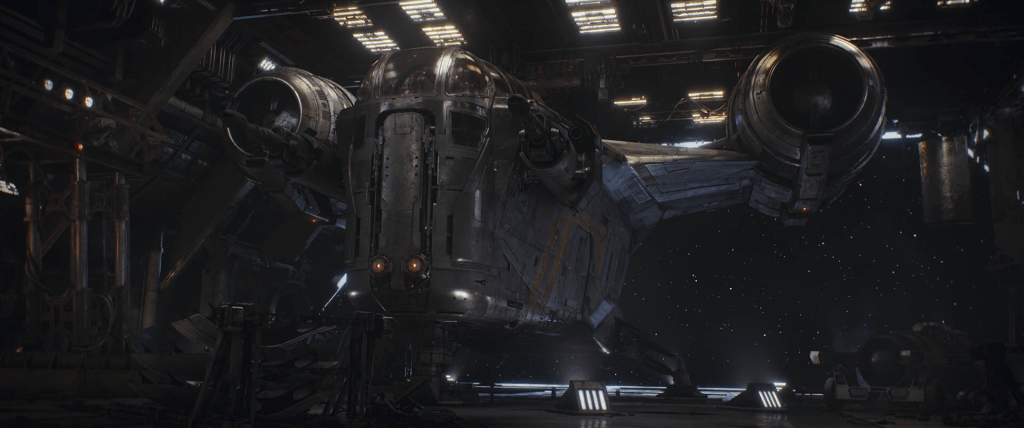
Directed by Rick Famuyiwa and again written by Jon Favreau, the episode wastes little time setting up its premise. The Mandalorian reconnects with a group of mercenaries from his past to take on a high-risk job: infiltrating a New Republic prison ship to free a captured associate. This setup immediately introduces a different kind of tension—one rooted less in survival against external forces and more in distrust among allies. It’s a classic heist set-up that has been played out many times before.
The crew itself is one of the episode’s highlights. There’s Mayfeld, played by Bill Burr complete with Boston accent, whose cynical, talkative demeanor contrasts sharply with the Mandalorian’s silence. Xi’an, portrayed by Natalia Tena, brings a chaotic, unpredictable energy, while Burg, played by Clancy Brown, serves as the group’s imposing muscle. Rounding out the team is the droid pilot Zero, voiced by Richard Ayoade, whose dry delivery adds a subtle layer of humor.
From the outset, it’s clear that this is not a team built on trust. The Mandalorian’s history with them is hinted at but never fully explained, creating an undercurrent of tension that runs throughout the episode. Unlike previous chapters, where the protagonist was often the most dangerous presence in the room, here he is surrounded by individuals who are just as capable—and far less principled.
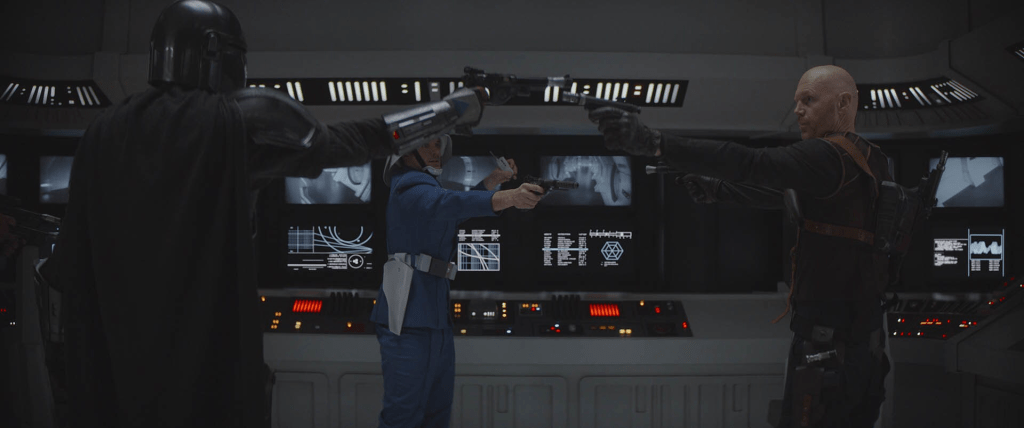
The bulk of the episode takes place aboard the prison ship, a sterile, maze-like environment that contrasts sharply with the open landscapes of earlier chapters. This confined setting allows the episode to lean into suspense, with flickering lights, narrow corridors, and the constant threat of discovery. The heist itself unfolds with a methodical pace, as the crew navigates security systems and encounters resistance from a lone New Republic security officer.
The action here is more about tension than spectacle. The Mandalorian moves through the ship using stealth and strategy rather than brute force. There are moments of close-quarters combat, but they feel grounded and deliberate, emphasising the danger of the situation rather than overwhelming it with scale.
However, as the mission progresses, the episode’s central conflict becomes more predictable. The crew’s inevitable betrayal of the Mandalorian is telegraphed early on, and while the execution is solid, it lacks the element of surprise. Once they turn on him, the story shifts into a familiar pattern: the hunter becomes the hunted, navigating the same corridors he previously infiltrated.
This reversal does allow for some visually engaging sequences, particularly as the Mandalorian systematically outmaneuvers each member of the crew. These encounters highlight his resourcefulness and reinforce his reputation as a formidable operator. At the same time, the resolution of these confrontations feels somewhat restrained. Rather than eliminating his former allies, the Mandalorian chooses to incapacitate them, leaving their ultimate fates ambiguous.
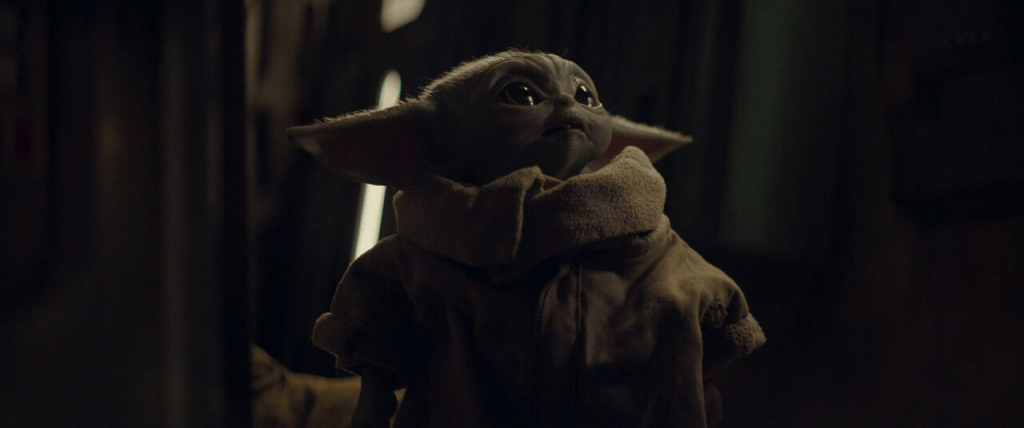
The episode also weaves in the ongoing thread of the child, though in a more limited capacity. Left behind on the ship during the mission, the child becomes a point of vulnerability, particularly when Zero discovers him. This subplot adds a layer of tension, but like much of the episode, it resolves quickly and without lasting consequence.
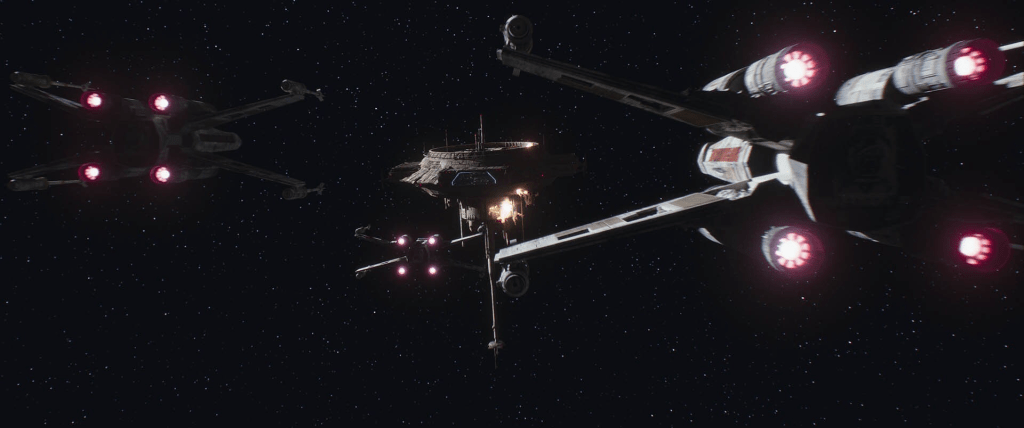
The episode brings us our first look at the New Republic, glimpsed through both the prison ship and the X-wing pilots who appear near the end of the episode to clean up the loose ends. Their brief but authoritative intervention hints at a larger galactic order beginning to reassert itself., serving more as world-building than a central focus.
The Prisoner is a stylish and engaging chapter that showcases the show’s ability to experiment with genre and tone. It’s let down by the visuals which are repetitive, with the characters appearing to be constantly walking down the same corridors. This is the first episode that seem confined by shooting on the Volume but memorable supporting characters, with Burr’s Mayfeld being the standout, and tense atmosphere make counterbalance the sterile environment. However, its self-contained nature and predictable structure prevent it from feeling essential within the broader narrative.
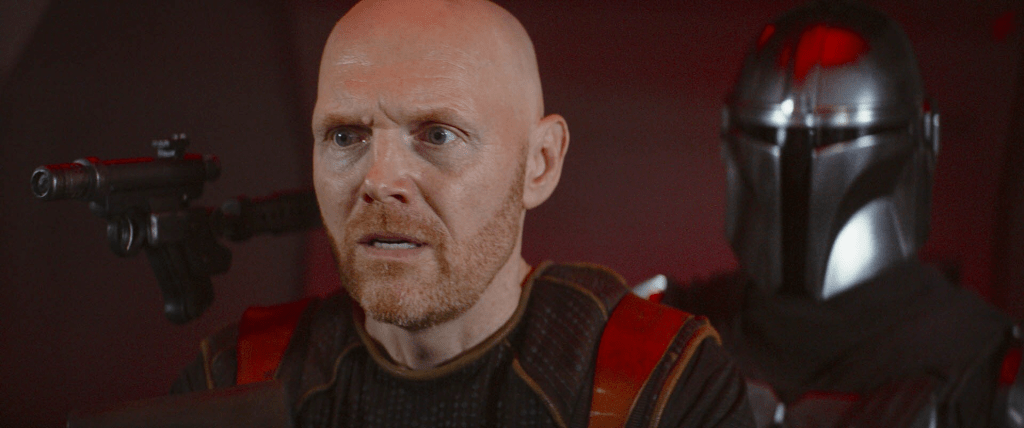
It’s an episode that works well in isolation, offering a darker, more suspense-driven take on the Mandalorian’s world, and proving that you can tell one-off stories within the universe. Yet, like Chapter 5, it leaves the sense that the series is momentarily treading water rather than moving forward.
🌟🌟🌟
 We Have Issues