
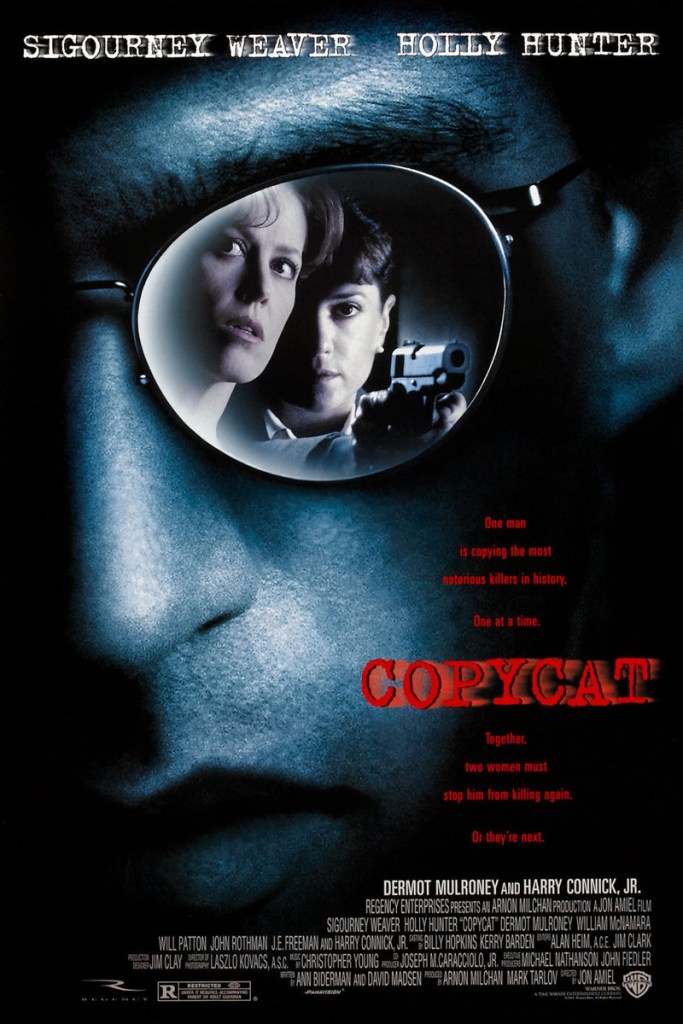
While we as a society have always been morbidly fascinated with the concept of serial killers (I once had a friend who had a pet tarantula named Jeffrey Dahmer, no seriously), it really picked up steam in the 90s after the release of Jonathan Demme’s The Silence Of The Lambs. To be fair, the psycho thriller had already been percolating quite nicely after such films as Fatal Attraction, Single White Female and The Hand That Rocks The Cradle had suggested that there’s so many sanity-challenged people wandering out there, it’s only a matter of time until you invite one into your home – but once Hollywood realised that serial killers too could be Oscar bait, the flood gates opened.
One of the more notable offerings to spring up in its wake was Copycat, a film that not only gave us a serial killer who was obsessed with other serial killers and a diminutive, female, protagonist with a southern accent, but we also get Sigourney Weaver doing her best to be a damsel in distress despite already surviving three whole Alien movies at this point – well, almost.
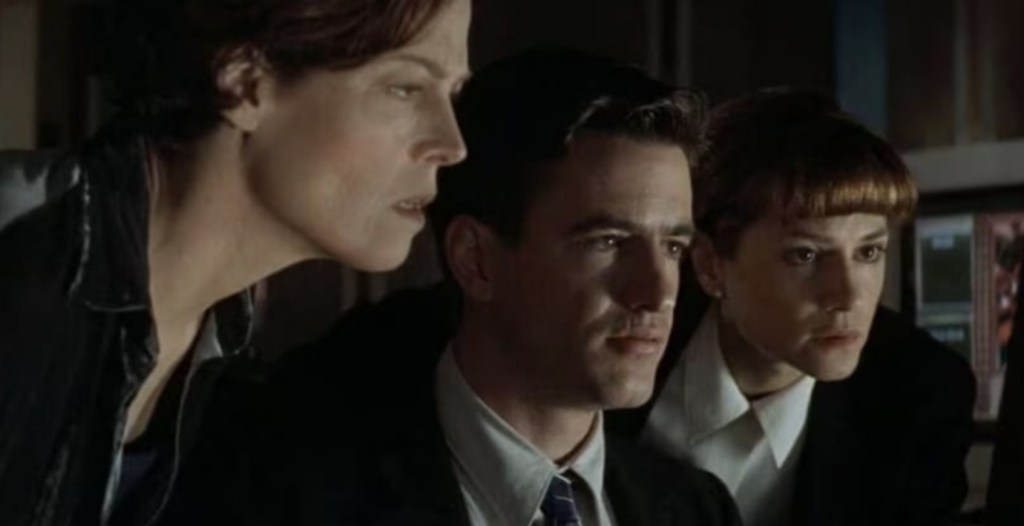
Dr. Helen Hudson is a field expert on serial killers who gives regular lectures on the subject at various universities. However, after one such talk, she’s attacked in the bathroom by escaped murderer Daryll Lee Cullum, who has targeted her due to being one of her previous subjects. While she barely escapes her harrowing ordeal and Cullum is ultimately recaptured, the scars it leaves on her personal life are pretty immense. Becoming severely agoraphobic and suffering devestating panic attacks whenever she even thinks about going outside, Helen becomes a shut-in, living her life from the relative safety of a computer screen.
Meanwhile, homicide detectives M.J. Monahan and Ruben Goetz have something of a sizable task on their plate when a serial killer starts targeting people across San Francisco. But while they’re initially stumped at the various deaths, various calls by Helen (who is initially written off as a crank), soon clue them into what’s actually happening. Breaking all the usual pattens that serial killers often follow, this one switches up everything from murder method to type of victim – but soon Helen finally spots something she recognises.
It seems this lunatic is a copycat, and is basing all of his kills from the crime scenes of other predators such as the Hillside Strangler and Son Of Sam. As he works through his twisted version of a greatest hits parade, Monahan tries to convince Helen to get back on the horse despite her crippling affliction, but this only seems to excite the killer even more. Taunting them by addressing notes to the serial killer expert at the scenes of his murders, this maniac may be working though a who’s who of deranged animals, but sooner or later, he’s hoping to copy Daryll Lee Cullum and finish the job his muse failed to do.
While Copycat plainly isn’t in the same league as The Silence Of The Lambs, that doesn’t mean that it isn’t a legitimately solid example of the 90s serial killer craze. It certainly checks off all the boxes needed to follow in the footsteps of the award winning horror/thriller as it gives us a murderer with a gimmicky, cinematic M.O.; plenty of musings about the nature of killers; an incarcerated, overacting puppetmaster that looms over everything; and a plucky, heroine who is so noticably short, she probably needs a booster seat when she goes to the cinema. However, while the filmmakers are eager to show us that they’ve done their homework when it comes to serial killer history, it isn’t the actual macabre policework that makes the film stand out from the crowd. While we’ll get into the minutia of some of the nineties-style approach of certain things, what really stops the film from merely being an actual copycat is the relationship between both Sigourney Weaver’s amazonian profiler and Holly Hunter’s determined cop.
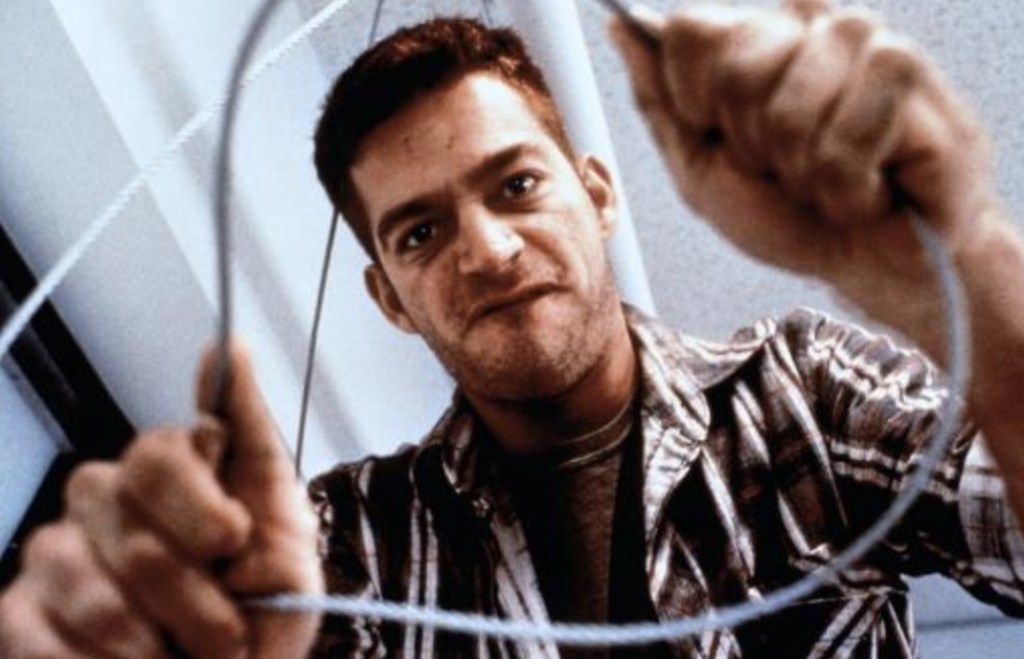
But first, let’s get back to the more dirtier work of the serial killer sections of the film and how surprisingly heavy-handed the film is. While Jonathan Demme was incredibly selective about how and when he showed the unnerving imagery that surrounded the grim works of Buffalo Bill in order to score maximum effect (the glimpse of a skin suit here, the methodial examining of a corpse there), here director Jon Amiel has no issues having us leer over lurid crime scene photos or linger on the pain of a character in torment. However, while Harry Connick Jr.’s leering Daryll Lee Cullum seems like a good, hateable villain, he’s really only a red herring, who tags out after an effective opening sequence in favour of a far less interesting antagonist. It’s not that William McNamara’s Peter Foley isn’t a threat, he most certainly is, but he’s a far more vanilla killer insofar that by design, he doesn’t actually have anything original to say.
Even though his identity is revealed fairly early, we don’t really get much of a grasp who this guy is rather than the creepy quirks of his kills, but while that sounds like suicide for a serial killer movie, Copycat manages to rise above its issues thanks that chemistry between its two leads.
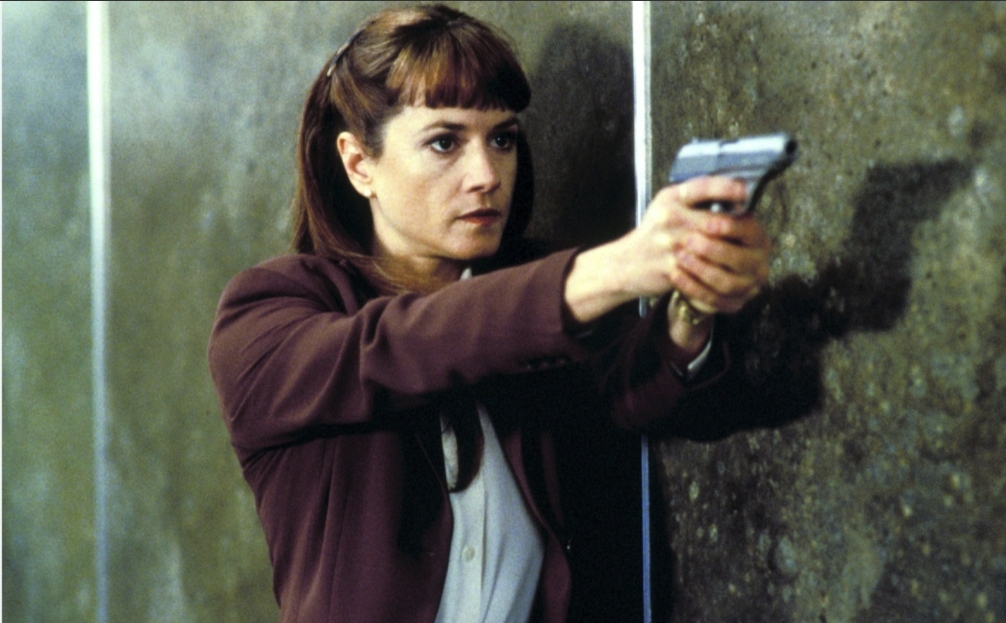
You’d think that the cinematographer must have been cursing the day when he heard that he had to try and frame the six foot Weaver and the five foot two Hunter repeatedly in the same shot, however, in a neat bit of casting, the movie makes the usually formidable Weaver the victim and Hunter the determined cop which immediately makes things incredibly interesting.
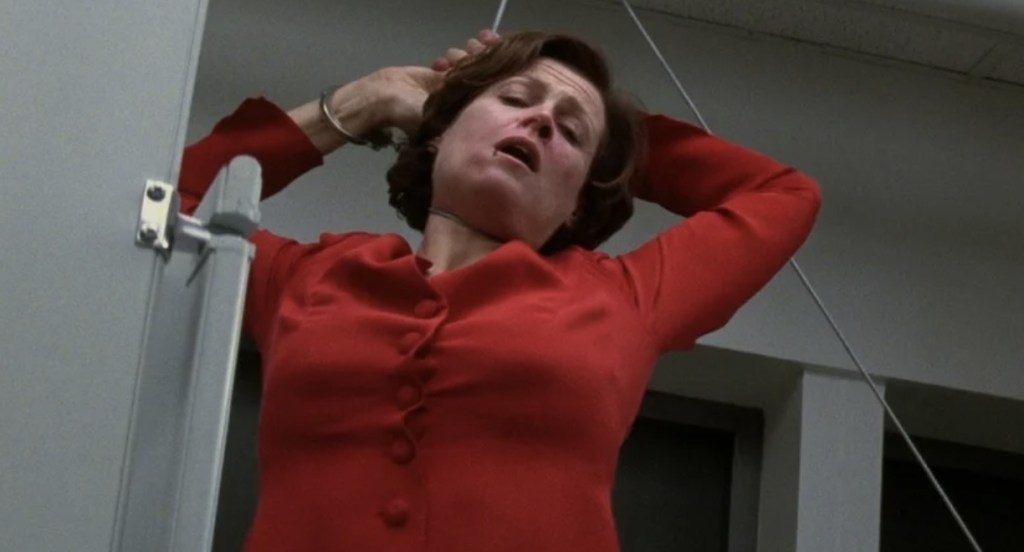
In order to maintain our belief that the extraterrestrial vaquishing Weaver is suddenly going to have troubles with a single pesky little serial killer, the film hamstrings the character by making her a complete shut-in who suffers gargantuan, Mexican telenovela-sized panic attacks if she has to go outside and while the film’s 90s treatment of the phobia is reliably overwrought (she virtually obliterates her entire house in a panic), it’s gives us the rather novel experience of seeing Weaver playing a more vulnerable character than we’re used to. Similarly, watching the teensy Hunter negotiate her male co-worker’s bullshit and a serial killer on the loose with a fuck-you attitude and a sarcastic twinkle in her eye means that when both characters spark off each other, it proves to be the hook the film needs to claw it’s way past familiar fare. In fact, it’s something of a shame that the team of Hunter and Weaver didn’t return to bring any more cinematic degenerates to justice when Morgan Freeman’s Alex Cross at least popped up for one more adventure.
Obviously, a film named Copycat isn’t going to rewrite the book on serial killer movies, but while the murder stuff is rather luridly basic, it’s the chemistry between the two heroes that really makes the flick come to life. Switching the body types of the protagonists and offering up Weaver as a victim proves to give the story the extra bump it needs to prevent it being just another standard exercise of killer catching.
🌟🌟🌟🌟

 We Have Issues