

After his Toho-mandated rumble with King Kong gave Godzilla some much-needed box office, it seemed like a no-brainer for the studio to dig further into their toy box and pull out yet another, pre-existing monster for him to pick a fight with.
Enter Mothra, fresh from her debut a mere three years earlier, who seemed a natural choice for a number of reasons with the most obvious being that both Mothra and Godzilla shared the same director; the indomitable Ishiro Honda. Beyond that, the two Kaiju seemed to be natural adversaries with the colourful, fluffy Mothra acting as a protector of Earth who takes a vested interest in the comings and goings of humans. However, on the flip side, Godzilla, with his spikey, vicious temper, obviously couldn’t give a faint fart in a hurricane when it comes to mankind and thus fulfills the role as a radiation spewing natural disaster. Simple.
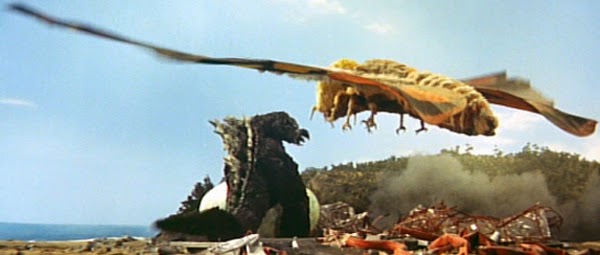
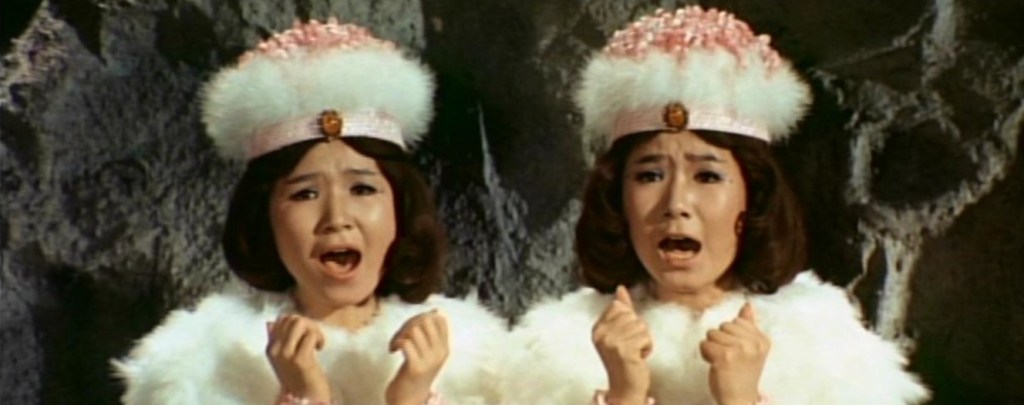
A raging typhoon results in a massive, candy-coloured egg being washed ashore near a fishing village on Kurata Beach. Obviously, as this isn’t generally an everyday occurrence, interest is stoked but when reporter Ichiro Saki and photographer Junko Nakanishi arrive on the scene, they are surprised to find out that the desperate villagers have sold the egg to rather shifty representatives of Happy Enterprises, a company owned by a business tycoon who intends to charge for the privilege of seeing it. The Shobijn, a pair of doll sized priestesses of Mothra – the God Of Infant Island from where the egg originally came – appear to beg for it’s return as keeping it disrupts the life cycle of their huge fluffy deity. However, the request from the teensy twins is predictably denied because rich equals bad – obviously.
Suddenly Godzilla, presumably realising that he’d better make an appearance at some point, rises from his hibernation beneath the ground and immediately makes a beeline for the egg, possibly in hopes of making a football field sized omelette, but most likely because he’s going to continue being the titanic-sized dick he’s built his reputation on.
As the Japanese army once again try every trick in the book to slow him down that involves everything thing from tanks to zapping him with pylons, Godzilla merely shrugs it all off like he’s being pelted with ping pong balls. There only seems to be one chance left, beg the Shobijn to convince Mothra to fight Godzilla for mankind while we try to change our greed-fueled ways.
Once again, the fates of all involved are in the hands of massive Kaiju, but Mothra is at the end of her cycle and Godzilla is, well, Godzilla. Can the contents of the giant egg contain the secret of halting the King Of The Monster’s latest rampage?

Technically more of a direct sequel to Ishiro Honda’s 1961 film Mothra than a fully fledged ‘Zilla flick (hence why Godzilla gets second billing under a giant moth), Mothra Vs. Godzilla pretty much attempts the same trick that earlier battle against Kong did, with the film essentially bouncing between the two, distinctly different tones that both Kaiju bring to the party. If I’m being brutally honest, there’s nothing really new here, as the plot thread that follows the benevolent good-guy is pretty similar to Mothra’s original movie (flood, egg, reporters, arsehole entrepreneurs, the usual) and addition of her reptilian foe as an angry-browed villain is remarkably similar to every other Godzilla to date. When I first settled down to watch Mothra Vs. Godzilla many years ago, I have to admit, the overfamilar themes originally left me rather cold with my reasoning being that it would be far simpler to either watch one or the other. However, I now see why the film is warmly regarded by so many fans and aside from the fact it’s very well made for it’s time and genre, the actual merging of the two styles actually compliment each other far better than King Kong Vs. Godzilla did.
The secret is that because Mothra and Godzilla are such opposites to each other, they compliment one another stunningly well, each making a fantastic foil for the other. While the colossal lizard stumbles his way through numerous landmarks like an alcoholic uncle crashing through a screen for at a family barbeque, it smartly marks him out as the single-minded brute this film portrays him as. In comparison, the gentle, almost delicate, Mothra is rational and compassionate to a certain extent and inherently more relatable as she not only has a mouthpiece in the form of her Barbie sized worshippers, but with her rainbow wings and her giant blue eyes, she’s far more pleasing to the eye than her beady-eyed adversary.

Their climactic fight is surprisingly unpredictable too as Mothra has to bow out of the fight despite blatantly winning on points due to the fact that her life cycle is at an end. However, hope in renewed when two, turd-like, Mothra larvae hatch from the egg and resume the fight, thus starting a decades old running joke that Mothra Larvae seemingly love nothing more than to bite down on Godzilla’s tail.
At this point in his career, Honda had all this monster stuff down pat and you can tell that the director and his crew have fine tuned the creative process of Japan once again getting tore up from the floor up by various titans, however, the real test here is that he manages to keep a good grip on the Achilles heel of every monster movie ever made – the humans. Actually having them able to communicate with Mothra through the Shobijn actually gives them far more to do than just stare off screen with their mouths slightly agape and the addition of a subplot concerning the unfeasibly dastardly actions of money grabbing, powerful men who live to arccue wealth by any means necessary, ticks the box marked “social commentary” that Honda so dearly loves to address. It’s this loving care that’s always made Honda’s Kaiju films stand out amidst any pretenders and you can tell there’s a conscious push to move the franchise away from the grim origins of the first Godzilla and into the realms of more audience pleasing, adventure flicks.
While some may argue that this started the inevitable slide into broader moments such as Godzilla doing his happy dance or using his radioactive breath to fly, the fact that Honda was able to craft both kinds of movies with equal care just shows how versatile he really was. Another noticeable addition to the ever solidifying style of the series is the second of six appearances by franchise regular Akira Takarada (who plays a completely different character in every one) and it’s this level of heartfelt detail that makes Mothra Vs. Godzilla a battle that’ll have you all of a flutter.
🌟🌟🌟🌟
 We Have Issues
One comment