
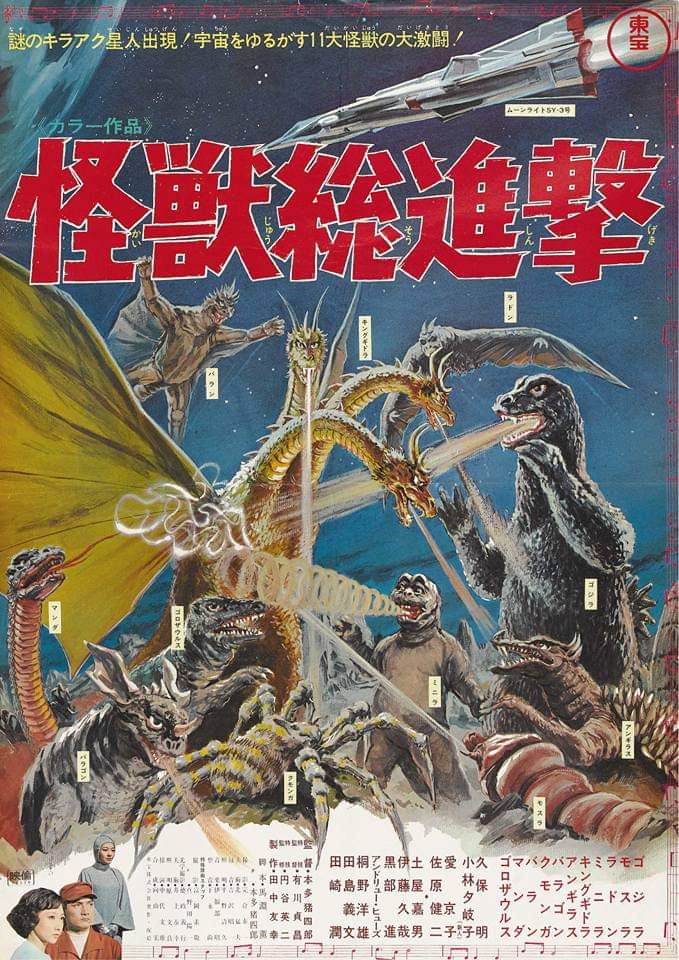
By 1968, Toho Studios had been on something of a Kaiju roll for well over a decade, but, behind the scenes, rumblings were occuring that asked the valid question – where can these movies possibly go next?
It was a fair question, after all, Godzilla had been in eight movies since 1954 and since Toho had started making monster movies, they’d managed to churn out nineteen of the things, so you could forgive them for thinking the bubble was about to burst. If the genre was to continue wrecking havoc across the globe, the studio had to brainstorn in order to unleash something suitably big. But not just big. Big. But, I hear you cry, what could possibly be bigger than a giant monster turning Tokyo into an atomic wasteland? Well, try eleven of the bastards.
That’s right, in an attempt to outdo 1964’s Ghidorah: The Three-Headed Monster that boasted a Kaiju pile-up of four bad tempered beasties, Toho crammed as many monsters they could into its gargantuan opus and the result may be one of the best entries Godzilla’s Showa era had to offer.

The year is now 1999 and all the world’s monsters have been corralled and contained on Monster Island, a body of land which uses various scientific methods to keep them all from wandering off and turning the closest capital city into gravel. While this sounds like the disastrous recipie to create an Arkham Asylum for giant monsters, Godzilla, Rodan, Mothra and the gang actually leave in peace and a hidden research station located on the island monitors and studies the Kaiju as they go about their daily business.
However weirdly motherly looking, shawl-wearing aliens named the Kilaaks abduct the monsters and the staff assigned to monitor them and soon their plans for global domination become apparent as Kaiju suddenly pop up all over the globe completely under the aliens thrall and start to cause more havoc than a kleptomaniac at a baby shower. But while Godzilla nails New York, Rodan mauls Moscow and Gorosaurus pounds Paris, the Japanese authorities also have the added complication of the human staff of Monster Island acting as enemy agents for their extraterrestrial masters thanks to a handy spot of mind control.
Only a plucky bunch of astronauts stationed on the moon and their state of the art rocketship, the SY-3, have any hope of saving the world as they are the only ones who have the means to globe hop but after the control of the monsters is broken after they all arrive looking to obliterate Tokyo, the devious Kilaaks reveal they have an extra ace up their sleeves; a three-headed one by the name of King Ghidorah.
Thus the stage is set for the mother of all showdowns as a horde of pissed-off monsters converge on Mount Fuji in order to give Ghidorah and the Kilaaks their marching orders.
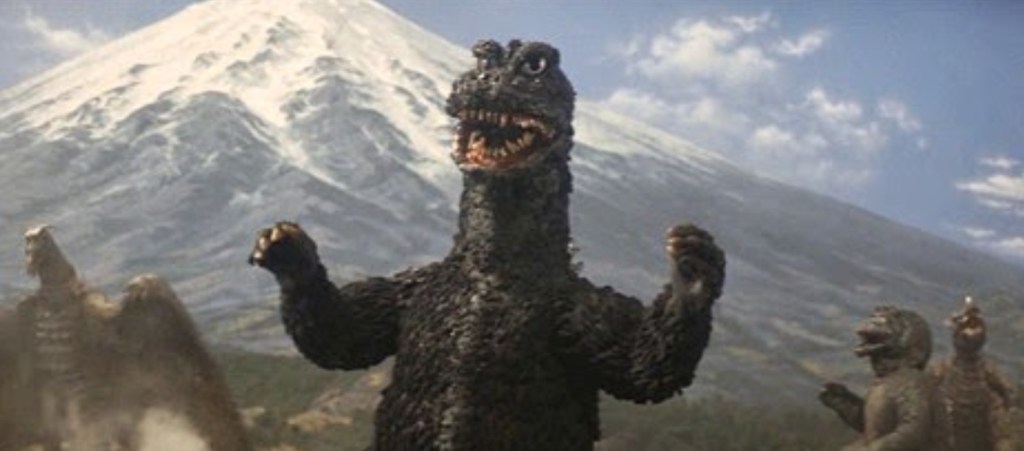
If truth be told, Destroy All Monsters may be one of the more derivative movies in the early Kaiju cannon as there isn’t really anything that occurs during the plot located within that hasn’t been attempted by the series already. Yep, it’s the standard pitch of aliens control monsters, monsters cause untold property damage, humans thwart alien’s plans, monsters attack aliens that we’ve already seen during Honda’s Invasion Of Astro-Monster back in 1965. But while Toho seems to have next to no interest in reinventing the wheel, they are interested in investing the movie with a sense of scale that towers far above any semblance of substance or originality.
While this is usually a bad sign, Destroy All Monsters turns out to be something of a freaking blast and you can tell that Toho really wanted to make this one special by bringing back director Ishiro Honda after a two movie absence in order to sheppard this extraordinarily tall order to the screen. Essentially Avengers: Endgame to Ghidorah: The Three-Headed Monster’s Avengers, to ensure that this entry was a complete extravaganza, the studio raided their sizable monster back-catalogue to truly make this an all-star event – sure Mothra and Rodan had appeared in Godzilla movies before, but they had debuted in their own movies first and joining them in this newly connected universe was the gliding Varan, the tunneling Baragon (last seen fighting a giant Frankenstein’s monster – no, really), the eel-like Manda from 1963’s Atragon, previous Kong opponent Gorosaurus and various other assorted monsters from other movies. Each are given their own city to destroy (Godzilla gets New York, pre-empting the ’98 U.S. reboot by 30 years) and do so with gusto as the model makers have an absolute ball crafting collapsible cityscapes from around the world with Gorosaurus’ fateful meeting with the Arc de Triomphe being especially memorable.

Once again, Honda keeps the human side of the story ticking along nicely with a familiar cast all gamely chipping away at type of disaster movie/alien invasion/adventure trappings that the director could do in his sleep. But the bit that everyone was waiting for is the climactic brawl and despite it featuring wires and painted backgrounds that are all hugely visible, it doesn’t take away a single second from the fact that it’s a truly stunning techinal achievement. Yes, the final battle is incredibly unfair – eight against one is ridiculous odds, even if your antagonist has three bloody heads – the sheer amount of planning it must have taken boggles the mind. Some creatures are entirely puppeteered, most are men in suits, how they didn’t regularly get all tangled up in one traumatic knot is a utter marvel to me.
While you’d think that the finale would be in danger of just being a bunch of blokes in rubber costumes pushing each other, the film is loaded with truly innovative action, such as the legendarily hapless Anguirus clamping his jaws into King Ghidorah’s neck only to be hoisted high up into sky and then dropped like a spikey bad habit, or the gruesome sight of Godzilla stamping on one of Ghidorah’s necks like Jimmy Conway stomping the life out of Billy Batts in Goodfellas while Akira Ifukube’s score goes fucking nuts. In fact, Destroy All Monsters is oddly hardcore for a family monster flick m which is further proved in an eyebrow raising scene where Akira Kubo’s hero works out that the Kilaaks are controlling his sister through her earrings, which causes him to simply just rip them out and proudly show them to the press as she sobs on the floor. Charming.

Arguably the go-to entry of the entire Godzilla cannon thanks to it’s sheer scale and value for money when it comes to it’s expansive monster line up, Destroy All Monsters remained an unbeaten monster mash until 2004’s Godzilla: Final Wars (which features fifteen the fuckers). While there’s an argument that Ghidorah: The Three-Headed Monster or Invasion Of Astro-monster are technically better films with more original plots, this entry remains a huge, steadfast favorite of many due to it’s simple execution, fast pace and the inclusion of a climactic monster mosh pit like no other before or since.
Destroy? More like Employ All Monsters, am I right?
🌟🌟🌟🌟
 We Have Issues
One comment