
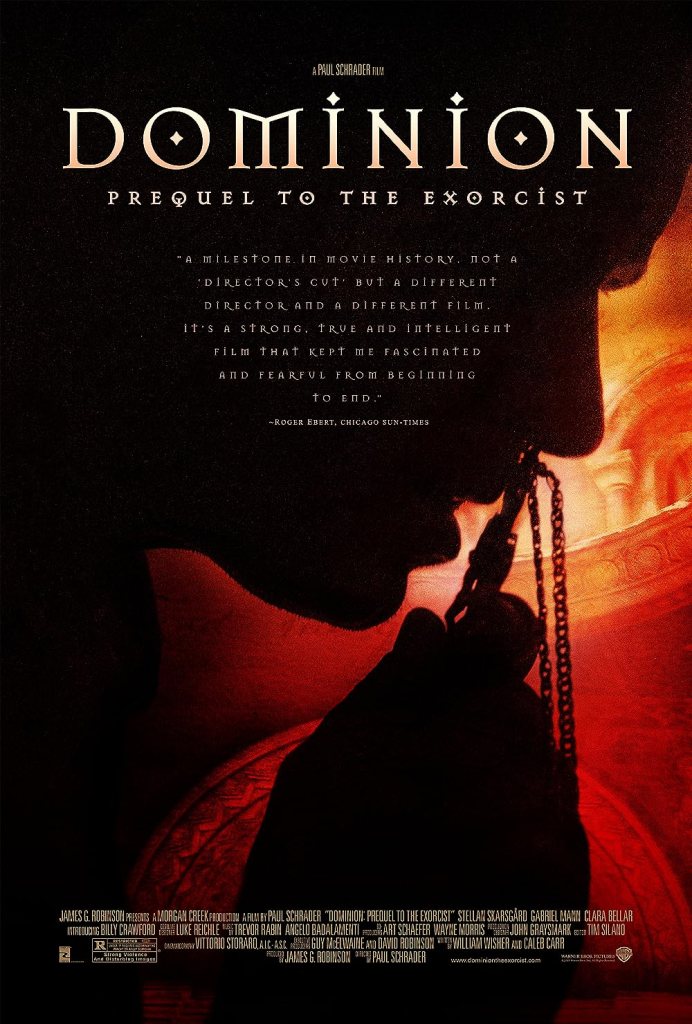
When it comes to the tale of two Exorcist sequels, it was hardly a case of “it was the best of times, it was the worst of times” – in fact, most of the time, “worst” was a very apt description.
Those of you unfamiliar with the convoluted string of events that led to there being not one, but two Exorcist prequels, here’s some abridged cliff notes: after hiring Paul Schrader to deliver them a movie about Father Lankaster Merrin’s first run in with the demonic force that goes on to possess little Regan McNeill, studio Morgan Creek started to suffer cold feet when the film didn’t live up to their frightening expectations. Instead of being a nerve shredding horror film, Schrader’s movie was more of a nuanced examination of guilt, faith and the tyranny of men and didn’t feature a single spider-walk and not even a drop of pea soup. In something of a knee-jerk reaction, the powers that be scrapped everything and started again with Die Hard II’s Renny Harlin at the helm (yep, you read that right), and the result was a splashy, disposable horror flick that relied too much of iffy CGI and unsubtle jump scares to get its point across. However, after Harlin’s version was cast out by the Peter of the box office, Morgan Creek had a change of heart and gave Schrader limited means to finish his version. Typical. You wait nearly 15 years for an Exorcist prequel and then two come at once…

After his harrowing experiences during World War II, former priest Lankaster Merrin has officially been on sabbatical, but in reality the former man of God has lost his faith and has spent his time indulging his second love: archeology. However, during his latest dig in a remote area of Kenya knoen as Derati, he’s stumbled upon something remarkable: a Byzantine church that not only must have been built sometime in the 5th century, but must have been buried almost immediately after being completed. While the dig is being overseen by the overzealous British army, Merrin meets the young, idealistic Father Francis and invites him to visit the church on the day they uncover and open the main doors but also finds time to bond with the local doctor, Rachel, who also shares a traumatizing history with the Nazis.
At the temple, Merrin meets Cheche, a deformed outcast who has suffered numerous beating from superstitious locals and out of pity, takes him to Rachel in the hope that he can receive medical treatment. However, matters take a sinister turn when two British guards enter the church in order to loot the place (no real surprise there) and end up massacred by a mysterious assailant and the murder immediately sets the suspitious soldiers against the local tribes people who in turn builds up a sizable distrust of anything representing christianity. It soon becomes apparent that the church was built over a sacrificial site in order to keep something unholy restrained and as strange circumstances effect both the tribes and the soldiers, it soon seems bloodshed will be inevitable. Worse yet, unbeknownst to everyone, Cheche’s miraculous recovery turns out to be anything but…

When watched as an experiment or held up as an example of a studio not knowing what they actually wanted from an established franchise, both versions of the Exorcist prequel unite to be quite the intriguing entity. In fact, the most interesting thing about the deal is that both Harlin and Schrader’s versions prove to be equally ineffective but for completely different reasons with Harlin’s effort leaning too hard on cheap scares while dumbing down the more the cerebral aspects.
Now, seeing as I’ve already reviewed Exorcist: The Beginning, there’s no point me putting the boot in further, especially considering that this is supposed to be a review for Dominion: Prequel To The Exorcist and once you break it down, Morgan Creek’s worries that Schrader’s version lacked sufficient bite don’t actually seen to be that unfounded.
Now, while I’m fully taking into account that Dominion is technically barely finished and allowing the fact that the score, post production and visual effects are noticably wonky (at one point it features digital hyenas that makes the ones in Harlin’s version look like Avatar level CGI), the main issue is that even though it’s a far more layered and thoughtful movie, the tension and fear is practically non-existent.
Yet in many ways, Schrader (who’s probably most famous for scripting a very different example of man succumbing to demons in Taxi Driver) has provided a prequel that, in theory, is a far worthier Exorcist set up thanks to it riffing on William Friedkin’s original themes of disintegrating faith and then embellishing them by throwing in the evils that come from man himself. Drawing parallels between the SS officer who makes Merrin pick members of of his flock to shoot and the British Major, Granvillie, who slowly goes mad due to the evil influence that whispers in his ear like a demonic nag. These aspects of the film work really well, as does the rising tensions between the openly dismissive British and the tribes people, but the issue seems to be that the director seems to be so in love with jabbing at the wounds of colonialism and Catholicism, he frequently forgets that he’s making a horror film.

Now, I’m not suggesting that Schrader should have loaded his film with the overused “Quiet – Quiet – Loud” method of scares, but lot of the possessed imagery ends up being either overlit (possibly a result of the rushed post production) or, even worse, unintentionally silly as it misses the target set the original by a country mile. As a result, the final scenes that involve Merrin yelling bible verses at a bald, possessed teen as he floats above the ground in the lotus position in white pants carries all the looming dread and choking atmosphere of watching a kid’s nativity play.
Still, the drama leading up to this is strong and its played nicely by Stellan Skarsgård who, at the time, obviously had no idea he was about to do it all again when the studio decided they wanted to give it another go. In a weird turn of events, however, while Skarsgård has plenty of drama to chew in here, it’s the Harlin version that gets him to have more fun as the Schrader cut doesnt really give him the full opportunity to really cut loose (he doesn’t even get to do the whole “Power of Christ thing).
Both misfires in their own way, it’s an interesting fact that no less than three separate directors have attempted to flesh out Merrin’s long standing relationship with Puzazu (John Boorman ballsed it up decades earlier via flashbacks in Exorcist II: The Heretic) and every single one of them have screwed the pooch.
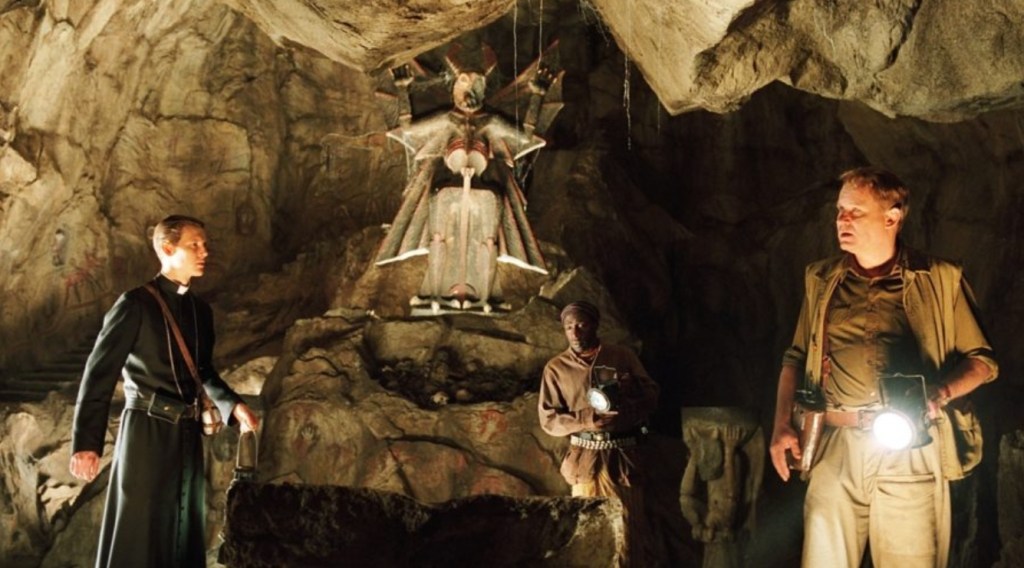
If I had to choose, Schrader’s version – atrocious visual effects aside – is technically the superior prequel (although that’s really not saying much) but when it comes to exploring the Exorcist’s past these filmmakers should have chosen to bow out and just eat, drink and be Merrin.
🌟🌟
 We Have Issues
Good post, i remember seeing the prequels years ago, neither were that good, not terrible either, just fairly forgettable.
LikeLike