
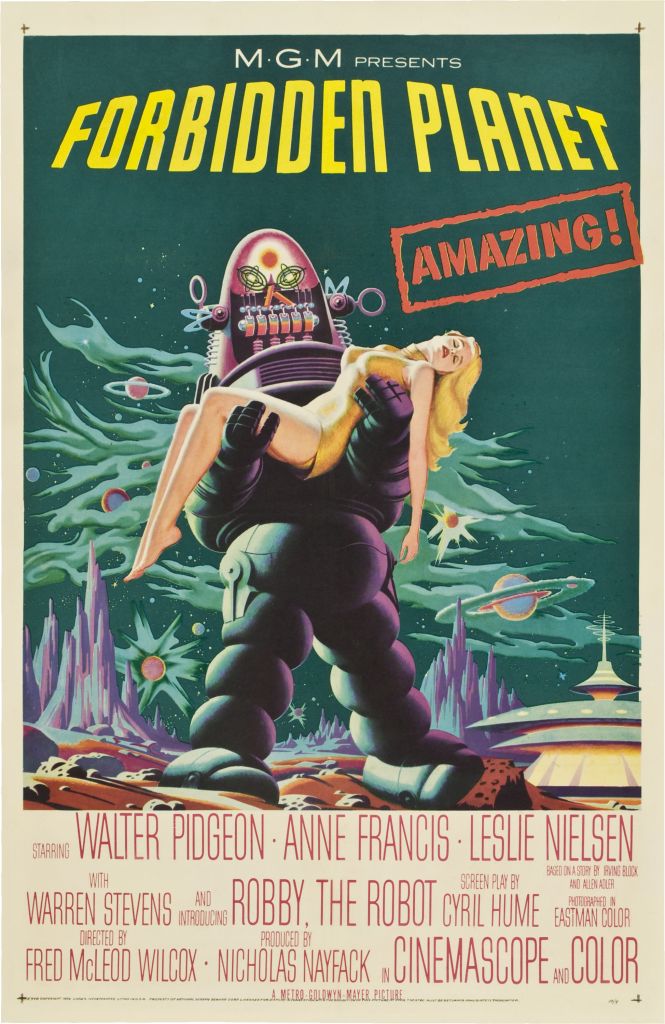
When casting a glowing, green scanning ray upon the fertile realms of 50s science fiction, it doesn’t take the clicks and whirs of a super computer to spot various similarities that came from within. During the unnerving times of the Cold War, numerous entries dealt with unknowable, cold, alien entities trying to usurp the all-American way of life either by strafing the hell out of it with death Ray’s, or by more insidious means as they strived to take away our very minds and civil freedoms. However, in the midst of communist hysteria and paranoid finger pointing, one film hovered above it all to hint at a future where everything was going to be all right and where mankind (e.g. Americans) traversed the stars in an attempt to extend the arm of humanity deep into the cosmos.
That film was Forbidden Planet, and in a decade of influential sci-fi flicks, this one may be the granddaddy of them all…
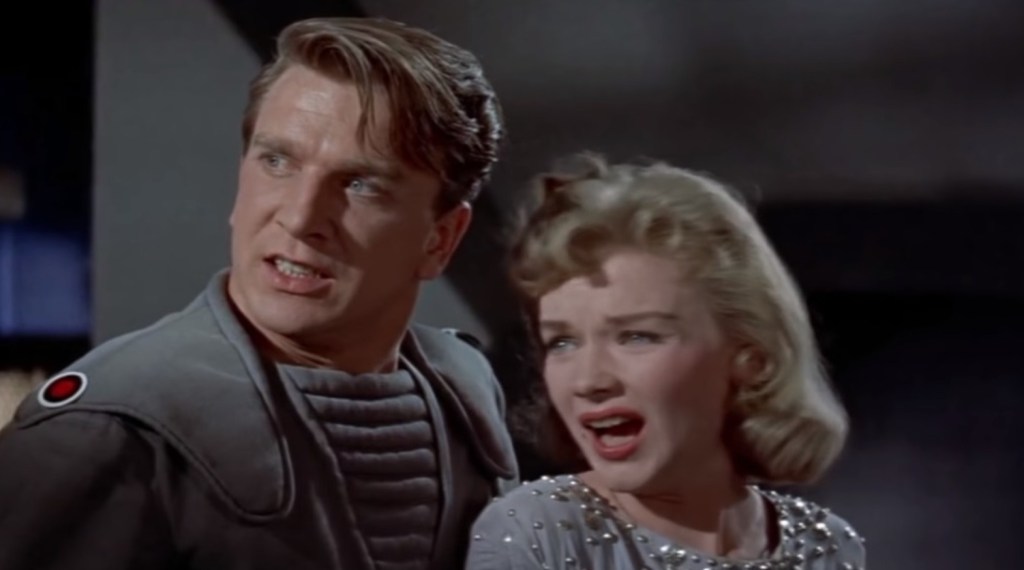
In the 23rd century we find the crew of the United Planets Starship C-57D completing their year long plus journey to Altair IV in order to check up on scientific expedition that had been sent there twenty years prior. Lead by the standup Commander John J. Adam’s, the crew are noticably grumpy at taking a year out of their life just to check up on some remotely stationed boffins, but before they even land, the ship gets a stern rebuttal from a Dr. Edward Morbius who insists that everything is fine and that they shouldn’t land for their own safety.
Determining that Morbius’ demands are contradictory, Adams follows his orders and lands anyway only for he and his crew to be met by Robby, a bulky, dome-headed robot whose design and abilities are far beyond the capabilities of earth technology, but who also proces to be something of a gracious – if dead pan – host. Escorting Adam’s, along with lieutenants Jerry Farmam and “Doc” Ostrow, to the luxury apartment of his master, they are met by Morbius himself and his nubile daughter Altaira who fill them in on Altair IV’s rather bizarre history.
It seems that all the other members of the expedition were killed by a mysterious force that also caused their ship to explode on take off, leaving Morbius and Altaira’s mother immune to whatever strange blight affected them all in the first place. However, after his daughter was born and his wife succumbed to natural causes, Morbius had plenty to keep himself busy as he’s been examining the incredibly advanced technology of an extinct alien species named the Krell that has not only resulted in the creation of Robby but has caused the scientist’s IQ to get a hefty boost.
While Adams tries to get to the bottom of what’s happening while simultaneously fielding the advances of the frisky Alteria, the same invisible force that wiped our Morbius’ colleagues returns to target the visitors – but what is this being and where does it come from?

While there’s quite a few sci-fi movies from the 50s that can quite comfortably claim to be absolutely vital when it comes to influencing the face of the genre in the decades to come, Fred M. Wilcox’s Forbidden Planet may just be the most important of them all as so many aspects of its story and production proved to break more ground than a slam dancing Godzilla. First of all, the movie was the first film that was set entirely on another planet that saw humans streaking across the galaxy at a speed faster than light while the film’s mascot, the instantly iconic Robby the Robot, was also one if the first on-screen robots that actually had a personality which lead to the amiable automaton eventually scoring guest spots in shows like Mork and Mindy. Elsewhere we also have a plot that famously seems to be a very loose adaptation of William Shakespeare’s The Tempest and the film’s score was the very first movie ever to feature one that was entirely performed via electronic means – to put it simply, Forbidden Planet rewrote the book on cinematic sci-fi.
By while all that is legitimately impressive, how does Forbidden Planet stack up today while still remaining very much in the dated realms of the 1950s? Well, the answer is quite well actually. While the effects are obviously not up to the standard of photo realistic CGI, the painted mattes of Altair IV are still utterly gorgeous to behold while the clunky tangibility of Robby is the epitome of camp, sci-fi cool with his spinning diodes, clicking inner bits and measured delivery – “Nice climate you have here. High oxygen content.” states Adams at one point, trying to make conversation, only to get the martini-dry reply, “I seldom use it myself, sir. It promotes rust.”. While the presence of pithy robot comebacks harken forward to Star Wars, the nature if the humans themselves couldn’t be more Star Trek if they tried and the presence of a familiar, naval-style chain of command help lend all the sci-fi stuff an air of legitimacy – hell, there’s even a ship’s cook who runs around with an apron on and a sizable drinking habit.

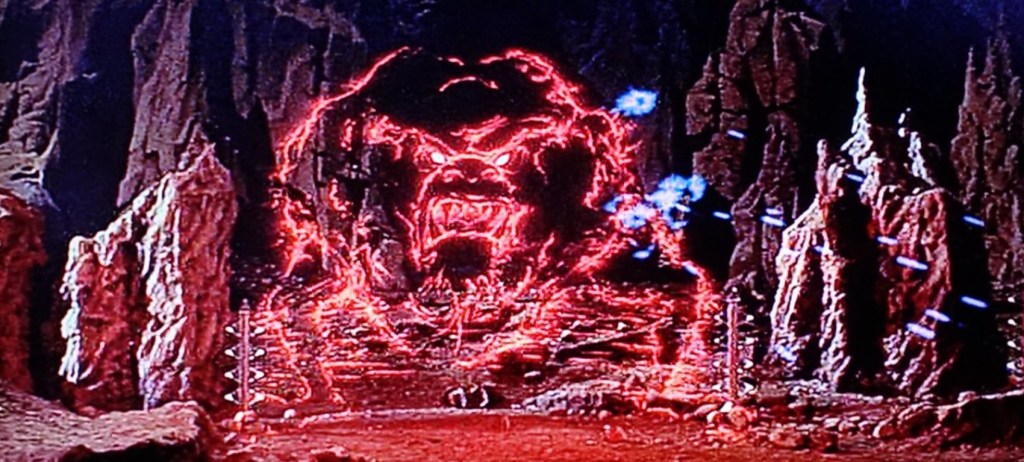
Also adding to the whole Star Trek vibe is the fact that the danger comes not from a marauding alien force, but from within the very psyche of the human brain as it turns out that the invisible force that’s been mauling and pancaking everyone is the physical manifestation of Morbius’ subconscious that’s been made real by the technology of the Krell. This “Id Monster” proves to be an unstoppable force and a tangible threat and not even the partial reveal of the creature as an animated beast that doesn’t look unlike a truck-sized Tazmanian Devil from the Bugs Bunny cartoons can dull its edge.
Admittedly, other sections of the film haven’t aged as well as a youth spent watching Leslie Nielsen give unparalleled straight deliveries in spoofs like Airplane and The Naked Gun means that its practically impossible to take him seriously in a more sensible role without expecting him to drop a “and don’t call me Shirley” atvthe end of every scene. Also, due to the appearance of the carefree Altaira who swans about the place in an array of short frocks, every crew member on the spaceship virtually turns into an intergalactic sex pest the very moment they lay eyes on her adding an air of horniness that even carries over to Robby who innocently drops the one liner “I was just giving myself an oil job.” proving that he’s been programmed to process double entendres just as well as he handles etiquette.
Still, while some aspects of the film dating poorly are to be expected, there’s no denying the effect that Forbidden Planet’s very own id has had on an entire genre and while the movie does tend to lapse into the realms of a particularly colourful science lesson when it comes to some of the heavier exposition, the movie’s buoyant and hopeful tone helps it effortlessly shoot for the stars.
Forbidden planet you say? Hell no, all are welcome here.
🌟🌟🌟🌟

 We Have Issues
It’s always interesting to reflect on or re-watch (as I did in Forbidden Planet’s case a couple nights ago) a sci-fi classic that may hold up in some ways but not so much in others. As an inspiration in many ways for Star Trek, it’s still quite appreciable. Compared to space-age films that followed in later years from 2001 and Alien to Interstellar, Forbidden Planet still earns respect for how it may open our minds to the potential risks of space exploration. As a 50s film, it had its own style with rewarding results. What a remake or reboot would achieve today can tax the imagination. But I certainly wouldn’t be opposed to the obvious optimism. Thank you for your review.
LikeLiked by 1 person