

There probably isn’t another filmmaker alive who understands the importance of American myth more than Clint Eastwood. Having portrayed more enigmatic, mysterious, quickdrawing leading men than anyone else during his younger years, he went on to direct himself as a couple more once he found himself on both sides of the camera. One of those prime examples is Pale Rider; a story involving a typically inscrutable saviour, trotting into town to liberate a group of simple folk from the shadow of a greedy and ruthless businessman. To be fair, those who have followed Eastwood’s Western outings of the past might find that the synopsis of this film feels eerily similar to previous entries in his gun slinging cannon (hello, High Plains Drifter), but considering that Pale Rider emerged as the highest grossing Western of the 80s, Clint must have been doing something right.

It doesn’t pay to be a prospector in LaHood, California, not when unscrupulous mining baron Coy LaHood wants to urge you to move on from your rightful claim. That’s exactly the dilemma facing the simple folk who have settled in Carbon Canyon in order to find their fortune only to find LaHood sending gangs of roundabouts to bushwhack their settlement and shoot their pets. One man who has had enough is Hull Barret, and in order to make some sort of a stand, he makes the ballsy, but unwise, decision to he into town and pick up some desperately needed supplies despite it being a meeting place for LaHood’s men.
Sure enough, he’s beset by axe handle wielding thugs before you can say “hickory stick”, but before things can go too far, Hull is saved by a mysterious Preacher who gives the heavies a darn good whupping and then attempts to ride off as if nothing has happened. However, a grateful Hull wishes to show proper appreciation and invites him back to the mining settlement. There he meets his fellow miners and his fiance, Sarah, who has a teenage girl from a previous marriage, the god fearing Megan.
Responding well to the Preacher’s hard-bitten pep talks and the fact he manages to smash one of LaGood’s gargantuan workers in the balls with a sledgehammer, the prospectors start to get renewed hope and vow to stay.
Of course, this doesn’t exactly sit well with LaGood himself, and so he resorts to more extreme measures in order to get what he wants by calling in corrupt marshall for hire, Stockburn and his deputies.
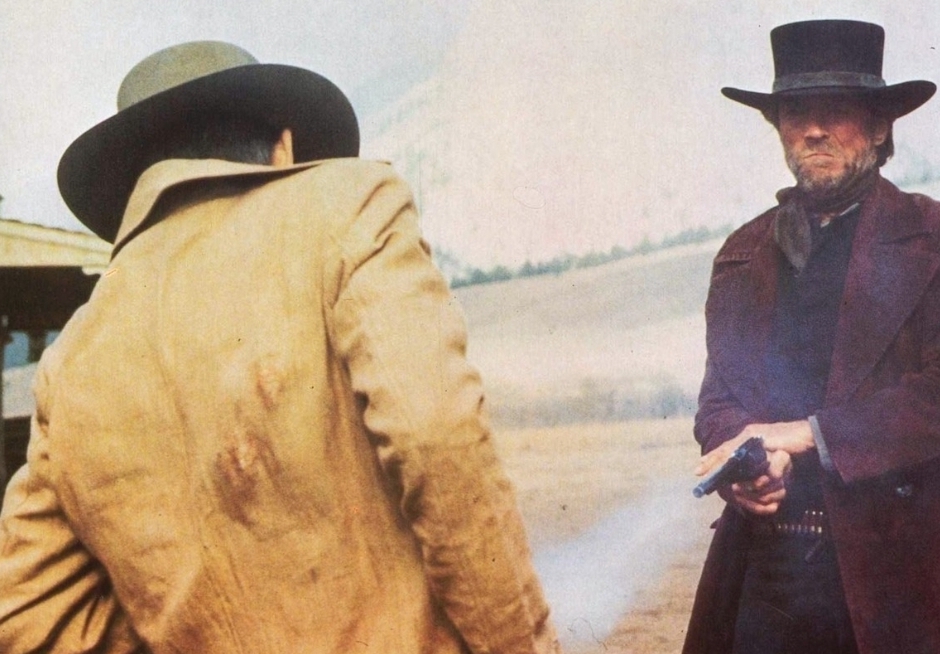
However, it seems that Preacher and Stockburn have something of a history together, something that might have something to do with the cluster of bullet hole scars dotted on Preacher’s back. However, the “lawman” refuses to believe that this could be the same man he once encountered because that man is dead. Isn’t he?
There are many things Pale Rider should be lauded for (and I’ll get round to them in just a minute), but long time watchers of revisionist westerns will probably know that originality isn’t quite one of them as the movie reworks a lot of themes from Eastwood’s earlier High Plains Drifter. Both feature scowling gun-twirlers seemingly returning from the dead to settle up some unfinished business and said business is eventually settled with the judicious use of bullets, but placed side by side, the differences between the two are more apparent.
While High Plains Drifter is the far more nihilistic of the two (Eastwood’s stranger returns to heap endless indignities upon a corrupt town that failed him), Pale Rider paints a far more benevolent and hopeful picture, casting the mysterious outsider as more of a protector than one dedicated at restoring order through cruelty. The switch in temperament is echoed by the change in temperature, with the former film set in blazing desert and the latter set in the crunching snows of a frontier winter, almost if the cooling of the stranger’s rage has affected the weather.
From there on in, things follow a fairly standard path, with the Preacher protecting the miners while the forces if greedy men move against them, but it’s often not the stiey that makes a western rather than the feel of it – and Pale Rider feels pretty good.
Leaning hard on the mythic end of the scale, Eastwood does everything he can, save having the Preacher wear a sign saying “‘I’m a ghost”, to suggest that his hero has emerged from somewhere far more remote than the American wilderness and he even has the “and I looked, and behold a pale horse” bible passage read out aloud when the Preacher rides into the settlement.

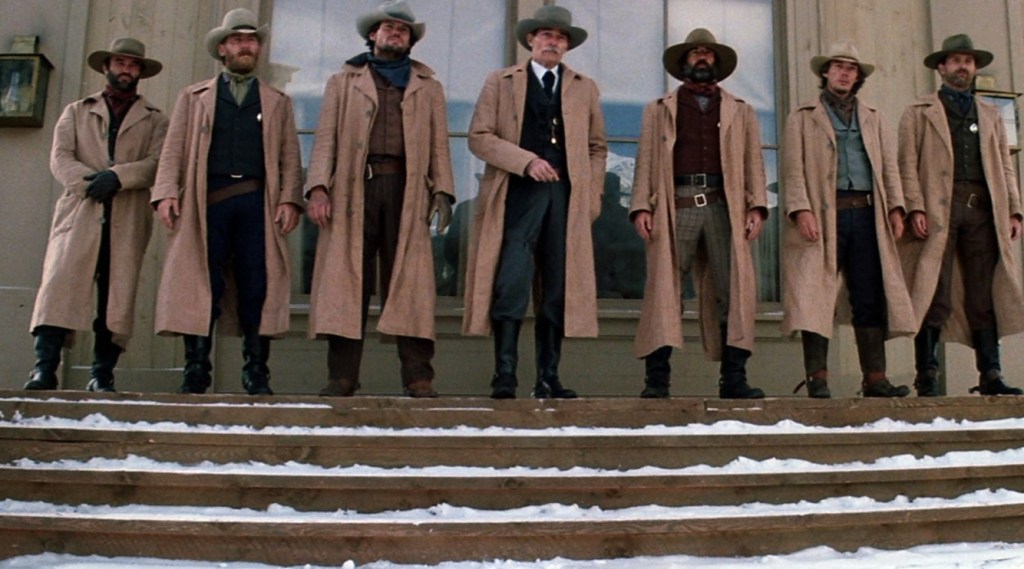
Elsewhere, side characters sport the sort of harsh facial features that would make his old mentor, Sergio Leone, proud, or contain other, memorable, visual flourishes – Stockburn’s six, identically dressed deputies, all lined up in a row us a genuinely unnerving sight. Also adding to a well measured, yet unhurried, pace is some magnificent surroundings that present a feeling of eerie calm between the odd bursts of brutal violence and some solid performances from the likes of Richard Dysart, Michael Moriarty, John Russell and, of course, big Clint himself.
It isn’t perfect, however. While the Preacher’s final deconstructing of Stockburn’s deputies seems weirdly easy, a far more disconcerting subplot lurks in the background that almost feels that Eastwood is overcompensating for his advancing years (55 at the time). Not only does it turn out that Carrie Snodgrass’ Sarah falls utterly in love with some random guy who literally just rides into town when Hull has been working his ass off to provide for her, but her barely fifteen year-old daughter has the major hots for him too – and it’s not just a small detail either, it’s a massive plot point that causes jealous friction between Megan and her mother. While the Preacher thankfully disuades the fourteen year old from yearning after a ghostly man of the cloth who is old enough to be her grandfather, it still feels awkwardly out of place and doles a hefty amount of disrespect to the hardworking and thoroughly decent Hull too.
Still, distracting, and somewhat dubious, subplots aside, Pale Rider is a rousing entry to Eastwood’s sizable contribution to the western genre that reworks an overused story to thrilling effect and does it in a way that’s far more hopeful than your average, vengeance-fueled, trigger puller. This Pale Rider is definately a smart horse to bet on.
🌟🌟🌟🌟
 We Have Issues