
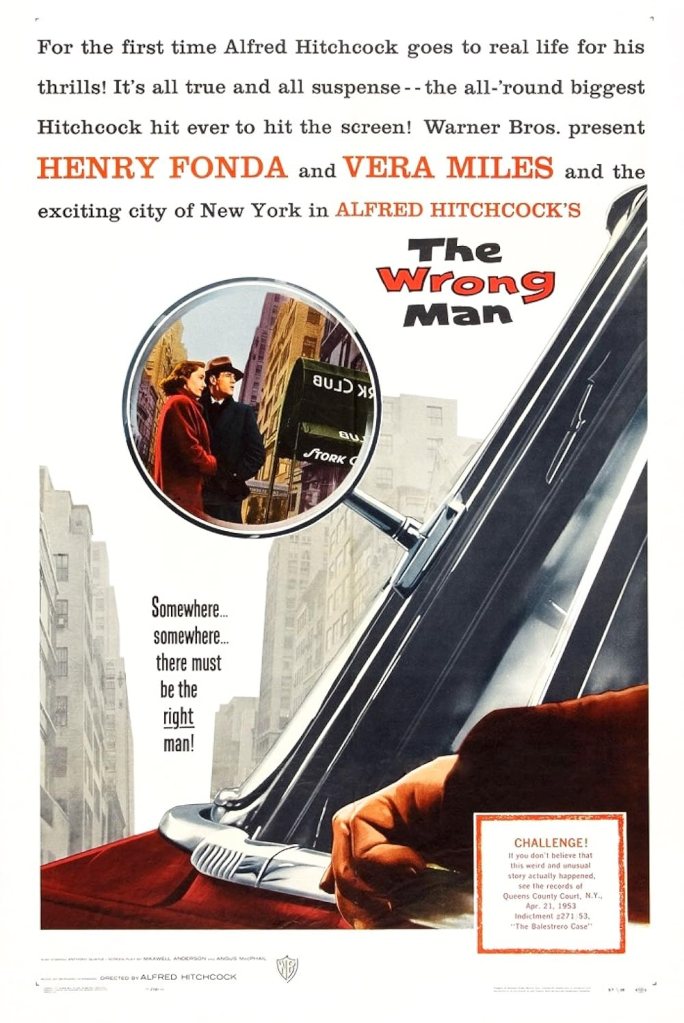
Alfred Hitchcock is, was, and ever will be revered as the Master of Suspense as his countless thrillers allowed him to play merry Hell with the medium of film in order to shock us, trick us and generally yank the rug of expectation out from under us in order to gleefully knock us for a loop. However, 1956, he set himself a new challenge that handcuffed his usual, extreme urges to a radiator made of a substance he’d never tried to play with before – reality.
Generally recognized as Hitch’s sole movie where it’s overtly based on true events (Psycho’s connection to Ed Gein was tenuous at best), The Wrong Man forgoes any huge narrative twists and grandstanding set pieces in order to instead plonk you into a nightmare senario so potentially bland and everyday, you can’t help at break out into a sweat, even though nothing overly strenuous is occuring on screen. Critics in the past have jokingly described it as Hitch’s “least fun film”, but that’s only because the director’s usual flights of fancy have been dial down to hammer home a sobering point. This shit could happen to you.

Christopher Emanuel Balestrero – Manny to his friends – is the sort of average joe you share the sidewalk with everyday as he works long hours to fend for his family. Working nights playing the cello in a club band, he barely earns just enough to help keep his wife, Rose, and his two boys living a decent life, but when his spouse reveals that they need $300 to get her impacted wisdom teeth sorted out, the couple look into borrowing money of her life insurance policy.
However, popping into the life insurance office to innocently inquire causes a cavalcade of events to unfurl that casually drops Manny into a,waking nightmare. You see, plaguing the area recently has been a rash of stick ups perpetrated by one man and either due to the clothes he’s wearing or the way he holds himself, the rather hysterical staff become convinced that Manny is the guy. After he leaves, the cops are called and before you know it, poor Manny is being frog marched into a squad car by three burly detectives who are already certain they’ve got their man and before you know it, the circumstantial evidence is mounting up good.
After repeatedly getting picked out of line ups and finding that his handwriting matches the perpetrator’s worrying closely, Manny finds himself arrested and put in jail for a crime he didn’t commit and as time goes on, he finds that fate and circumstance seem to be worryingly against him.
After barely making bail and securing a helpful, but inexperienced lawyer, Manny has to chance his arm with the legal system, but with a lack of witnesses at hand, and Rose’s rapidly deteriorating mental state, things look bleak for this random guy thrown into a waking nightmare.

With The Wrong Man, it really does seem that Hitchcock was giving himself as little wriggle room as possible in order to indulge in his usual line of cinematic trickery by deliberately hamstringing himself with the constraints of trying to tell a true story as pointedly as he can. It’s a fascinating experiment, and one that impressively pays off as the relatively straightforward nature of the story manages to create a whole new line of tension from the auteur’s usual flamboyant theatrics. Instead of wowing and stunning audiences with his usual deployment of twists, turns and precision camera work that leaves you wondering what’s going to happen next, he fashions the drama in such a way to condition you in thinking – holy crap, this could happen to anyone!
As if to drive that fact home with the force of a thousand ironies, The Wrong Man ingeniously casts Hollywood’s go-to bastion of truth, decency and downright niceness, Henry Fonda, as the beleaguered Manny. While other directors might have worried that Fonda being collared for a string of robberies when its obvious he’s a mild mannered family was simply way too far fetched for audiences to fully buy, Hitch positively leans into it, knowing that he’s protected by the fact that this is a true story. “Ah”, he hypothetically states in that slurred, jowly drawl of his, “if someone as obviously honest as Fonda can be railroaded into going to jail for simply looking like the guilty party, then surely can’t we all?” – and you know what? The tricksy son of a gun is absolutely right.
All Hitch does, plotwise, is to simply lay out the facts in a manner so plain and simple, that times the film shifts from a drama/thriller into a glossy, Hollywood reenactment that soberly recounts the procedural aspect of the police work in an almost leisurely pace. However, the effect is a slow burning feeling of dread when you realise that, from the cop’s point of view, thing are actually adding up and pointing the finger at an innocent man.

Fonda is great, underplaying everything almost as if he can scarcely believe what’s happening to him and the choice to keep him virtually shellshocked and compliant as his workd crumbles is made all the more chilling than having him fly off into wall thumping, bar rattling theatrics and impassioned screams of “I’M INNOCENT!”. Joining him in this well behaved madness is Vera Miles’ Rose, and while she gives capable support, her “sudden” nervous breakdown isn’t really given the space it needs to breathe and as such feels more like a random side quest to keep the pressure building on Manny. However, providing a sense of hope is Anthony Quayle’s level headed attorney, but even his pragmatic advise doesn’t dull the disbelief you feel when Manny and Rose still have to source their own witnesses for the trial.
While locked into dedicatedly telling this story as truthfully as he can, Hitch still manages to find room for the occasional spot of bravura filmmaking that mischievous, rotund man is so beloved for. When the reality of this bizarre situation finally hits a poor, stunned, Manny when his jail door slams shut, Hitch leaps into the fray, twirling the camera in circular, sickening motions while nausea wallops our hero like a Mac truck. Later, the camera glides in and out of the narrow slit in the cell door to truly allow us to writhe in the claustrophobia as Manny’s panic swells and as we approach the rather sudden denouement, the grand master treats us to a masterful dissolve that sees Fonda desperately praying in close up slowly merging with a shot of the actual robber walking up a street until their faces (whose similarity is what’s caused the whole mess in the first place) shift from one to the other – thus laying out the entire movie in one visual effect.

A more serious Hitchcock makes for a more intriguing cinematic experience (although he still manages to squeeze himself in in a silhouetted introduction), and while film isn’t usually held up alongside some of his best, The Wrong Man contains the right stuff.
🌟🌟🌟🌟
 We Have Issues