

Give Alfred Hitchcock a decent plot and the man was untouchable – his intuitive use of the camera would certainly guarantee that – but give him a truly world class script and the rightly christened Master Of Suspense would attain near God-tier status when it came to the juicy ins-and-outs of murder. Never is this more evident than with the taught, tense, yet strangely playful Strangers On A Train, that armed the rotund auteur with a screenplay co-wrote by none other than Raymond Chandler and saw him wrangle perhaps one of the most famous concepts of his career.
In many ways, the curious, salacious tale of a random meeting that leads to a web of murder and deceit, is the ultimate Hitchcock film that sees a hapless, everyday joe suddenly thrown into an upside-down world where paranoia rules and their brow sees a constant sprinkling of sweat adorn it as matters get ever more desperate, so hop aboard and prepare to get familiar with one of the filmmaker’s best.

Guy Haines seemingly has it all – an aspiring tennis player who has plans to move into politics and is on the verge of marrying Anne Morton, the daughter of a US senator – but there’s a major hurdle standing between him and seemingly achieving hapiness: his promiscuous, estranged wife Miriam. When she isn’t spreading herself around like margarine, she’s plotting to make Guy’s life as awkward as possible and when she discovers she’s pregnant (not by him), she intends to put the divorce on hold in order to squeeze more money out of him. Understandably enraged, Guy can’t help but wonder how easy his life would be if Miriam, and her impossibly thick horn rim glasses, were to be taken out of the picture.
Enter Bruno Antony, a charismatic psychopath who has as tenuous a grasp on reality as Miriam has on her knickers and after a chance meeting on a train, Bruno fixates on Guy’s hatred for his wife as a way to sort out a similar problem he has with his domineering father. Bruno’s suggestion is simple; he’ll murder Miriam and in return, Guy murders his father, leaving both of them utterly free of suspicion – but while Guy brushes off this outlandish ploy as eccentric banter, Bruno seems only too happy to commute to where Miriam lives and strangling the life out of her at a carnival.
However, with the deed done, Bruno now expects a horrified Guy to fulfill his end of a bargin he only listened to humour the random lunatic, and starts putting on the pressure.
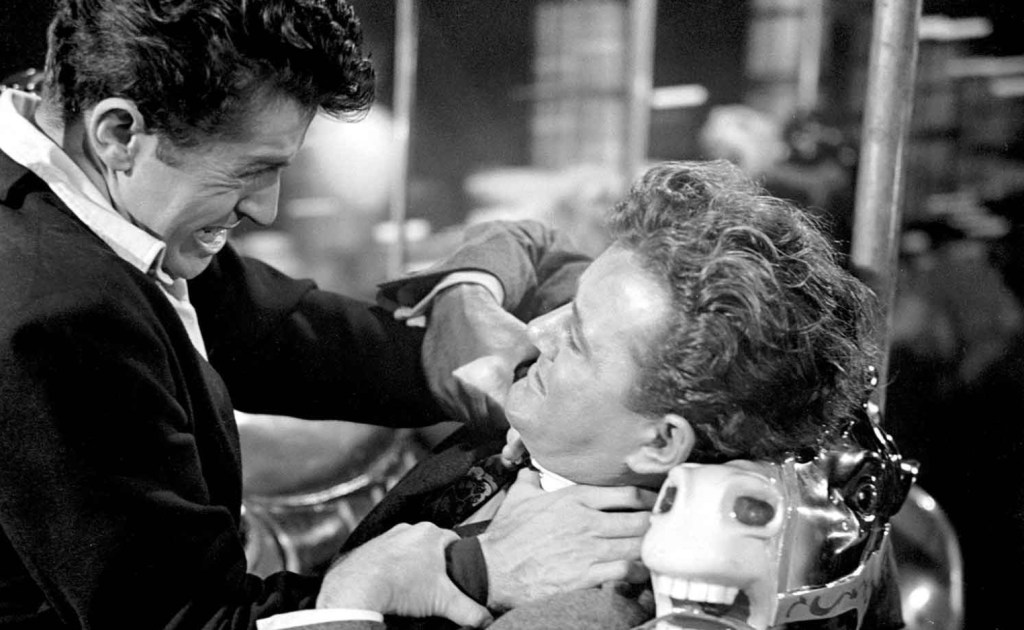
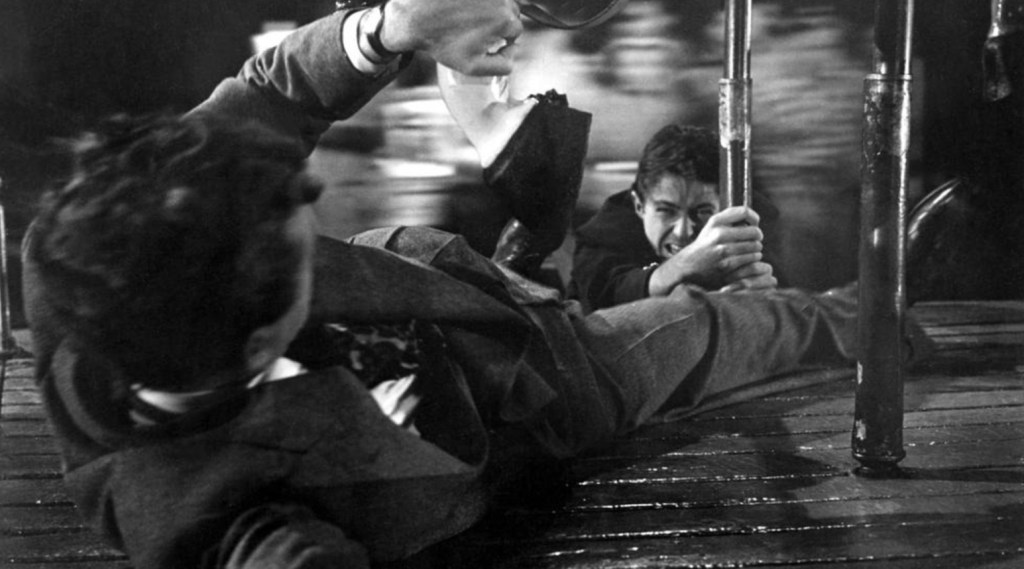
However, when Guy steadfastly refuses to casually commit homicide, Bruno begins a secondary campaign to frame Guy for the murder that was technically committed on his behalf. As the two struggle for dominance, and the police closing in, the two have a final showdown at the fateful carnival that’ll see the merry-go-round, break down – spectacularly.
While there’s an understandable urge to declare other, later entries of Hitchcock’s oeuvre as the ultimate examples of the director’s output (all admittedly valid), in many ways, Strangers On A Train could be described as the Ultimate Hitchcock. There’s a fiendishly complex plot powered by an insanely enticing central concept; there’s a bewildered everyman, stunned at how quickly he’s ended up neck-deep in caca; there’s a deliciously intelligent antagonist who is as overwhelmingly charismatic as he is impressively unbalanced and, best of all, there’s the filmmaker himself obviously having an complete ball while pulling of of his threads as taught as he possibly can. Whether it’s callously laying out Miriam’s indiscretions like a vicious gossip, or making Guy’s existence as claustrophobic as humanly possible, Hitch’s legendarily mischievous streak is in full effect as he takes a casual – if daringly dark – conversation and sends it careening out of control to magnificent effect.
Hitch doesn’t have to lay out Miriam’s murder framed in the reflection of her bizarrely thick glasses, but the fact that he does is incredibly gratifying and he his gift for staggeringly memorable shots is in full effect here like no other. Take the utter flabagasting shot where Guy notices Bruno watching him during a tennis match, his head locked perfectly still on him while everyone else’s turn this way and that to follow the game; or the audacious, early moment where we’re introduced to the clear differences in the two main characters merely by using extended shots focusing on the differences on their shoes.

However, like all the best Hitchcock experiences, the great man doesn’t do it all on his own and he’s bolstered by a cast who are all gifted with cracking roles. Farley Granger gives good everyman (despite being a tennis playing political hopeful) and Ruth Roman is a refreshingly smart female lead, but the real catch here is Robert Walker’s playfully batshit Bruno who genuinely – and gleefully – seems utterly unaware how crazy he truly is. Be it misidentifing a hideous painting of his mother’s as a portrait of his father in a freaky Rorschach effect, or seeming strangely bewildered when Guy reveals he has absolutely no intention of pulling off his end of the bargain (the nerve). Flouncing about the film in grotesque dressing gowns and tie clips emblazoned with his own name, he’s a fascinating creation of playboy insanity and the only other character who can even match him for pure entertainment is Pat Hitchcock’s Barbara, Ruth’s adorably inappropriate sister.
However, as the screws tighten and the tension contracts, Hitchcock realises that the best way to release all in the climax is to go absolutely crazy and provide the greatest action metaphor for an out of control carousel of a plot that he can – an actual out of control carousel. As all the plot threads leads to this truly deranged ending that sees the two players brawling on a dangerously revved up fairground ride, Hitchcock still has a deceptively tight hand on the chaos, spinning out numerous mini-plots within the frenetic action. While Bruno and Guy wrestle over vital evidence, there’s the old carny crawling under the twirling death machine to try and turn it off, there’s the other, screaming patrons clinging on for dear life and, best of all, there’s the small boy who not only thinks that the whole thing is hilarious, but he even gets involved in the climatic fisticuffs.
While you’d fear that the film might have lost its power over the years (especially in the wake of Danny Devito’s loving pastiche, Throw Momma From The Train), even screening it now shows us a Hitchcock at the height of his powers that easily rivals everything else the guy ever made.
Don’t be a stranger – all aboard for a thriller that triumphantly goes off the rails.
🌟🌟🌟🌟🌟
 We Have Issues
Always interesting to learn more about Hitchcock’s pre-Psycho classics. Thank you for your review.
LikeLiked by 1 person