
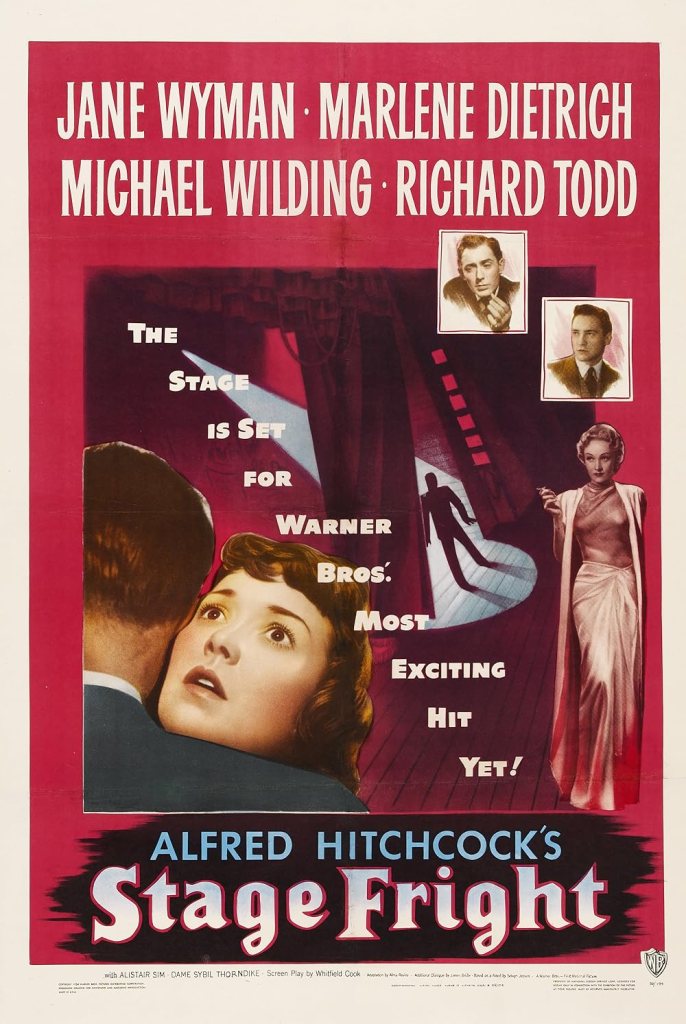
After making a slew of cutting edge thrillers in Hollywood since 1939, Alfred Hitchcock decided to return to home soil to make Stage Fright, a typically twisty outing that takes in all the duplicitous lovers, shocking turns and wannabe murder masterminds you could hope for in Hitch’s particular field. However, considering all the tropes that the director lays out in front of us, Stage Fright proves to be something of a jaunty mystery that, thanks to an ever escalating string of convoluted events, feels more like a spiritual predecessor to rollercoaster ride of Rian Johnson’s Knives Out, than a harrowing delve into the brutality of murder.
Of course, with Hitch at the helm, this is obviously a good thing and while Stage Fright may not have the clout of some of the director’s more well known titles, it still provides all the goods a growing mystery could ask for.
Enter murder: stage right.

Eve Gill is an aspiring actress at the Royal Academy of Dramatic Arts who hopes to hit it big one day with her thespian attributes, but while he big, innocent eyes should be fully locked on the prize, they’re also locked on the dashing form of her friend, Jonathan Cooper, whom she Carrie’s a rather sizable crush. However, her yearnings are about to be answered in the most unlikely way when the object of her affections suddenly turns up, begging for her help.
You see, while Eve lusts from afar, Johnny has been keeping flamboyantly melodramatic actress and singer, Charlotte Inwood, warm at night after becoming her secret lover, but their relationship has taken a rather nasty turn after he claims that the actress came to him in a panic after she confessed that she had just murdered her husband. Obviously further under her thumb than a damn fingerprint, Johnny went back to her apartment in order to get her some non-bloodstained clothes only to be spotted by Nellie Goode – Charlotte’s maid.
Framed for murder and on the run, Johnny begs for Eve to gide him, and so the devout actress helps by stashing him in the coastal house of her eccentric father while they figure out what to do. But while Jonathan pines for his two-faced lover, Eve desides to go above and beyond what’s usually required of friends and vows to get a confession from Inwood any way she can – and so armed with a confidence in her acting skills and a well-placed bribe, she gets herself planted as Charlotte’s new maid to get close to the opportunistic husband Slayer.
However, this is where things get extra complicated, as a kind man she flirted with earlier whom she invited to meet her family, turns out to be one of the main detectives of the case. Can she get the info she needs while avoiding detection – and more importantly, is Jonathan worth all this trouble to begin with?
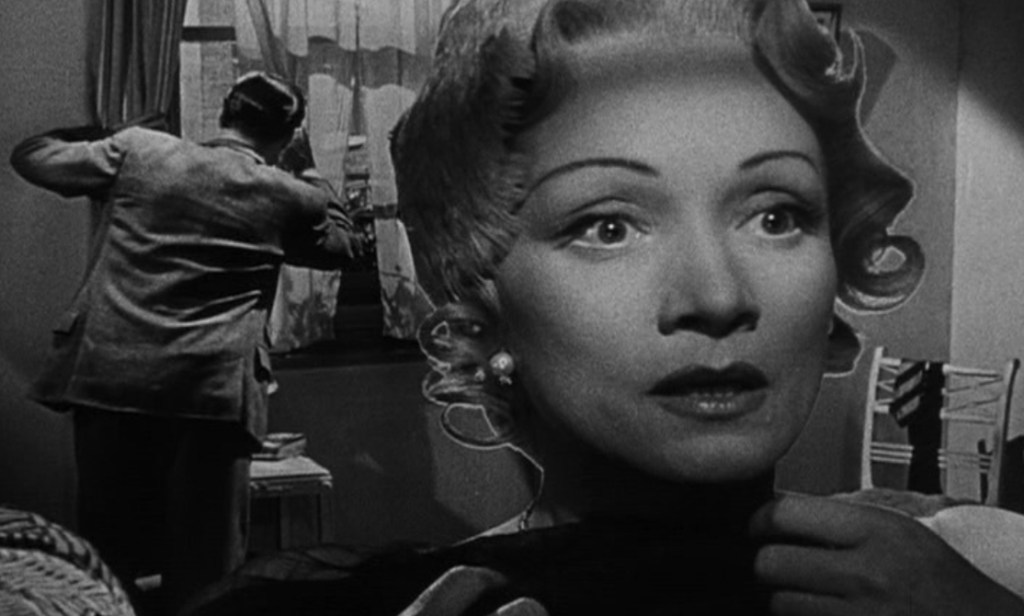
Sometimes it’s just nice to settle down and watch a less-lauded entry in an auteur’s filmography, just to watch them at work without the knowledge that you’re watching a game changing classic. But while Stage Fright may not have the seismic repercussions of Psycho, the technical prowess of Rear Window, or the brain scrambling twists of Vertigo, it greatly benefits by simply being a very good story that’s extremely well told. The tone is light and perky (although not North By Northwest light and perky), it has likable characters, some funky twists that probably play better now than they did in 1950 and a performance by Marlene Dietrich that sees her in top bitch mode as she destroys all before her with a withering gaze or a bombastic put down (“Detectives are just policemen with smaller feet.”).
However, if there’s a weird issue floating around Stage Fright, it’s that apart from the fact that it was released in the same year, the movie shares many odd similarities with that other, shrewd, side-eyed glance a showbiz, All About Eve. Sure, Joseph L. Mankiewicz’s legendary tale is far more interested in the attempt homicide of someone’s career than any actual murder, but both do feature hopeful up and comers named Eve trying to get under the skin of a razor-tongued star and the many sycophants they have to negotiate along the way. While this should be an issue as the two are from completely different genres, there’s still the sense that Hitchcock’s venture weirdly suffers in comparison anyway and thus tends to lurk in the shadows of that unmitigated classic.

However, when taken on it’s own terms, Stage Fright proves to be a delightfully fun murder mystery with Jane Wyman’s constant deer-caught-in-the-headlights expression helping Eve to be an endearing lead. Sure, she inserts herself into the middle of a murder investigation after siding with a guy she’s got the host for (never a wise thing to do in a Hitchcock movie) and sure, she drags her father into his mess without a single thought about the possible legal consequences, but in that gutsy, determined way that female characters tended to be in the 1950s, shes a fetching mix of vulnerability and determination that just has you betting on a happy ending. Her gradual – if risky – dalliance with Michael Wilding’s detective is also rather sweet, even if the actor bears an distractingly uncanny resemblance to Alan Cummings, but it also manages to add extra tendrils of drama when she has to endure the disinterested commands of Dietrich’s mega-diva while simultaneously having to avoid her cover being blown from a guy who is a far better fit for her than Jonathan ever could be.
Dietrich brings her distinct aura to the show and even gets a couple of musical numbers to deliver in that trademark voice of hers. But amusingly, her real life persona seemed to bleed into her character as she is one of the rare actors who had final say how they were filmed as her controlling nature even out-ranked Hitchcock himself.
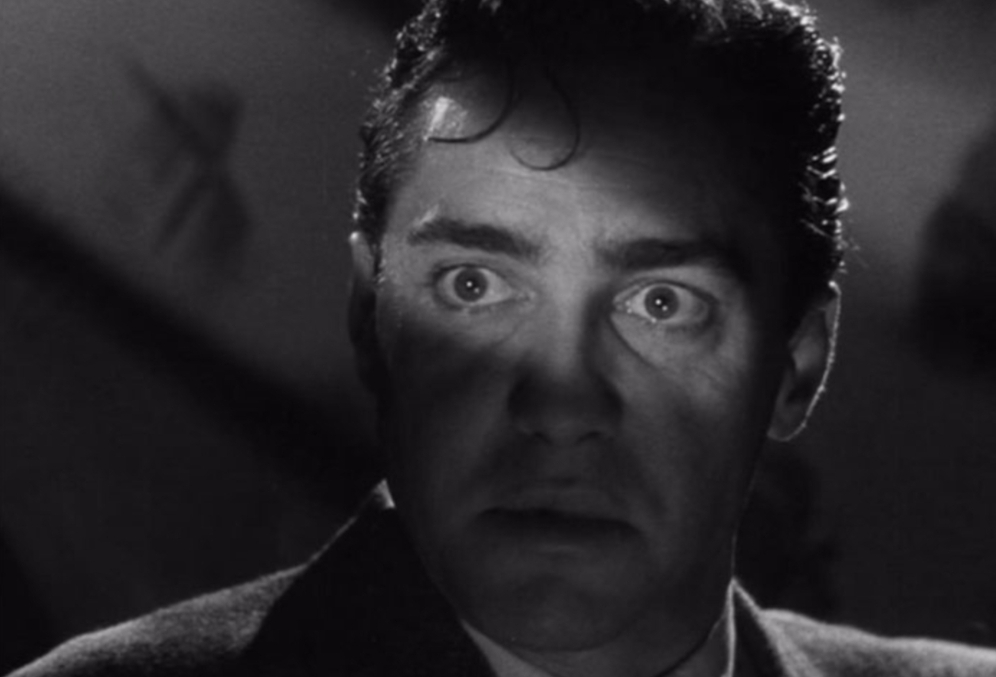
Truth be told, while Stage Fright isn’t quite considered to be included in the upper echelons of Hitch’s work, it’s still tremendous fun with a couple of neat reveals that nicely catch you off guard thanks to Hitchcock simply doing the unthinkable and exposing an vital flashback as an outright lie. However, audiences at the time slightly rankled by being manipulated to that extent which Hitch himself felt that he didn’t pull it off quite right. However, in these modern times when all rules of cinema are regularly rendered as fluid as water, the final twist work fantastically well as Eve almost realises too late that her yearning has led her down a potentially lethal past.
Hardly essential Hitchcock, Stage Fright nevertheless is great fun, especially when its catching its killer quite literally in the act.
🌟🌟🌟🌟
 We Have Issues