While it’s hardly fair to say that Hammer Studios only made endless adventures featuring the antisocial exploits of Peter Cushing’s Frankenstein and Christopher Lee’s Dracula, it is what they’re mostly known for. Never mind the large amounts of weirdo fantasy films they made, or the huge clutch of thrillers they put out, or even the redos of other classic monsters such as Curse Of The Werewolf, The Mummy, or Phantom Of The Opera; the first thing that always springs to mind when someone mentions the iconic studio is those two titans of terror.
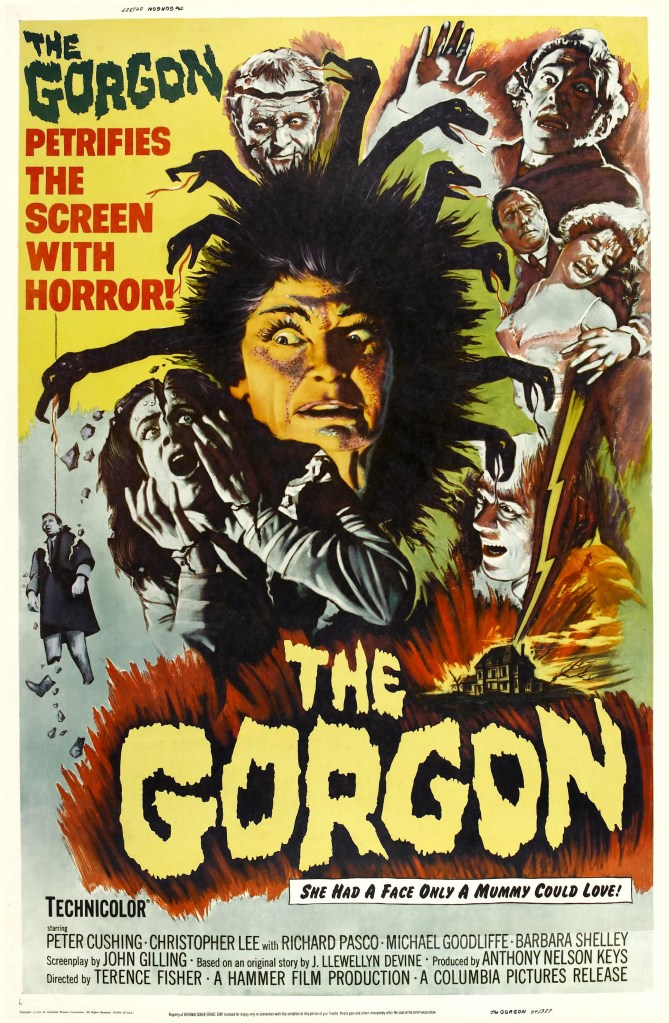
But every now and then, the studio would attempt a production that would forgo pointy fangs and crackling laboratories altogether in order to forge a slightly new path and one of these was Terence Fisher’s The Gorgon.
Yes, that’s right, Hammer once made a movie about that cursed female creature from Greek mythology with snakes for hair and a particularly lethal line in withering stares – but the only problem with this is that their new monster forgot to break new ground…
It’s 1910, and over the past five years the German village of Vandorf has been plagued by no less than seven, baffling deaths where each of the hapless victims has been turned to cold, unfeeling stone. Now, that’s not a metaphor for a spot of emotional coldness, you understand – no, I mean these poor souls have literally been turned to stone and the latest person to fall foul of this malady is a young woman whose lover has recently dumped her for being with child.
After the lover is found hanged, apparently the victim of suicide, the town, desperate for some sort of scapegoat, turn on Professor Jules Heitz, the young man’s father, who vows to get to the bottom of this petrifying mystery and quizzes the local doctor, Namaroff, about the details of these crimes. However, it seems the medical man hasn’t been completely truthful with the local, incompetent, law enforcement and has withheld the fact that the victims have been turning to stone.
In the midst of his search, Heitz finally discovers what he seeks in the dilapidated Borski Castle where lurks the inhuman creature known as a Gorgon, whose spirit inhabits some poor soul every full moon and roams around, giving a literal death stare to anyone she happens to come across. Of course, the downside to this is that Heitz catches a glimpse of those peepers and soon gradually turns to stone; but in the time time it takes for him to fully solidify, he managed to get home and scrawl a three page letter to his other son, Paul, in order for him and his tutor, Professor Meister, to come and untangle this deadly riddle once and for all. However, upon arriving, Paul soon falls in love with Namaroff’s beautiful assistant, Carla, who suggests that her boss may know something about the Gorgon that he’s not letting on and if something isn’t sorted out soon, more people will undoubtedly be left stoney faced.
At this point in his Hammer run, Terence Fisher was on something of an impressive hot streak after not only successfully reimagining a clutch of famous monsters for a whole new generation (not to mention Sherlock Holmes), but his lush, atmospheric style had pretty much become the blueprint for every subsequent horror flick that the studio would release from 1957 onwards. In fact, a good, modern analogy would be how Jon Favreau’s Iron Man dictated the entire tone of the MCU moving forward as it pretty much had the exact same effect on the entire output the studio had every since.
It’s this steady hand that drives The Gorgon, but in a strange twist of irony, there’s a distinct feeling that the movie may have been far more memorable if it had broken the Hammer blueprint and strived for something completely different. It’s not that Fisher was a predictable director, buy any means; for example, his approach to the werewolf myth in Curse Of The Werewolf is quite unlike any that’s come before or since and every one of his Frankenstein pictures is subtly different – but bizarrely, Hammer’s attempt to tackle an entirely different myth altogether suffers from altering things to fit what they could reasonably afford.
For a start, plonking this creature from Greek mythology into a German village may have saved a few quid on sets and costumes, but it also immediately means it visually resembles 80% of every horror film Hammer ever made. Also, when trying to concoct a sufficiently creepy backstory for a rare, female monster, the script just chops and changes in details from vampire and werewolf mythology, having the Gorgon haunt a castle, only appear during a full moon and have an unknowing, innocent, human persona whom you’ll probably guess in about four seconds flat. Plus, once you add in some other Hammer traits like a blustery professor, a secretive doctor, a doomed romance and a handful of angry villagers, at times you’ll wonder why Fisher and Hammer bothered to “create” a new monster at all. However, while The Gorgon admittedly suffers from overfamilar- itus (not a real illness), the director is far too hood at his craft to let the enterprise become a complete waste.
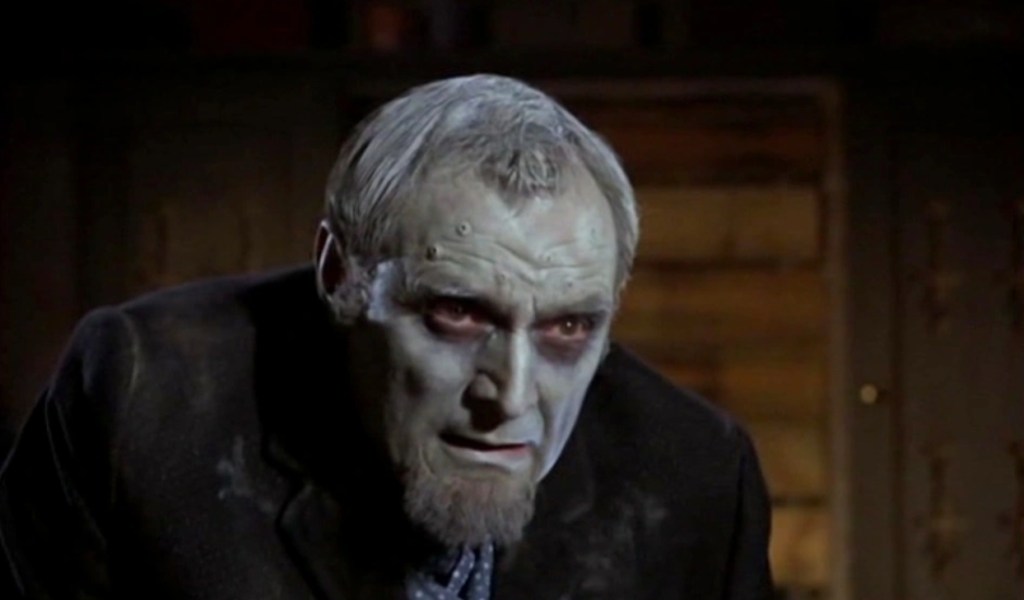
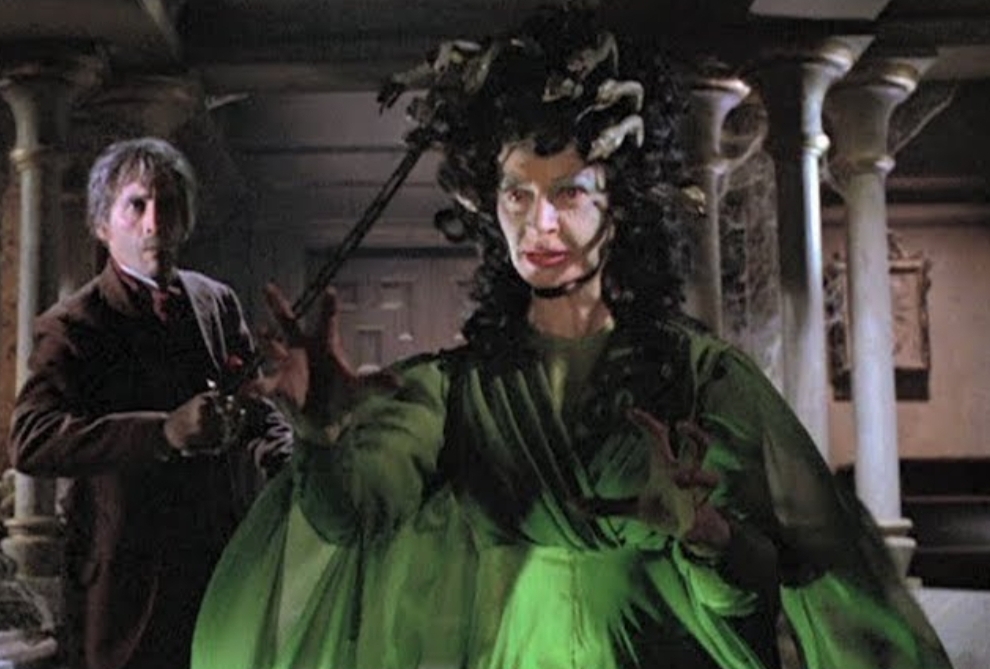
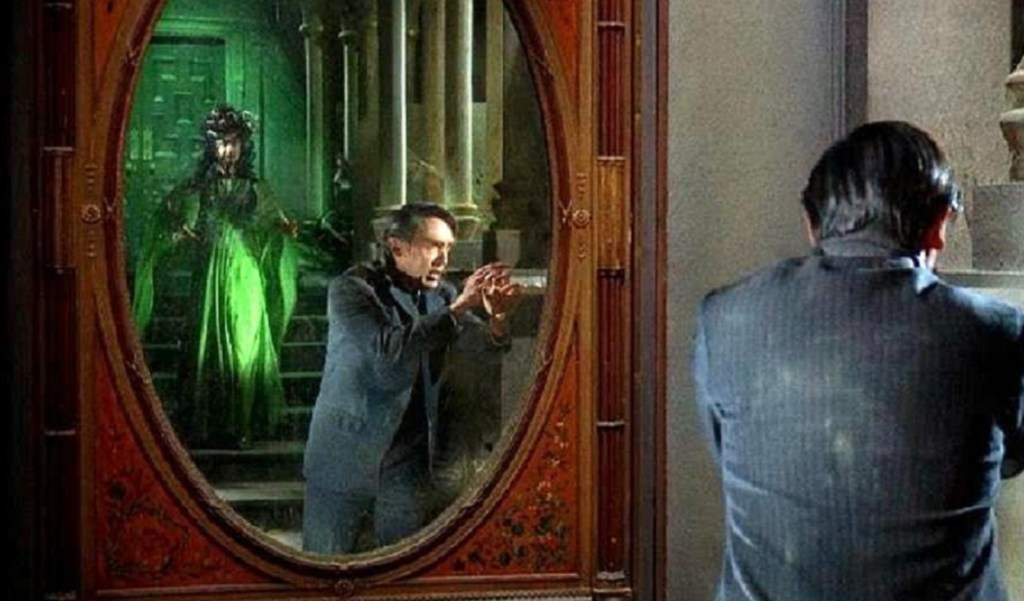
For a start, Fisher knows atmosphere like Michael Bay knows explosions, so that lush sense of technicolor dreas that the director can conjure so effortlessly is in full effect and with it comes some genuinely memorable images. Yes, the Gorgon herself with those obviously rubber snakes spasming and jerking comically on he scalp may pale horribly compared to the iconic, Ray Harryhausen version seen in Clash Of The Titans, but the short where Paul look down into a puddle to see her looming over him in the quivering reflection is a doozy of a shot and is creepy as hell. Similarly, the concept that it takes a good hour or so to fully turn to stone is actually quite gnarly when you think about it and even smeared in grey face paint, Michael Goodliffe sells the absolute fuck out of it while his character struggles to write one final letter to his son.
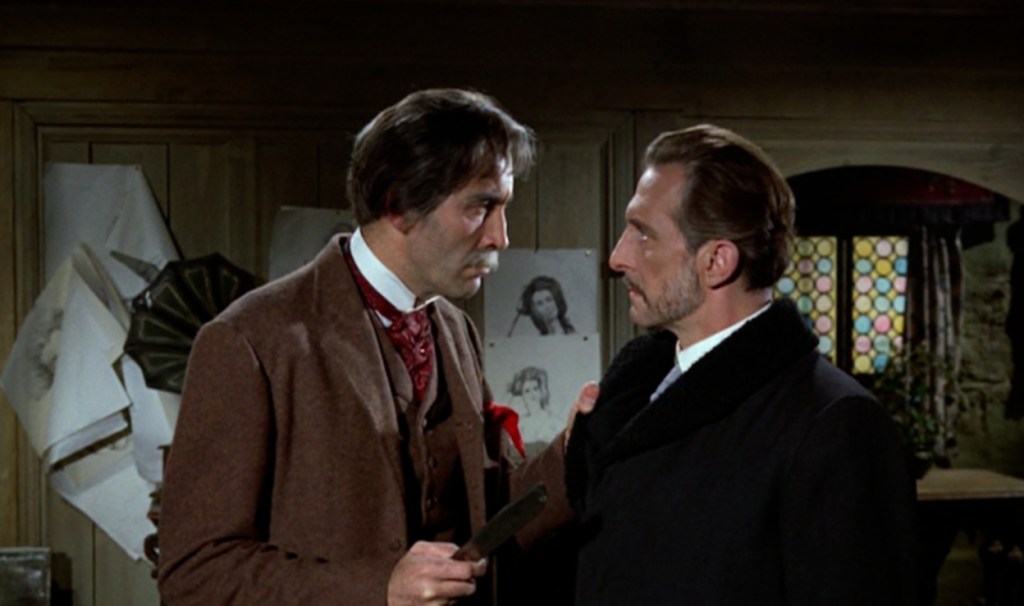
Also, we once again have that unbeatable duo of Christopher Lee and Peter Cushing on screen together again and it’s nice to see their roles reversed slightly as it’s the former who plays the fatherly, Van Helsing type this type, while Cushing plays the secretive doctor. Even though their screen time together is brief, they also get to trade a couple of delicious barbs, mostly at the expense at Patrick Troughton’s ignorant policeman – also the character isn’t turned to stone, Lee’s disdainful remark of “Don’t use long words, Inspector; they don’t suit you.” is far more fatal than a glance from a Gorgon could ever hope to be.
Not Fisher’s best by any means, but this attempt at adding a new creature to Hammer’s pantheon proves to end up like the Gorgon’ victims: decidedly solid, if a little devoid of life.
🌟🌟🌟
 We Have Issues