
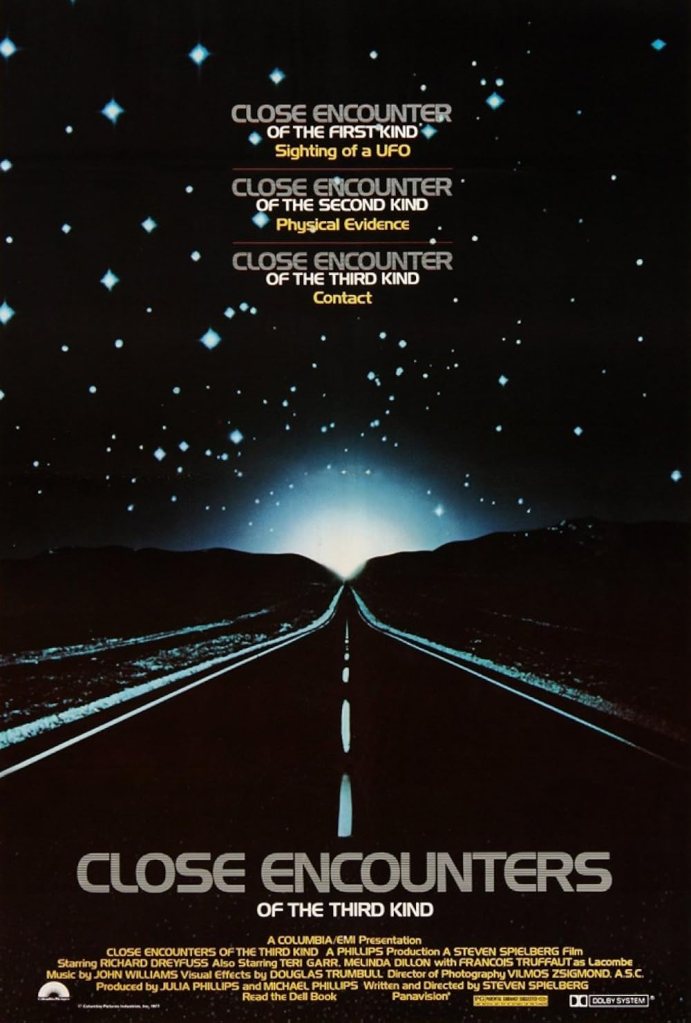
You know that feeling when you sit down to watch a movie that you’ve taken for granted since forever and you suddenly say to yourself “hold on, have I actually ever seen this movie?”.
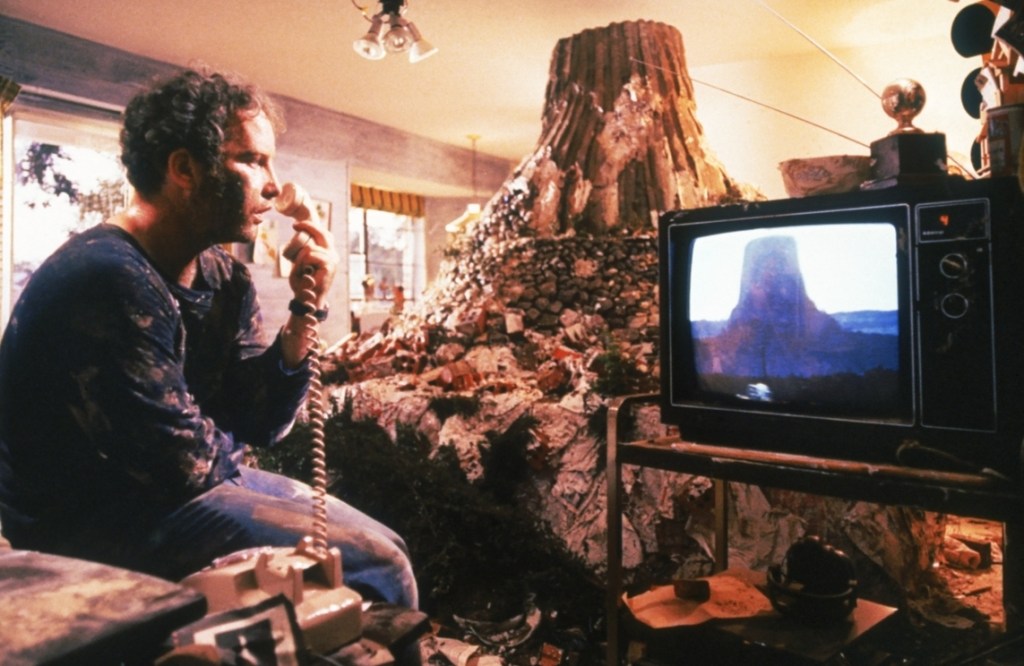
Well, that was me thanks to a recent viewing of Steven Spielberg’s glittery goggle-fest, Close Encounters Of The Third Kind where, much like Richard Dreyfuss’ erratic protagonist, Roy Neary, I was dropped feet-first into a beguiling experience I had never technically seen before. Oh, I’d seen the highlights, of course – the first contact on a night road, the mash potato sculpture, the ending that resembles a particularly ambitious ELO gig – but when it actually came to watching the thing as one long experience I soon came to realise I was a novice.
Of course, this isn’t necessarily a bad thing – I mean, how often do you get to watch a stone cold classic that’s nearly as old as you are with entirely new eyes? This was not a hurried chance to fix my cinematic inadequacies; this was a chance to see a wonderous something I had never truly beheld before. Spielberg would approve.
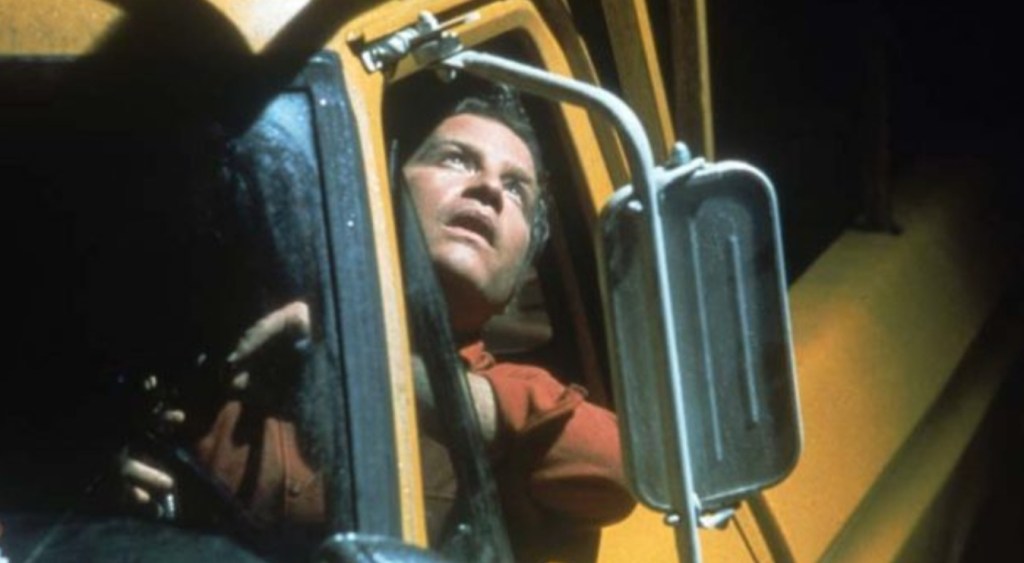
Roy Neary is your classic, 70s, Spielbergian leading man. He has a blue collar job (electrician), he has an expansive family and his house constantly looks like a bomb has hit it thanks to the chaotic rampages of numerous, noisy children. However, one night, while he’s out investigating the numerous, rolling blackouts that have been plaguing Indiana, he has an encounter with a cluster of glowing phenomena that changes his outlook on life entirely. Becoming rapidly obsessed with his experience and desperately trying to comprehend what he saw that night, Roy gradually starts alienating his disinterested wife who simply just can’t comprehend the mania that her husband is experiencing.
However, Ray’s encounter and his ensuing mania isn’t just a coincidence as a team of scientists led by Claude Lacombe have scoured the globe and have theorized that other worldly life is about to make contact with us with all the clues they’ve left strewn around. On top of this, those that joined Roy in witnessing what he saw that night – including single mother Jillian – have been experiencing subliminal visions of a distinct mountain shape and soon, once he figures out that it’s an actual place named Devil’s Tower in Wyoming, he sets out to finally get himself some answers.
It certainly won’t be easy, especially seeing as the government has set up a whole load of cover story bullshit to mask this unprecedented opportunity. Can Roy and Jillian – whose son has been abducted by the space faring critters – make it to Devil’s Tower in time to witness possibly the most important event in all of human history?

We all know that Steven Spielberg is a talented director, right? I mean, that’s a given considering his incredible range; but even with that in mind, I was still surprised by the fact that Close Encounters Of The Third Kind managed to play more emotional notes in such rapid succession than that iconic five-note tune the aliens (and John Williams) use to communicate. On one hand, it contains the exact kind of wide-eyed, slack-jawed wonder the director later broke out in E.T. and Jurassic Park to similarly enchanting effect, but on the other, the movie has a really gritty, almost realist, edge that features overlapping dialogue and scenes of scientists casually spouting facts that you couldn’t possibly hope to follow. As a result, this movie features a starker, often colder feel than, say, the more populist stylings of Jaws or Raiders If The Lost Ark and instead tonally feels more like something one of his peers like Scorsese or Coppola would attempt.
The main reason for this is the approach Spielberg’s script takes with Richard Dreyfuss’ lead that certainly pull any punches when it comes to offering some insight into an ordinary man recoiling from an extraordinary happening. While a later Spielberg might have diluted Roy’s ensuing mania, here his rapid descent into obsession is seen as something that needs to the bitter end and it’s a little weird that the movie seems to cheer him on while he essentially ditches his family to chase his dream. In the movie’s defence, his wife and kids are horrible and amusingly seems to be the inverse of the similarly chaotic family unit of E.T. which gets treated way better. It’s like the movie is one GIants metaphor for following your dreams at all costs and while it certainly matches the sort of approach Spielberg probably had back in the earlier days of his career, modern audiences might be a bit taken aback about the director enthusiastically giving the thumbs up to someone sacking in their entire life to chase UFOs.
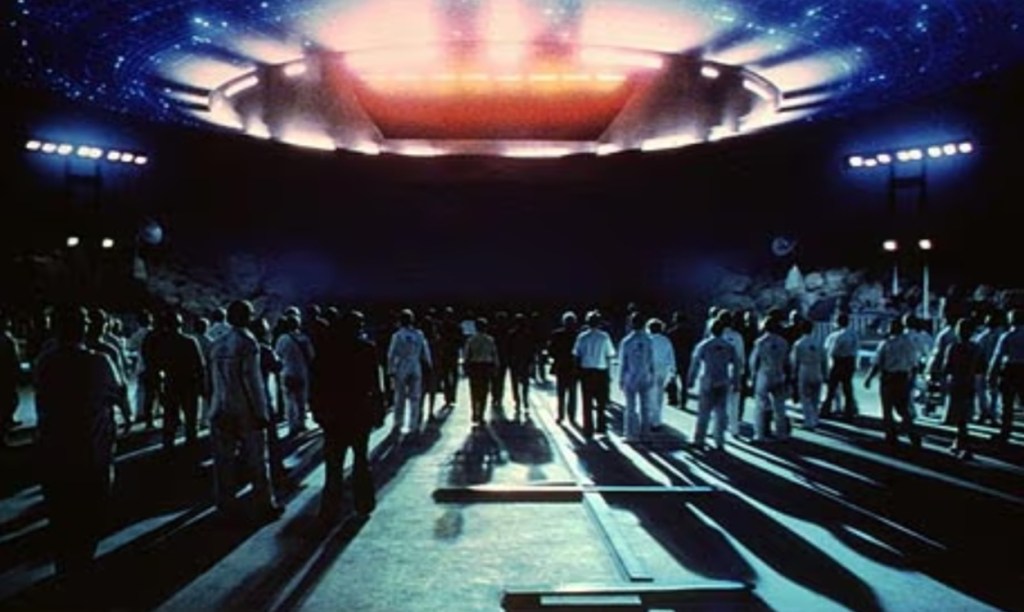
Thankfully, the movie justifies this rather novel approach by firstly giving us some genuinely astounding visuals to convince us that ditching Terri Garr’s unimaginative spouse is absolutely the right thing to do that somehow still hold up despite being crafted in 1977. Secondly, it helps immensely that the impulsive and abrasive Ray is played by Richard Dreyfuss who made something of a career of making impulsive and abrasive characters relatable. While it’s endlessly upsetting to see him without a beard (think Jason Statham with hair or Burt Reynolds without his moustache), freed from having to share the screen with Roy Schieder or Robert Shaw, the actor throws himself into Roy’s borderline mental breakdown with the usual, energetic flair he brings to everything. As a result, virtually no other character, aside from possibly François Truffaut’s endlessly rational scientist, has even a remote chance to resonate – but that only heightens Roy’s determination more.
But like I said – if Spielberg didn’t get ILM to produce the goods, then Roy’s journey would have been rather horrible to witness so props have to be given to the effects house (still in its relative infancy) for making the impossible possible. Be it the moment when Roy first sees the rainbow coloured scout ships whizzing by his truck (the shot of the alien’s “headlights” rising into the sky through his back windshield is marvelous), or the edibles demanding climax that sees a gargantuan mothership lazily roll over to point it’s glittering, Disney World-type spires to the heavens, the movie never fails to astound (although the aliens themselves are admittedly a little… halloween costumey?), but rest assured that Spielberg doesn’t hide behind his effects team. Even without groundbreaking effects at his command, the director orchestrates a never ceasing string of amazing compositions to bulk up that simplistic story – in fact, the shot of Devil’s Tower on a television in the foreground of the massive replica he’s made in his living room may actually be one of my favorite shots of his that I’ve ever seen.
Believe the hype, embrace the wonder and prepare to hum that five note tune to the end of eternity because this is the real deal, whether its your one hundredth encounter or your first….
🌟🌟🌟🌟🌟

 We Have Issues
Thank you for your 5-stars rating (I give it the same) and review of the first sci-fi film that my parents took me to see when I was 7 years old. ⭐️⭐️⭐️⭐️⭐️
LikeLiked by 1 person