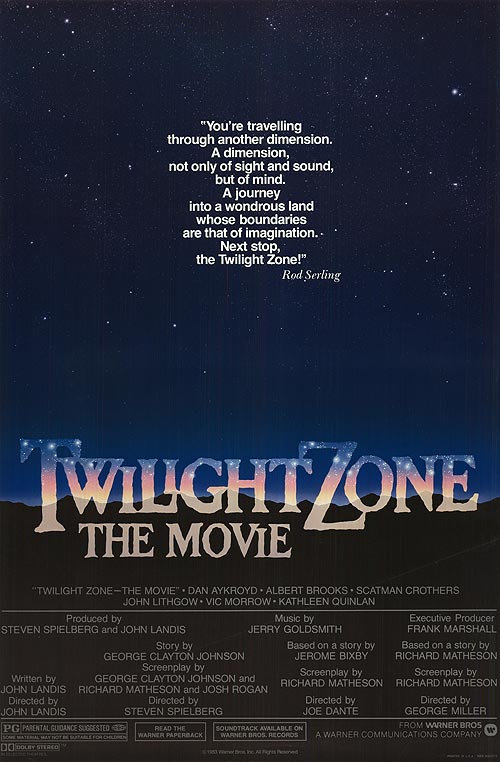
“You are about to enter another dimension. A dimension not only of sight and sound, but of mind. A journey into a wondrous land of imagination. Next stop, the Twilight Zone.”
So began the clipped, super-serious narration by Rod Serling for his ground breaking anthology show, which blended more sci-fi/ horror twists than a M. Night Shyamalan marathon and inspired a whole slew of future filmmakers. In fact, it inspired them so much that Steven Spielberg and John Landis decided to hired two more of their peers and do a movie version that updated their favorite stories for 80s audiences.
However, in a strange and oddly chilling turn of events that eerily echoed the kind of rug pulls you’d find in the Twilight Zone itself, the movie was hit with a shocking tragedy that still incur debate today and thus stands as one of the most fractured anthology movies that’s ever existed. So buckle up and brace yourself, because we’ve now set course for that dimension of imagination and just crossed over into the Twilight Zone.
You wanna see something really scary?

Our quartet of tales starts with “Time Out” when we’re introduced to the bigoted Bill Connor who can’t help loudly spewing his racist views to anyone within earshot after he’s passed over for a promotion in favour of a Jewish college. However, after leaving the bar, he suddenly finds that he’s going to get a painfully lesson from the wrong side of history where he suddenly finds himself slipping back through time to Nazi-occupied France, 1950s Alabama and the Vietnam war. However, the twist is that the people he comes across during these periods only see his as Jewish, black or Vietnamese respectively, which gives Bill a history lesson he soon won’t forget – or survive.
Next is the gargantuan tonal shift of “Kick The Can” where a old folks home full of youthful minded pensioners are given a new lease on life thanks to the mysterious Mr. Bloom – but as my doctor has informed me that I have to keep my sugar levels down, we’ll quickly move on from that saccharine adventure and plough right into the good stuff.
In “It’s A Good Life”, aimless teacher Helen Foley literally runs into an intense little child named Anthony who accepts her offer of a lift home, but when she gets there she finds that his nervous, jittery, eager-to-please family something of a overwhelming red flag until she finds out the sobering truth. Anthony has the God-like ability to alter reality at will and what Anthony wants, Anthony gets.
Finally, we take a stormy, rain-lashed trip with “Nightmare At 20,000 Feet” as the hapless John Valentine writhes in the grip of an endless panic attack as his fear or flying takes devastating hold. But worse than his manic, sweat-soaked anxiety is the fact that he’s become convinced that there’s a strange, cone-shaped creature fucking around on the wing of the plane and if it isn’t stopped, doom with surely come for every single passenger on board. So pretty much every EasyJet flight ever, then…

So we unfortunately can’t address Twilight Zone: The Movie without bring up the tragic accident that saw actor Vic Morrow and two child actors killed during a helicopter crash that occured while film John Landis’ segment and as a result, the ominous spectre of actual death renders the first segment an uncomfortable watch for numerous reasons. Obviously the accident was avoidable enough that legal action was (unsuccessfully) directed at Landis, but it also renders the truncated story into an ugly and weirdly pointless story filled to the brim with Morrow having to utter a near endless stream of racial slurs before his character is sent through an educational time stream that eventually sees him begging for his life while he’s carted away to a Nazi death camp. Even if the tragedy hadn’t happened, there’s a sense that “Time Out” probably would have been the odd story out even if the tragedy hadn’t occured and even Landis’ magnificent pre-credits sequence featuring Dan Ackroyd and Albert Brooks can’t balance out the bad taste left in the mouth.
In fact, the damage from “Time Out” was so great, it drifts into Spielberg’s “Kick The Can”, a course correct so clumsily handled and so mawkish, it slows the film to a grinding halt. Story goes that the legendary director chose the agonisingly sentimental tale as an immediate response to Landis’ accident but the fact that his segment is noticably worse than one where people were actually killed may be one if the biggest surprises that the Twilight Zone has ever pulled off.

However, once we head into the second (read: unproblematic) half of the movie, things change for the better at an exponential rate. While Joe Dante (not long off The Howling) and George Miller (fresh off the first two Mad Max movies) may have been considered the “lesser” directors compared to Spielberg and Landis, they certainly understood the assignment way more and as a result, their movies may be the two best anthology segments ever put to film.
It certainly helps that the episodes they chose to remake are absolutely top tier and are legendary in their own right, but Dante unleashes the full force of his Looney Tunes sensibilities onto “It’s A Good Life”, turning the story of a reality altering moppet into a multicoloured nightmare absolutely loaded with freakish visuals. The sight of a nervous Kevin McCarthy unknowingly pulling a giant, mutant rabbit out of a hat is fucking resplendent and it’s followed with a Rob Bottin created television monster that whizzes around the room like the Tasmanian Devil.
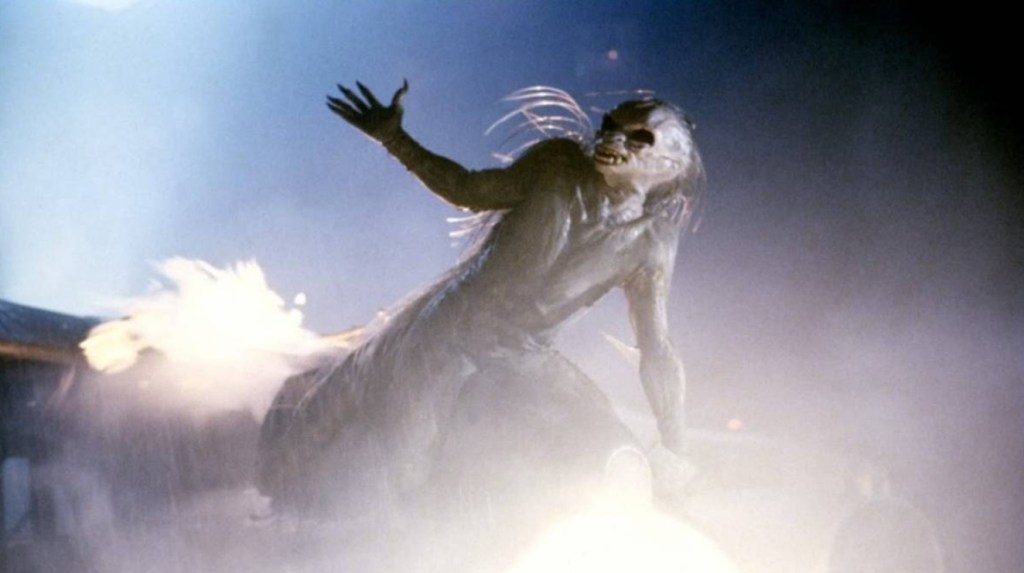
Things somehow get even better (and somehow more frenetic) with the arrival of George Miller’s “Nightmare At 20,000 Feet” which takes the iconic panic attacks of William Shatner and swaps it out for some truly epic scenery chewing by a sweat leaking, utterly histrionic John Lithgow who practically feeds off his director’s maniacal visuals. While the original gremlin-like creature who tries to remodel the plane’s engines mid flight looked like a fuzzy yeti, Miller reimagines the destructive little shit as a lithe, bug-eyed, lizard thing who seems to greatly enjoy its work while it leers at a horrified Lithgow through his window. Adding to the mounting hysteria is a clutch of awesomely obnoxious passengers who treat the poor bastard’s sheer terror as something to be sneered at (extra points to the little girl who declares “You used to be a normal person!” while he quivers in the fetal position).
While Landis and Spielberg bring the overall average down drastically, both Dante and Miller’s efforts more than make the effort worth it and if the previous two segments had matched their pitch perfect, mischievous fun, we could have had an anthology for the ages.
Sadly, an underachieving Spielberg and a truck load of controversy means that it’s more friend zoned than Twilight Zone.
🌟🌟🌟

 We Have Issues
As the first Twilight Zone endeavor I saw when I was a kid, it was a most unsettling disappointment. For the second, which was the classic TZ’s The Little People, I thankfully still became a devoted fan. Thank you for your review.
LikeLiked by 1 person