
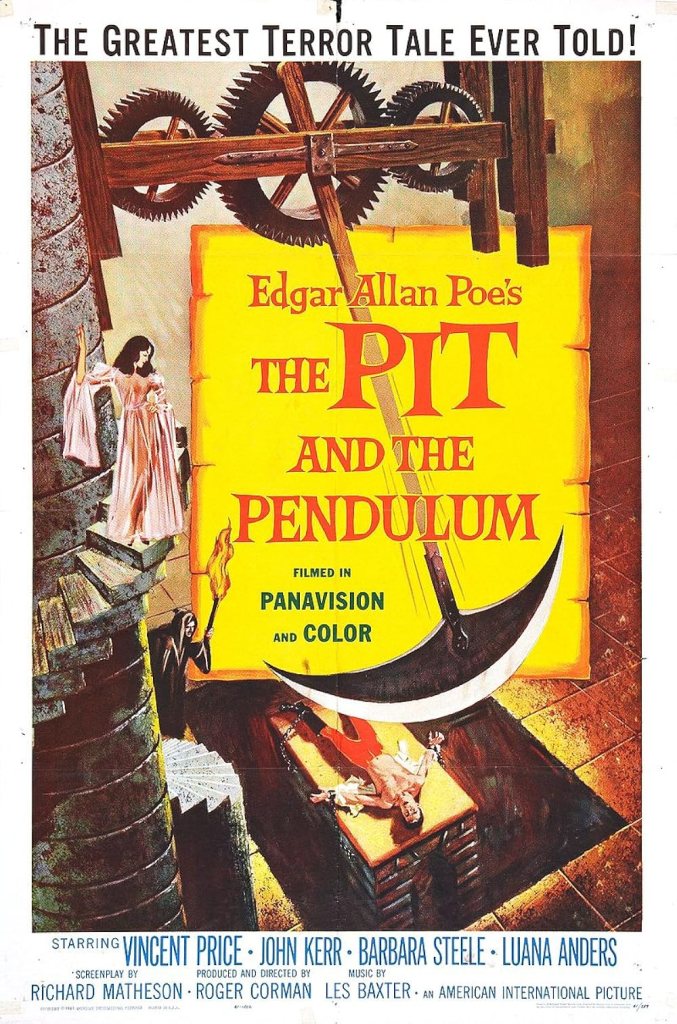
Of all the handsome Edgar Allan Poe adaptations Roger Corman mounted during the 60s, surely the most infamous was Pit And The Pendulum; a rousing tale of madness and betrayal that not only gave us yet another slice of delicious American gothic horror, but it also introduced us to possibly the most needlessly complicated instrument of torture ever committed to film. After the success of Corman’s previous effort – the similarly melodramatic House Of Usher – the producer/director’s desire to continue to bring the works of the morbid author seemed to be in full swing (no pun intended), so with yet another script provided by Richard Matheson, another starring role for Vincent Price and yet another dollop of lethal family drama to work through with the aid of beautifully shot technicolor and more of those trippy-ass dream sequences.
Is it the best of the Corman/Poe series? That depends, but my opinion tends to swing back and forth like the titular implement of death…

The year is 1547 and “Englishman” Francis Barnard has travelled to Spain to the castle of his brother-in-law Nicholas Medina to investigate the strange disappearance of his sister, Elizabeth. However, once he arrives and weathers a rather tense greeting from family servant, Maximillian, he’s eventually welcomed in by Nicholas’ sister, Catherine who gives him the rather shocking revelation that Francis’ sibling has died of a rare blood disorder.
However the longer Francis stays at the castle, the more he learns that his sister’s demise was far more bizarre than some random ailment and the majority of the bad news comes from the grief stricken Nicholas himself, who claimed to adore everything about Elizabeth and blames the sordid history of his family for her untimely passing. You see, Nicholas and Catherine’s father, Sebastian Medina, was one of the more vicious agents of the Spanish Inquisition who kept a virtual arsenal of torture devices in the castle’s dungeon and after discovering that his wife and his brother were making the beast with two backs under his very nose, took bloody vengence while young Nicholas watched. As a result, the once lively Elizabeth suddenly grew sullen under the questionable influence of the castle and after accidently locking herself in an iron maiden (easily done I suppose) she promptly died of fright.
However, as Nicholas demeanor begins to gradually erode into a state of near permanent fear and guilt, it seems that his mental state is under attack by some supernatural force that may probably be the pissed-off spirit of his dead wife. However, while Francis, Catherine and family physician Dr. Leon look on, it seems that there is some sort of insidious conspiracy at work that will send Nicholas on an all expense paid trip to crazy town and horrifically backfire on those who would attempt to pray on Medina’s shaky mental state.

If we’re going to be brutally honest, you could hardly claim that Pit And The Pendulum is a shining example of originality as both Roger Corman and scripter Richard Matheson are fairly content to repeat the basics of their previous Poe hit – House Of Usher – almost wholesale. Both begin with a dashing young man arriving at a creepy house/castle looking for information concerning a loved one and soon end up concerning a spectacular unravelling of a man’s sanity who is under constant mental assault from the sins of his family. Both feature premature burials, an abundance of atmosphere, dream sequences that feel like an LSD trip and a third act mental break that sends the movie awesomely careening all the way to the end credits that pays off all that build up with Vincent Price going utterly fucking loopy.
As a result, the slight differences between both Usher and Pendulum mean that I personally find it rather tough to place a clear winner as where one has the clear advantage in one field, the other film clearly takes over somewhere else.
So let’s deal with the backswing of that nasty pendulum first and focus on where the movie suffers and while the morbid, handwringing dread of Poe writings infuse both films from top to toe, I have to hand it to Usher for nailing that macabre angst far better than most other movies ever made. Oh it’s still present in Pendulum thanks to a show stopping flashbacks that lays out Nicholas’ family dread perfectly, but the brittle health and melodramatic outpourings of the family Usher proves to be pretty tough to beat. Also acing Pendulum by a country mile is the acting. Certainly Price aquits himself magnificently as always as his existential anguish ultimately gives way to some top notch, scenery chewing villainy and the addition of Barbara Steele as the duplicitous Elizabeth is a freaking coup no matter which way you slice it, but everyone else in the cast is so wooden if they posed on all fours in the middle of the park, they’d often be mistaken as a park bench. It’s not too damaging, but the blank line readings of John Kerr or Luana Anders make the resplendent camp of Price and Steele seem like Oscar worthy stuff.

Having said all that, it’s time to throw all those negative thoughts into the pit and have the pendulum of criticism swing the other way and the fact that Corman’s second stab at Poe is far more sordid and way more aggressive, proves to be something of a sizable virtue. The unspeakable crimes of Sabastian Medina are way more disturbing than anything the Ushers could bring and the ever-unfurling plans of those who mean Nicholas harm provide some genuine creeps, especially during a moment when Elizabeth’s corpse is exhumed to reveal she apparently died mid-scream as she suffered that oddly popular Poe malady of being buried alive.
However, where Pit And The Pendulum really pulls ahead is unsurprisingly when the torture apparatus finally comes into play and Price’s magnificent overacting is allowed to crest the insanity wave like a glorious dolphin comprised of pure trauma. With the plot revealed that the nefarious Elizabeth isn’t dead at all and has been conspiring with Dr. Leon to drive Nicholas insane and claim his wealth, however all this achieves is for the poor man to think he’s his maniacal father and attempts to reenact the torture and murder of his mother and uncle. It’s here that Corman wheels out the infamous invention of death and while it doesn’t make a lot of logical sense, with its vicious design and ominous paintings of spirits and phantoms adoring the walls, it looks pretty fucking tasty and effortlessly iconic. In fact, I could well imagine that the whole sequence, which sees a bound and sweat soaked Kerr helplessly staring at his razor sharp and rapidly descending fate, was utterly nerve racking back in the early 60s – mainly because it’s still pretty effective now – and was a world away from the atomic monsters and gangly aliens Corman was delivering during the previous decade.
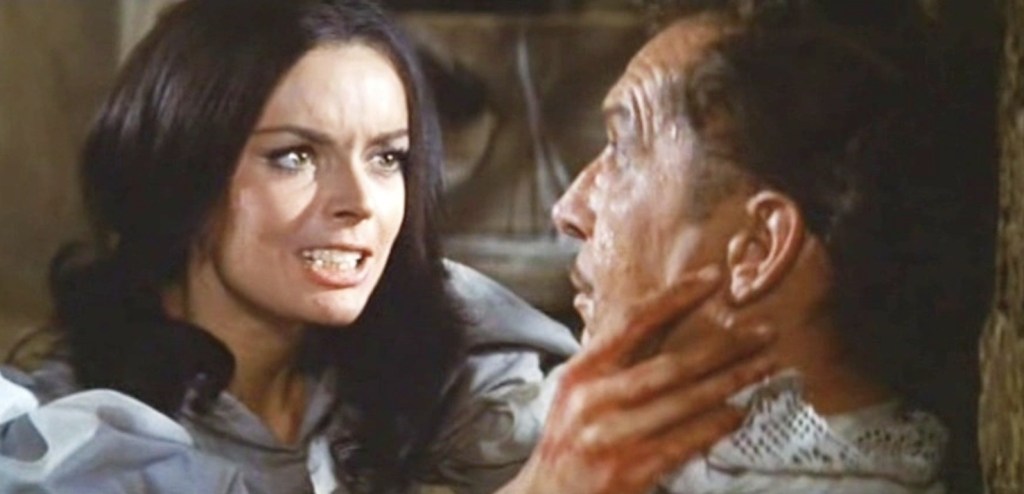
At the end of the day, both Pit and Usher are so hard to separate simply because they’re both perfect examples of 60s gothic horror that delivers oodles of atmospheric gold while succeeding in being fairly sophisticated for their time, so no matter where you sit on the axis, they’re both damn good no matter which way you choose to slice it.
🌟🌟🌟🌟
 We Have Issues