
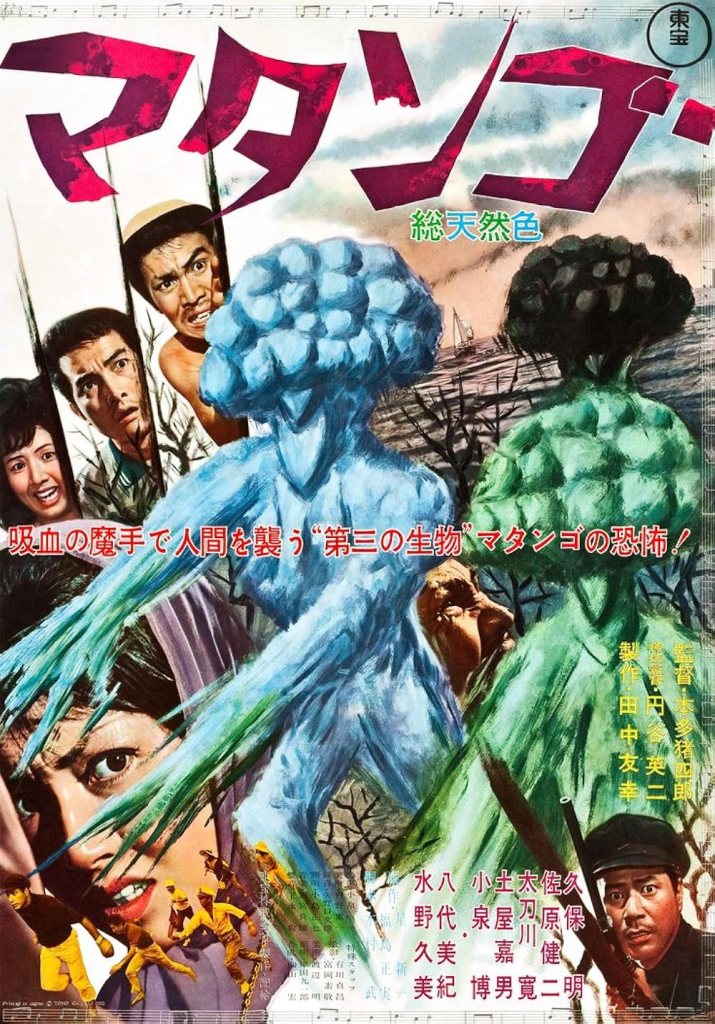
Hey, you guys all know Ishiro Honda right? I mean, some of you less familiar with Japanese fantasy cinema actually might not instantly have prior knowledge of the prolific director, but those who recognise the name with probably know what comes with a certain kind of sci-fi edge. After all, while the filmmaker gave us Godzilla back in the 50s, he also deployed numerous and varied titles that included it’s fair share of social commentary among all the rampaging rubber monsters and far-out alien invasion plots. However, while you could say the majority of his genre filmography leant towards more high spirited adventure, such as such romps as Destroy All Monsters, King Kong Escapes and Atragon, it tended to overshadow just how dark and disturbing Honda could take his themes even though the original Godzilla was a fairly hard-core attack on the use of nuclear warfare and man’s inate talent when it comes to fucking up his own existence. However, in 1963, Honda delivered an underrated reminder of just how down-beat he could still be with Matango, a monster movie quite unlike any other that laid out how tenuous the will to live can be when you’ve got mutated mushroom people banging on your door…

We join a group of Tokyo’s best and brightest at they all embark on a day trip on a yacht to soak up the sun and boast about their various accomplishments while salaryman skipper Naoyuki Sakuda and his rough around the edges assistant Senzō Koyama look on. Leading the trip is the boat’s owner, the aloof, wealthy industrialist Masafumi Kasai and he’s joined by a noticably mish mash grouping of celebrity writer Etsurō Yoshida, psychology professor Kenji Murai, professional singer Mami Sekiguchi and student Akiko Sōma. However, any case of social anxiety about how such a disparate gaggle of humanity can possibly mingle is soon swept away when the party sail into a violent storm which wrecks the boat and eventually leaves them stranded on a mysterious, mist enshrouded island that seems utterly deserted despite there being numerous clues that other people have been here at some point.
However, the only thing more curious than the lack of people is the sheer amount of fungi that covers the island and even when the group finally manage to find shelter in another, larger wrecked ship, they initially find every surface of the place coated with spores. The good news is that fresh water is plentiful, the bad news is that food is not and as their rations steadily dwindle, the worst aspects of human nature inevitably start to surface.
Kasai seems to think he can make it through this ordeal separating himself from the group, but hopes to buy himself out of his pickle while both Koyama and Yoshida seem to be selfishly in it for themselves while uncomfortably eyeing up the female members of the group. But while the remaining survivors try their best to survive and keep the peace, the giant mushrooms outside hint that something freaky is about to begin that will claim all souls present in a way that could cost them their very humanity.

When you’re served up the cinematic smorgasbord of a bunch of people trapped in an island being menaced by hefty, sentient mushroom monsters, your first instinct is to think of the type of melodramatic, 50s creature features that would usually come from USA – it certainly was the first instinct of the Americans who unleashed onto television under the more snazzy title of Attack Of The Mushroom People. However, when you sit down and watch Matango, it soon becomes apparent that there’s much more going on here than just screaming damsels and big, ungainly mushroom costumes.
Honda had played in the realms of body horror before in such films like The H-Man and The Human Vapour which saw people unwittingly transformed into other states and promptly go bonkers, but Matango is something else entirely and because it frequently takes trips to darker, murkier places – which unsurprisingly proves to be a great breeding ground for fungi, spores and the like – it stands as clearly one of the best of the director’s non-Kaiju outings. The reason for this is that the film isn’t afraid to pull the slowest of slow burns and spend the vast majority of its bulk simply watching these seven random souls sucumb to their baser instincts as the gravity of the situation slowly crushes the hope and humanity out of them.
If it isn’t Koyama and Yoshida hording food, it’s Kasai thinking he still has the right to live separately from his comrades like his former high station in life still allows him that privilege and on top of that, Mami still seems to think that her looks and feminine wiles will protect her when things go bad. Ultimately, thinks get so grim, the initially virtuous skipper, Sakuda, up and abandons everyone, taking the remainder of the food and the fixed up yacht for himself in an attempt to selfishly flee thus island of the dammed and Honda seems to be relishing piling on the pressure and downbeat themes of civilisation collapsing in on itself before the monster stuff even starts.

However, when it does, it adds a whole new layer of cruelty to the already grim proceedings because nothing can make a bad situation worse then finding that you are sharing the surrounding area with humans mutated into giant fungi who really want you to join them. From here the movie tackles themes of identity, conformity and the desperation of man that brings the flick more directly in line with the likes of George A. Romero’s Night Of The Living Dead (made five years later) and Don Siegel’s Invasion Of The Body Snatchers and the film got into more than a little bit of trouble with Japanese producers when some scenes seemed to have some mushroom infected folk resemble the radiation scarred victims of the atomic bomb (another favoured thread of Honda’s). But the movie also benefits from some truly creepy sets with the moldly wreck the characters take refuge on being the perfect backdrop to a zombie-like assault from lumpy headed invaders that only probe to be the tip of the iceberg. Yes, I was truly expecting the moment when the human/mushroom hybrids finally make their appearance to be as goofy as The Last Of Us if it was remade by Yo Gabba Gabba, but while there’s some unavoidable kitch factor involved with people dressed in giant rubber mushroom costumes, it actually plays off like some disturbing bad trip as they rise out of the forest with the sound of giggling, unearthly children. Worse yet, Honda has managed to make his character’s fates so hopeless, the prospect of fending off starvation in order to nosh of fungi that with first take your mind and transform your body actually seem like the lesser of two evils.

It’s this eagerness to jettison humanity in favour of some sort of survival that gives Matango its relentlessly pessimistic tone that manges to impressively throw off most of the cheese factor that comes with rampaging mushroom people that want to sap your will. It takes a brave director to suggest in 1960s Japan that living life as a mindless, tripped-out mushroom person may actually be preferable to enduring the stress and cruelty of the real world, but Hondo’s never been afraid of an unsettling metaphor.
Spore blimey!
🌟🌟🌟🌟
 We Have Issues
See it start to finish in it’s original Japanese version. A truly unusual film and worth it.
LikeLike