
Since his inception, Tarzan has been primarily the personification of a pulp adventure hero with such actors such as Johnny Weissmuller, Gordon Scott and the dude who played Junior in Smokey And The Bandit filling the loin cloth to bring justice and heroism to the darkest parts of the African jungle. However, by the time the 80s rolled around Edgar Rice Burroughs’ lord of the apes was deemed a little passé for modern tastes and various creators attempted to do something different with the legendary vine swinger.
Forgetting John Derek’s hilariously misguided attempt to turn Tarzan into an uncomfortably horny leading man in the 1981 erotic drama, Tarzan The Ape Man, surely the most intriguing version came in 1984 with Hugh Hudson’s serious as a heart attack Greystoke: The Legend Of Tarzan, Lord Of The Apes, a movie that was determined to retell the story as straight and realistic as humanly possible. Whether that was a good idea or not is debatable, but you have to admire the balls for trying.

After getting shipwrecked on the Congolese coast, Lord John Clayton, the heir to the sixth Earl of Greystoke, and his pregnant wife Alice attempt to make the best of it and manage to build a tree house in the jungle. However, despite their best efforts, simply being British isn’t enough to protect them from the worse nature has to offer and after Alice succumbs to malaria soon after giving birth, John meets his fate not long after thanks to the bludgeoning fists of an enraged mangani ape.
However, as chance would have it, one of the other apes, a recently bereaved female by the name of Kala, adopts the baby and raises it as her own. As baby John grows under the watch of Kala and her mate Silverbeard, he not only uses his superior intellect to avoid the hateful Kerchak, but becomes a gifted mimic which aids him greatly when he finally comes into contact with civilised humans.
After a band of British adventurers are attacked by arrow firing pygmies, the only survivor is Belgian explorer Phillippe d’Arnot who is gradually nursed back to health by a curious John.
The two bond with Phillippe teaching his protector how to speak English and after a while he manages to make John understand his important heritage and convinces him to head back to England with him to claim his birthright. Once there, he’s warmly welcomed by his ailing grandfather and suitably eyed up by his ward, a comely young American by the name of Jane, who is fascinated by the sensitive nature of this man raised by apes. Of course, not everyone has John’s best interests at heart; Lord Charles Esker sniffs in derision at this savage who has apparently claimed the heart of Jane while others wish to study him for science. But even with the love of Jane, can John tolerate a world away from the jungle where a different type of cruelty reigns?
If I asked you to imagine what a Tarzan movie directed by the man behind Chariots Of Fire, chances are Greystoke is exactly what would come to mind and taken purely as a crazy experiment, the movie mostly proves to be as challenging and fascinating as you’d hope. The best way to describe the basics of the film is not unlike what John Milius tried with that other, muscle bound pulp hero, Conan The Barbarian at it takes its subject and approaches his world and all the conventions that goes with it deadly straight with virtually no irony or humour whatsoever. The result, for the most part, is utterly stunning as the entire production bends over backwards to make this intrepid experiment work and while the concept of a “gritty reboot” is something of an overused trope these days when it comes to the glut of superhero films that released every year, trying it in the 1980s on such a scale can only be admired.
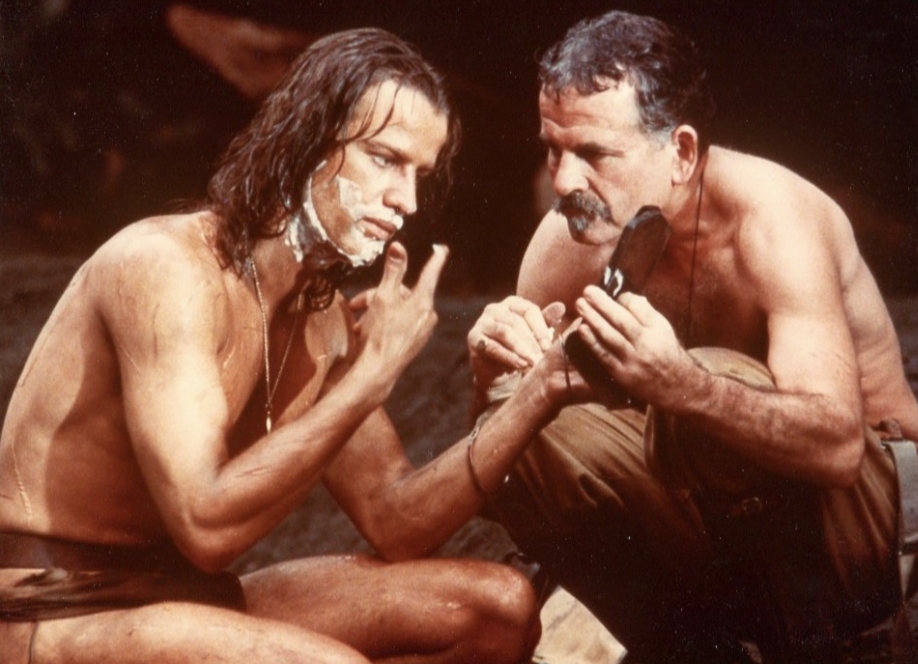
So dedicated to the bit is the movie, we barely get any dialogue in the jungle set half as a growing John (never once dubbed Tarzan in the film) is surrounded by Rick Baker’s revolutionary ape suits. In a time where the Planet Of The Apes movies have rewritten the book on digital apes, it’s still gratifying to see the practical stuff holding up remarkably well and even though you’re never fooled once that you’re looking at performers in rubber costumes, they all carry enough character and personality that you can effortlessly tell the main ones apart. And then Christopher Lambert walks in as the grown “Tarzan” and completely dedicates himself to portraying a man raised by apes in a way that’s utterly immersive and if the film had stayed on this path of watching him rise through the ranks of hid clan to become their leader and maybe fought off the odd poacher or twelve, we possibly could have had one of the greatest Tarzan movies of all time.

However, with the entrance of Ian Holm and a Belgium accent right out of a community theatre production of a Hercule Poirot mystery, Greystoke gradually starts to turn away from the grimy, hard bitten adventure film into some sort of merchant ivory tragedy as our hero is taught English and eventually brought back to civilisation and it’s here where Hudson’s desire for realism starts to work against him. After watching John grow to adulthood, survive in conditions so harsh it would make Bear Grylls shat his britches and piss on an enemy ape to make a point, the shift to England slams the breaks on so hard, it would give even the most muscular neck the most violent whiplash.
Sure, we get Ralph Richardson in his final role, Edward Fox being a complete bounder and John having a full, existential crisis as he struggles to stand astride two very different world, but the genre shift from the harsh but thrilling first half to the more melodramatic second only manages to put you in Tarzan’s shoes because you too soon become desperate to see him removed from this stuffy world of uptight refinery and back to fighting leopards and hooting like a chimp. I totally get what the movie is striving for and the themes it’s striving to convey, but managing to painstakingly create a world where the legend of Tarzan seems relatively feasible is such an achievement, it seems a shame to shove it to the side in favour of him doing forward rolls on a pool table and bedding Andie McDowell’s Jane in a fit of grief.
Another thing you’ll notice about Greystoke – aside from those admittedly lavish production values – is that the movie is often relentlessly cruel and tragic as almost all of John’s loved ones, both human and simian are all lined up to suffer tragic heart breaking deaths. Be it Richardson fateful trip down the stairs on a makeshift toboggan (it makes sense in the movie) to the utterly gutting reunion with Sliverbeard, once again you’ll soon long for the sights of John living his best life ruling his tribe with triumphant roars.

With a rousing first half that’s genuinely exemplary, Greystoke unfortunately darts itself in the foot with the second that probably still stands as one of the most depressing merchant ivory stories ever filmed. If we’d stayed in the jungle the entire time and continued that hypnotic trend of realism by having John have a slightly more traditional adventure (again, like Conan The Barbarian) we could have had an experience for the ages, but while Lambert goes above and beyond the call of duty to deliver the most realistic Tarzan ever seen on screen, the overzealous swing to drama causes it to wither on the vine.
🌟🌟🌟
 We Have Issues