
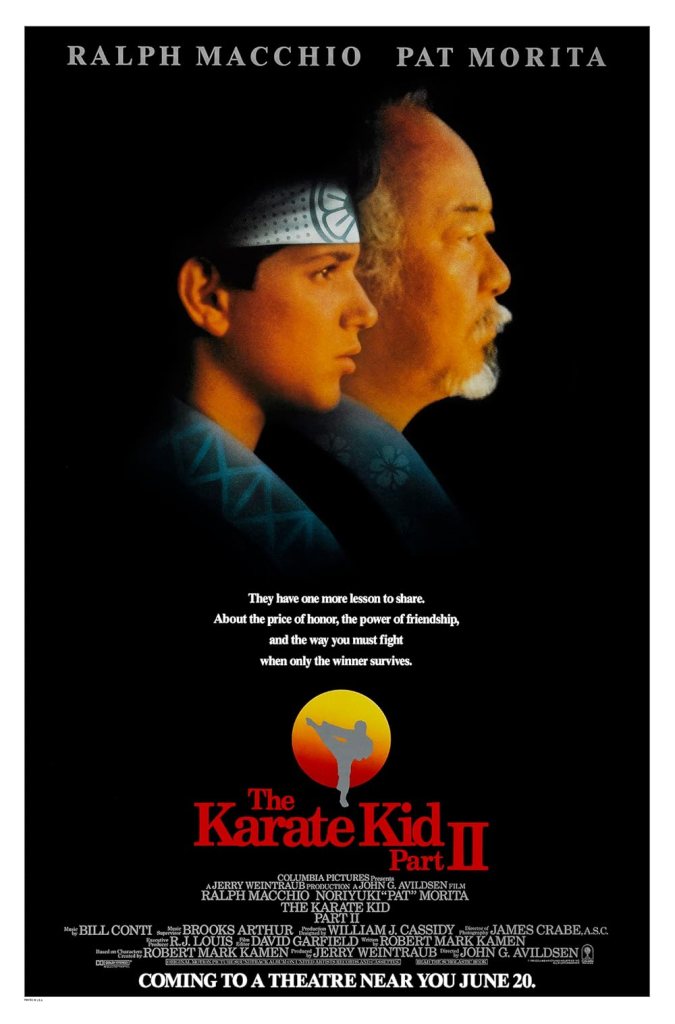
While I’ve always found The Karate Kid to be too twee for my personal tastes, I have to say I do get why the high-kicking adventures of Daniel LaRusso and Mr. Miyagi went on to spawn a rather hefty franchise. Some may say that it’s simply Rocky for teens, others might say that it’s a martial arts movie that goes incredibly heavy on the melodrama, but in any case, a sequel was inevitable.
Kudos then have to be given to The Karate Kid Part II for trying something different and instead of simply shoving LaRusso into yet another tournament, the follow up instead ups sticks and relocates the entire series to Okinawa to give it a completely new feel. While I’ll freely admit that the only real use I have for the The Karate Kid franchise is whenever it’s backstory is relentlessly plundered by Cobra Kai every five minutes, the decision to focus on Mr. Miyagi’s past is a great one, but can the movie sustain its premise when there’s an alarming lack of actual Karate on display?
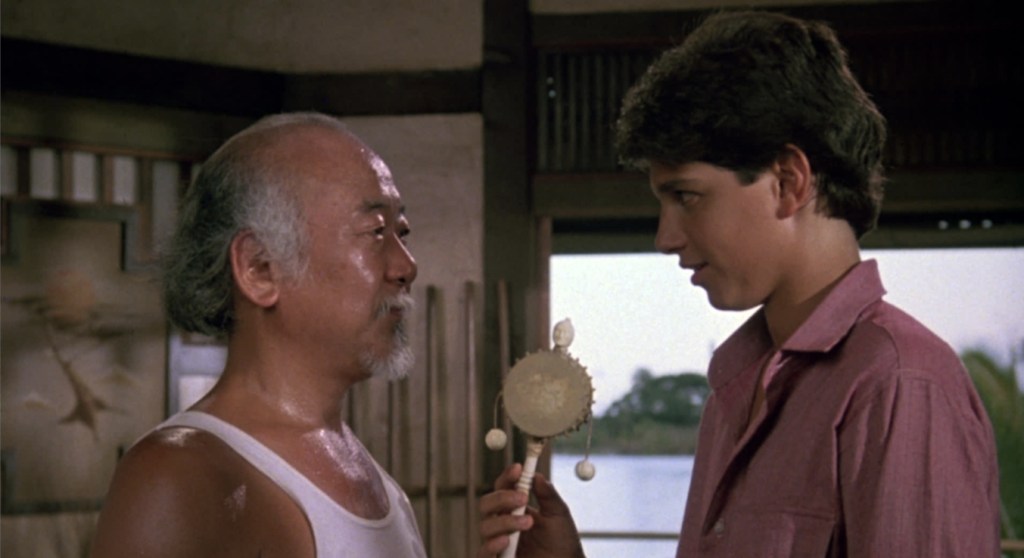
Picking up immediately after the first movie finished, with LaRusso picking up the tournament win after booting his adversary in the face, Daniel’s weirdly slight celebration (neither Randee Heller or Elizabeth Shue are anywhere to be seen in this movie) is marred by the sight of Cobra Kai’s deranged sensei, John Kreese, beating the shit out of his students for the shame of taking second place. However, after Mr. Miyagi takes care of business by getting Kreese to bust both of his hands up, we skip ahead six months to find Daniel single and his teacher rocked by the news that his father is dying.
However, when Daniel volunteers to go with him, he finds that his beloved father figure has something of a salty past that involves love triangles, dishonor and the small detail of an actual blood feud that exists Miyagi and Sato, his former best friend, after they both fell in love with the same woman. However, after breaking tradition and asking her to marry him, Miyagi found that Sato considered this a grave injustice, but instead of accepting his former friend’s challenge to fight to the death, Miyagi – ever the pacifist – fled to America.
Apparently, elephants have nothing on a vengeful, Japanese businessman who seemes to be just as pissed off now as he was at eighteen and once Miyagi arrives in Okinawa, Sato wastes no time in restarting old grudges and still maintains that he’s owed a battle to the death. However, while all this is going on, Daniel is doing his usual thing by going around like he owns the place, wooing local cutie Kumiko and firing up his own rivalry with Sato’s vaguely unhinged nephew, Chozen, that soon also spirals out of control.
But while Daniel frets about Miyagi’s blood feud, he soon finds he’s managed to get himself into one of his own and it’s going to take a lot more than a tournament to sort this out.
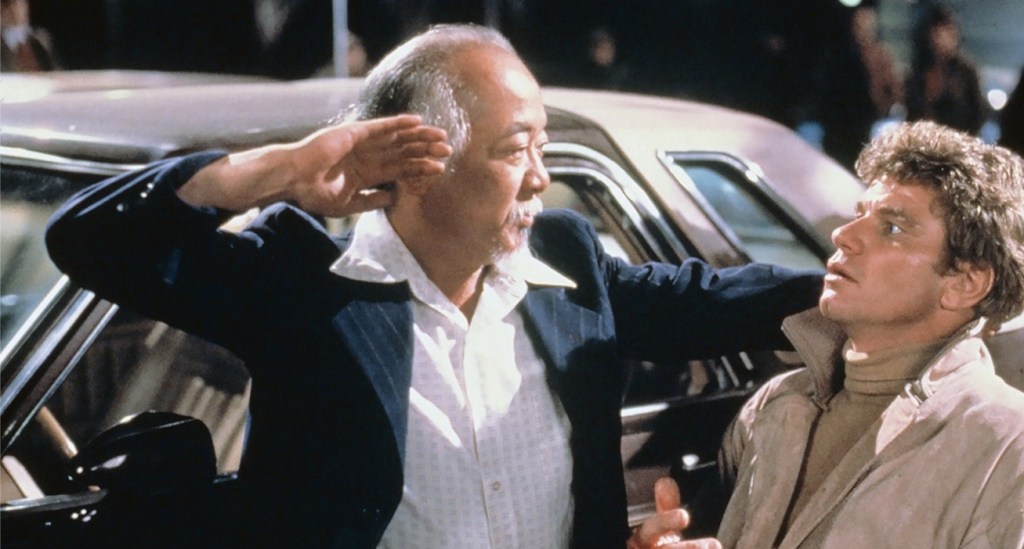
Conceptually speaking, The Karate Kid Part II has a lot going for it as the trip to Okinawa manages to add a whole new feel to the film that manages to help remain fresh even when it’s covering old ground. Sure, the storyline that sees Ralph Macchio’s Daniel-san now bullied by snarling Asians instead of sneering Americans hardly reinvents the wheel, but it does mean that Noriyuki “Pat” Morita gets to delve deeper into the past of the role that nabbed him a supporting actor nomination at the 1984 Oscars. The movie gives him everything; a dying father, a rekindled romance, a dangerous enemy, a surrogate son to protect and even a fight scene or two where he isn’t so obviously swapped out for a stunt double who looks nothing like him. With such a wealth of drama to play with, Morita certainly doesn’t disappoint, however after a while, after endless dramatic scenes between people north of fifty, you can’t help but begin to wonder if the actual target audience – y’know actual kids – were starting to complain that there’s actually very little Karate in this Karate movie.
Now, I don’t want to seem the impatient type and I do genuinely applaud a movie that focuses as much on a more mature character as it does on its lead, but the only real times that The Karate Kid Part 2 manages to get you out of your seat is actually in the first and last ten minutes. For as start, anyone who thought that the first movie ended a bit too abruptly must have been overjoyed when the film opens with Miyagi teaching Martin Kove’s maniacal Kreese a long overdue lesson (the Mandela effect had my brain thinking it actually occured in Part I for years), but then the drama fully takes hold and as you patiently await for the more martial art orientated parts of the script to kick back in, you can’t help but nick pick at some of the narrative choices.
For a start, the actress who plays Daniel’s mother is nowhere to be seen which oddly gives us the impression that she’s an incredibly shitty mother that has no issues allowing her son to head off to Japan with the matinance man from their building while she heads off to work in Fresno. Also, Elizabeth Shue’s unseen love interest gets something of a short shrift when she dumps our boy LaRusso off-screen which kind of dulls how unfeasibly nice and dedicated she was in the first flick. From here we move to Okinawa and because this is an American family film made in the 1980s, we get a Japan where virtually everyone speaks English almost all the time. It’s understandable, but it’s also a little unfortunate that a film that does it’s meager best to immerse us in a culture can’t even give us one whole scene where the characters speak their native language. In fact, it can’t be helping Daniel-san’s gargantuan ego much when everyone on the entire island is making the effort to speak English for his benefit – even when he isn’t in the bloody room.
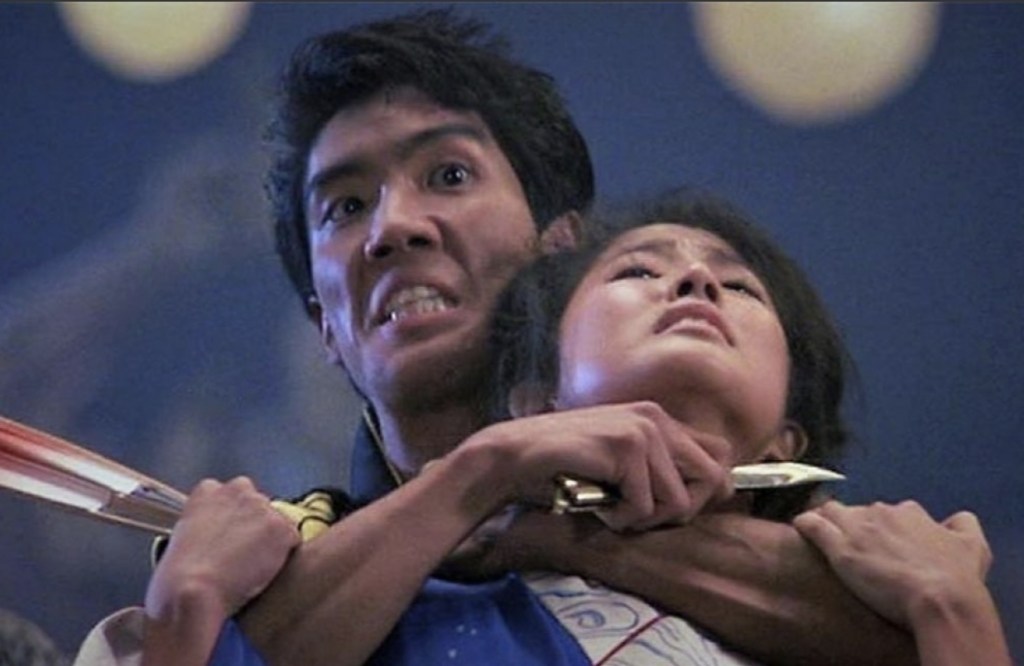
Macchio still gives his slightly more mature lead that sense of irritating main character syndrome, but at least LaRusso whines a lot less this time, although it is a little bizarre that an entire village would happily stand by and watch a pair of teenagers fight to the death right in front of them. Still, Yuji Okumoto’s Chozen may not be as memorable as Johnny Lawrence, but he’s still a credible threat and the fact that we’re given a showdown between him a LaRusso in a castle while they’re dressed in funky fighting threads almost makes up for the fact that it only occurs barely ten minutes from the end.
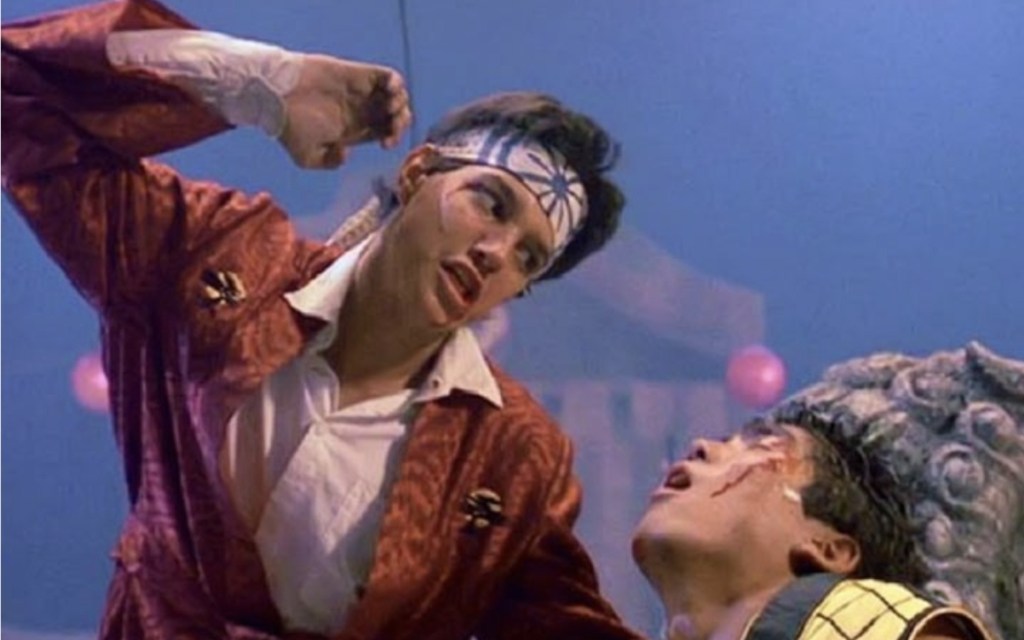
Despite creating a bigger canvas for its characters and more background for its elderly co-lead (surely Miyagi is the main character here, not Daniel) The Karate Kid Part II suffers from too sedate a pace that, like it’s unflappable sensei, would much rather talk than fight.
Still, I will admit that the “live or die” nose honk is a massively underrated finishing move.
🌟🌟🌟
 We Have Issues
I remember liking the sequel somewhat better than the first Karate Kid. But I didn’t bother the third film afterwards. Although The Next Karate Kid I took a chance on which, for my intro to Hilary Swank, impressed me enough at the time. It may have taken Cobra Kai to breathe the best new life into this martial arts universe after so long. But this one had some significant drama which can affirm how a martial arts film doesn’t have to be entirely about martial arts. That’s certainly a good thing. Thank you for your review.
LikeLiked by 1 person