

Movies about mankind attempting some sort of chinwag with an alien intelligence are a dime a dozen and some of the finest filmmakers around have attempted to put their own spin on it. Some have been awe inspiring, some have been terrifying and at least one of them has been Mac & Me, but leave it to thoughtful visualist Denis Villeneuve to deliver a close encounter of the more introspective kind that ranks as one of the most original.
The secret is that even though the director ticks all the usual boxes expected with the genre (breathtaking spacecraft, awe coated gawping, a deep yearning for peace all around), where Arrival differs from its peers that instead of focusing solely on the meeting between species, he’s far more interested in the manner in which we would have to do it and with no five-note tunes or Spielbergian light shows on hand, Villeneuve goes cerebral with jaw dropping effect.

The world suddenly all has a legitimate reason to look to the skies when twelve unidentified spacecraft suddenly enter out atmosphere and takes up seemingly random positions around the globe and hover around twenty feet above the ground. Each country that’s received one of these visitors soon deploy crack teams to try and communicate with the beings that reside within by using very different methods, but while some countries are attempting to be open with their info, the usual divides mean that others horde their findings like a suspicious student covering their exam answers.
Enter linguist Louise Banks, a woman who is suggested by random flashbacks to have had a noticeably tragic past; but after being recruited by Colonel Weber of the US Army to join with physicist Ian Donnelly to try and figure out what exactly these alien “hectapods” want, she hits upon an idea that just might work. If learning and decoding their language is next to impossible, then she rationalises then maybe switching to written words may draw out the similarities in their methods of communication. While certainly audacious, this works a treat and so the long journey of teaching the hand-like hectapods our language while decoding theirs begins.
However, thanks to all of this being carried out on an extraordinarily tense global stage, time and patience is in short supply as the population of the world seems mere days away from complete rationality meltdown.
The extraterrestrial shit really hits the political fan when Chinese military, led by immovable General Shang, become convinced that their attempt to communicate have yielded an unmistakable threat of war and before you know it, already frayed lines of communication between countries have been cut off completely.
While the world teeters on destruction, Louise discovers that she’s being plagued by memories of events that have never happened; has the learning of the hectapods’ language itself altered her understanding and can it be used to solve the puzzle of the alien’s arrival?

While I’ve never put much truck in the Oscars personally, the fact that Denis Villeneuve has never picked up an academy award for Best Director is nothing short of stunning. Maybe you vehemently disagree with Josh Brolin about the whole Dune Part 2 thing, but getting snubbed for Sicario has to be considered some sort of a crime. This shocking turn of events is bad enough, but when you realise that his thoughtful sci-fi opus, Arrival, also came back down to Earth with only a measly statue for sound editing, you have to at least consider that something is amiss. While he has a raft of instant classics to choose from, there’s a very good chance that Arrival has a punt at being the best Villeneuve has ever been as he merges serious sci-fi and genuine emotion with a side order of the expected political commentary. But when you also factor in towering performances, eyeball hijacking visuals and a twist that assaults the tear ducts as hard as Pixar does in its prime, it all becomes tougher to figure out than an alien language.
Amusingly for a film that tackles it’s subject matter with vast amounts of subtlety, the basic plot isn’t a million light years away from Independence Day as we see a world split between hope and fear when gargantuan alien spacecraft suddenly rock up to Earth’s doorstep and plant themselves at very specific locations for maximum efficiency. But from here, things take a sharp turn from Roland Emmerich territory and into Spielberg town as the main plot threads concerning the search to communicate seem somewhat similar to Close Encounters.

However, it’s to Villeneuve’s credit that Arrival feels nothing like either of those two films as it makes its major concern detailing the importance of communication and actually making sure that two disparate parties actually understand themselves fully before heading rashly into disaster. While the idea of watching the sci-fi equivalent of teaching an alien to read See Spot Run may not sound overly engrossing, the film bolts our attention to the screen by making the dissection of the basics of language utterly fascinating, but the ticking clock of intergalactic war means that watching Amy Adams and Jeremy Renner decode alien gobbledygook is also somehow edge of the seat stuff.
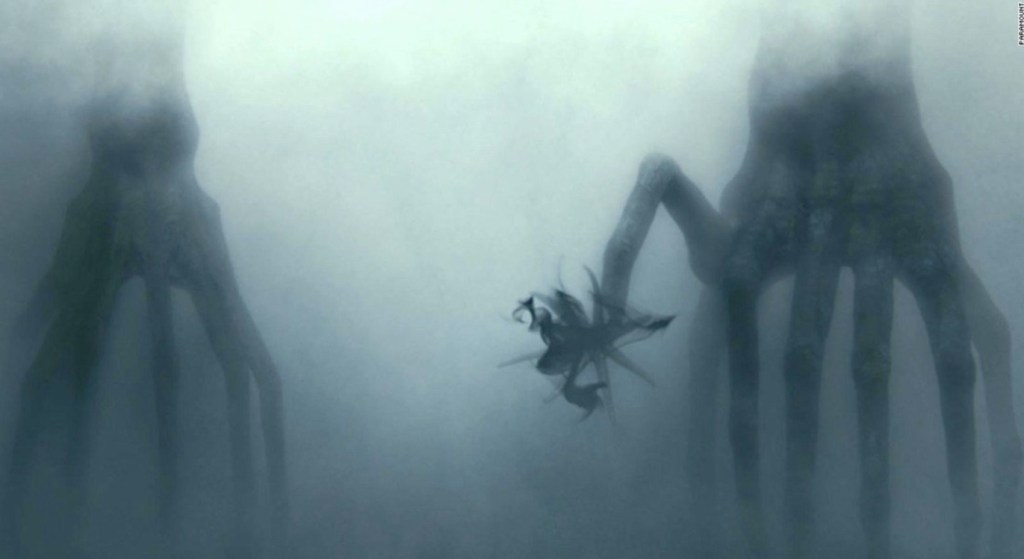
Casting a stern eye over the planet’s habit of leading with a gun and how our distrust of one another will always prevent us from being the best we can be as a species, Villeneuve talks plainly (usually through Forrest Whitaker’s Colonel or Michael Stuhlbarg’s glass half empty CIA stooge) but never preaches, even when a sub-plot sees some terrified American troops attempt to take matters into their own hands. However, the overriding tone is that of a profound sadness as the film adds an existential, reality bending, paradoxical twist that Adams sells beautifully. The fact that there isn’t a dry eye in the house for a film that features other worldly life forms that look like giant creepy hand/spiders that communicate by forming inky symbols in the air like a telekinetic Banksy is especially impressive as most other directors would (and have) gone the route of using the doe-eyed “grey” design for their alien. However, Villeneuve seems dead set to take the alien part as literally as he can so even the hectapods’ (named Abbott & Costello, thus making it technically the greatest Abbott & Costello movie ever made) craft are giant, monolithic, curved pebbles that look more like an indulgent art installation that a vehicle capable of faster than light travel and yet looks utterly stunning.
Obviously, Villeneuve has since moved into more “commercial” sci-fi waters with Blade Runner 2049 and Dune, but as staggeringly impressive as both of those projects are, neither, for all their scope and honking Hans Zimmer scores, can even touch the immense emotional core that Arrival brings thanks to the results of having Amy Adams teach funky looking aliens with a white board.
🌟🌟🌟🌟🌟
 We Have Issues
After the breakthroughs of 2001: A Space Odyssey and Close Encounters Of The Third Kind, the chances of a first contact movie having an equally profound impact are inevitably challenged. Arrival was clearly able to meet those challenges in a way that only Denis Villeneuve’s unique sci-fi direction could make possible. With Blade Runner 2049 and Dune: Parts 1 & 2, he could clearly do for sequels and remakes what most of today’s filmmakers couldn’t. So for an original sci-fi premise like Arrival, and with a resolution that takes a lot to wrap our minds around, I give this one five stars too. Thank you for your review.
LikeLiked by 1 person