


Whether we like it or not, surveillance is a part of modern life now with cameras literally everywhere. Be it on street corners, ATMs, hovering in the sky or even mounted on the helmets of cyclists, the chances are that you’re getting photographed more times every day without knowing it than a Hollywood actor walking the red carpet. One filmmaker who has seemingly been obsessed about how much we’re being watched is Tony Scott, who previously tackled the subjects in his own, distinctive way with 2001s tricksy Spy Game and with a frenzied sense of paranoia for 1998s Enemy Of The State, but in 2006, Scott took the notion of that ever watching digital eye and added a thin coat of science fiction.
The result was Dèjá Vu, a movie that not only gave a police procedural thriller a Hitchcockian, voyeuristic twist, but it also preemptively laid out the same sort of blockbuster headfuck that Christopher Nolan became the posterboy for shortly after. How’s that for seeing ahead through time?

543 people are killed when a bomb goes off on a ferry in New Orleans as it carries U.S. Navy sailors and their families down the Mississipi for Mardi Gras, and while it seems to be the latest in a long list of tragedies that befallen the people of this beleaguered city, dedicated ATF Special Agent Doug Carlin is adamant that the domestic terrorist responsible is brought to justice. However, while normal surveillance draws a blank, Carlin finds another in-road to solving the case when the charred body of Claire Kuchever washes up from the river. At first, you’d think she was just another victim of the bomb, but the fact that her body was found before the time the ferry went boom sparks Doug’s spider-sense and he manages to piece together an incredible amount of information based in his findings to suggest that if they can find her killer, they’ve found the bomber.
Impressed by his intuitive, deductive skills, FBI Special Agent Paul Pryzwarra brings Doug in to join a borderline experimental goverment unit that utilises a new type of surveillance system that continously allows you to view everything from four days ago on a constant “live” stream that can’t be paused, rewound or fast forwarded. Focusing on Claire’s life the days leading up to her death, the team hope to either gather new clues or at least see the terrorist enact his grisly task in order to secure a new truck to hold his explosive device. However, it doesn’t take long for all this prying into the past to frustrate Doug that he can only catch criminals after they’ve done the damage and not before, but the game changes substantially when he discovers the surveillance system’s unbelievable secret. It isn’t a revolutionary rendering of the past, it is the past as the boffins involved have accidently found a way to look through a rift in space/time to actually view events back in time. But this gets Doug thinking; if they’re looking at four days ago through a wormhole, wouldn’t it possible to cross through it and change the outcome?

While some filmmakers would take such a crazy plot point as using an Einstein-Rosen bridge as a time window to spy on Paula Patton as an excuse to throw us headlong into a tech savvy world of gadgets and flying cars, Tony Scott realises that all those bells and whistles would only detract from the real film that exists here – a Hitchcockian brain melter that would rather have you cheering on Denzel Washington than have you confused. Thus Dèjá Vu is one of those sci-fi thrillers that only gets remotely space-agey when it’s absolutely necessary or just to get the plot going, not unlike John Woo’s Face/Off revolutionary mug swapping operations or the dream tech of Inception. Yes, the movie is a time travel movie, but the ability to warp reality is weirdly, one of the minor points of a film that really wants to fuck about with the reality of police work not unlike that bit from Minority Report where Tom Cruise is nimbly sifting through precognitive data. The result is a tense, police procedural that proudly stands mostly in the thriller section while keeping it’s pinky in the realms of sci-fi which is probably where Scott feels most comfortable.
It works, because not only is the director well versed at shooting thrillers that see us cut between surveillance footage at fluid speeds while people at desks glare at it intently looking for clues, but it also means that he doesn’t have to lead with the sci-fi stuff and instead presents it as a mid-movie twist. Obviously, it was Ridley who was more confident with the science fiction stuff, whereas Tony learned the hard way to stay out of genre fare with the disastrous reception his horror movie The Hunger got back in 1983, but while he remained solidly locked into crafting slick actioners and thrillers, it’s actually kind of cool to gradually watch him slowly creep into more fantastical realms as the film goes on.
Of course, someone else who’s been burned by sci-fi before is the usually super confident force of nature more commonly known as Denzel Washington (anyone else seen killer AI movie Virtuosity?), but the more downplayed nature of the film fits him like a glove as he strides about the place, connecting clues and demanding that the eggheads drop their theoretical shit and just give him a straight answer.
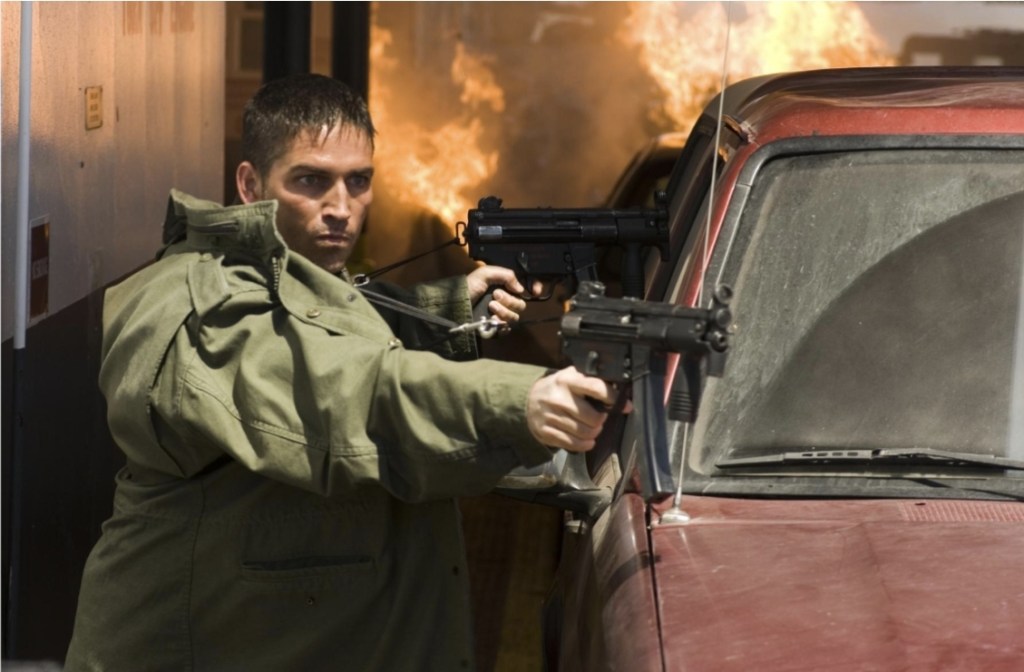
But while most movies would dive straight in with the time travel stuff, Dèjá Vu interestingly holds back on a reveal until it pops up organically in the story which should prove to be pretty risky. Not only may it test the patience of those desperate for the weird shit to drop, but those already invested in the detective side of things may find a sudden handbrake turn into time travel a bit too preposterous to stomach. However, both Scott and Washington keep a tight grip on things, hammering home the science and the rules to avoid losing us in the time stream. Admittedly it comes at a cost that anyone who isn’t Washington is reduced to rather stripped back roles – Paula Patton’s victim is mostly required to be admired through a time window, while Val Kilmer’s FBI guy and Adam Goldberg’s techie continuously reiterate the rules for anyone who’s had to nip to the toilet during an important bit and Jim Caviezel’s mad bomber (who interestingly dresses like Kyle Reese from Terminator) is your usual, ice-veined “patriot”.
However, this is all redeemed by Scott’s typically fluid editing and slick visuals which also finally takes full advantage of the time hopping by not only dropping a bunch of paradoxical happenings, but delivers one of the most original car chases I’ve seen in ages as Doug, armed with a portable time window, motors through the busy daytime streets while trying to chase a car that traveled the same way four days ago. Hear that? That’s the sound of my brain popping at all the awesome.

Once again, we find yet another Tony Scott film that doesn’t really get the recognition that it deserves, especially as it treads in the same kind of complex sandbox as that other great cinematic time manipulator, Christopher Nolan. But with yet another commanding performance by Washington and a concept that’s somehow as weirdly feasible as it is complete bollocks, Dèjá Vu truly is another movie that deserves repeat viewings.
🌟🌟🌟🌟
 We Have Issues