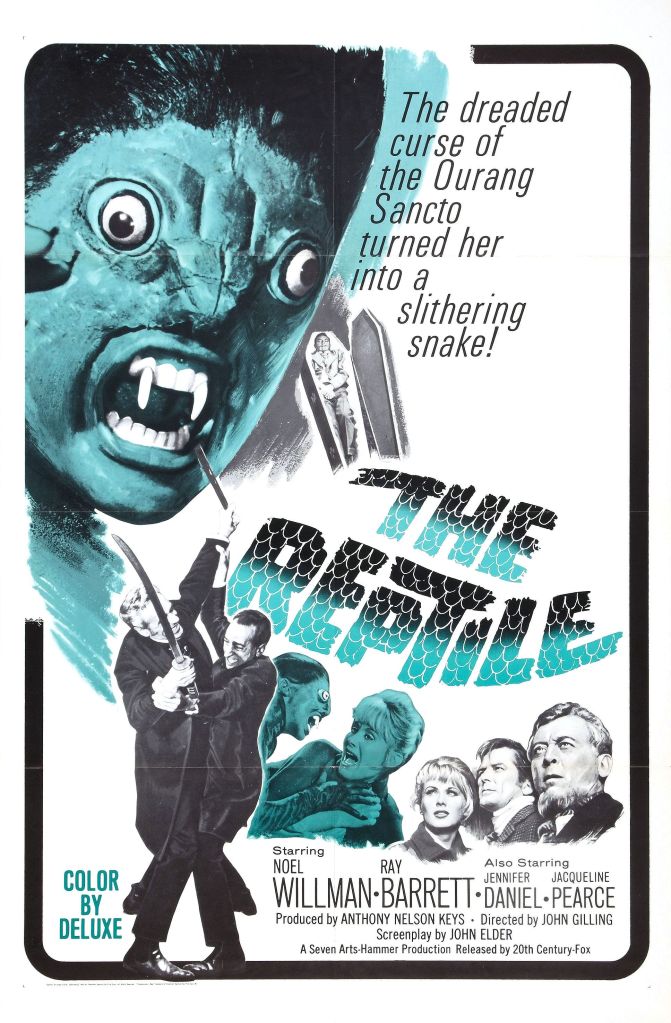

When you think of Hammer Studios, you tend to conjure up mental images of old castles, crayon red blood, heaving cleavage and big old mutton chops – but also foremost in your brain is the sight of either Christopher Lee working a mean cape as Dracula, or a priggish Peter Cushing ruining everyone’s day as Frankenstein. However, whenever a Hammer film came along that didn’t contain Lee, Cushing, vampires or experiments, it always tends to peak my interest as the studio steps out of its horror comfort zone.
This leads us to The Reptile, a curious little entry that offers us up something relatively new insofar that it’s kind of a rejigging of the classic werewolf fable only with a completely different animal. Let’s put it this way, if the absence of vampires wasn’t enough for you to claim this movie is fairly original, surely the presence of a hissing were-snake should seal the deal. However, on closer inspection, The Reptile might not be as overtly fresh a concept as you might of first thought…
Like so many other small Hammer communities before it, the simple village of Clagmoore Heath in Cornwall has found itself gripped in the coils of fear. Several locals have been found dead with foam on their mouths and swollen, discoloured faces which have led others to name this nasty demise as the Black Death and to avoid certain places like… well, the plague. The latest victim seems to be Charles Spalding, but as we discover from the grisly prologue, his awful death isn’t the cause of some terrible disease, but is actually brought along by the bite of some strange creature that tends to hang around the ominous Well House, owned by the reclusive Dr. Franklyn.
Suddenly finding himself with one dead brother and an inherited house, Charles’ sibling, Harry, and his new wife Valerie hope to move into the empty cottage, but soon arrive to find that Clagmoore Heath is not the most friendly of places. However, after dealing with hostile locals and finding their new home ransacked by persons unknown, the couple spark up strange friendships with pub owner Tom Bailey, and local loose lipped eccentric, “Mad” Peter, who warns them that danger is afoot. As we’ve already surmised, that danger is almost certainly connected to the stand-offish Franklyn, but when Mad Peter is suddenly stricken with the Black Death, Henry and Valerie attempt to get the stern professor involved much to the man’s dislike.
Still, a prickly friendship is formed, but after meeting with Franklyn’s daughter, Anna, it becomes obvious that something decidedly iffy is going on. Why does Franklyn treat his daughter with such open and cruel contempt? Why does it seem that The family’s Malay servant is the one that’s truly calling the shots? And what is it about Anna and her frequent bouts of illness that requires the house to be kept so unseasonably hot The answers are surprisingly cold blooded…

While the fact that Hammer chanced their arm at building a movie around a brand new creature that stalks around the moors, searching for victims, The Reptile isn’t actually quite as fresh as you’d first think. As I alluded to earlier, there’s many points to the story that feel fairly close to classic werewolf lore as it reuses such story points of an ancient curse, a tragic victim who is unaware of their animalistic shifts and a stern parent whose apparent cruelty is actually an act to protect the world from their murderous offspring. But beyond that, the film also has quite a few similarities to the earlier Hammer release, The Gorgon, which probably can be attributed to the fact that the writer of that movie went on to direct this movie – however, believe it or not, there’s still other aspects of the film that come directly from other places. Not even some of the sets can claim to be original as in an understandable attempt to keep costs down, The Reptile was filmed back to back with Plague Of The Zombies and thus shared a director, some of the cast and a good portion of the surroundings.
With all that being said, The Reptile stands as a fairly solid offering from the legendary studio that focuses chiefly on mood as the players all run around trying to discover why so many men are falling foul of a-reptile dysfunction (sorry, not sorry). Director John Gilling may not manage to stoke up a misty ambiance quite as potent as Curse Of The Zombies, and his leads may be a bit on the forgettable side, but he manages to excel when it comes to his supporting cast and a truly striking creature design. To focus on the more warm blooded members of the cast, while Ray Barrett and Jennifer Daniel may be a bit bland as the “young” couple who seem surprised after bad shit happens after they move into the cottage of a murderer relative, but it’s soon rectified by some familiar faces. Michael Ripper was a Hammer stalwart who had so many titles under his belt I’m frankly amazed he’s not mentioned more; but after playing everything to minor characters to victims, it’s genuinely nice to see him playing a rather kindly pub landlord who makes it to the end credits with his heart still beating.
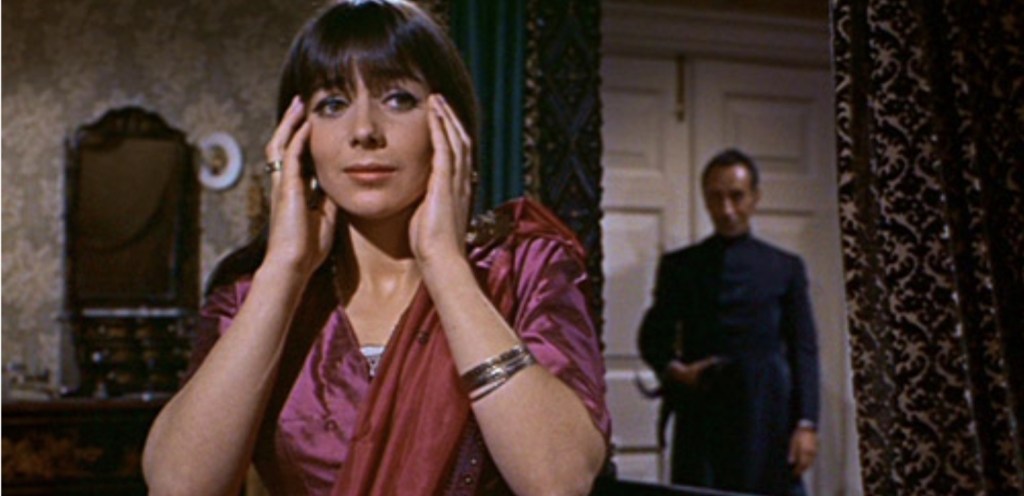
However, as sweet as that is, it’s tough not to have your attention drawn by Dad’s Army’s John Laurie who unrepentantly trims the ham as local eccentric Mad Peter who manages to give a number of delightful, rambling monologues before meeting his maker all too soon. Of course, while there’s admittedly less blood and heaving bossoms than you’d get in your average Hammer title, that doesn’t mean we get short changed on the gruesome Death front and while I’m not entirely sure what the titular reptile is packing in those fangs of hers, but it has its victims stagger around the place with green, black and yellow faces and spit foam like they’ve sneezed while brushing their teeth.
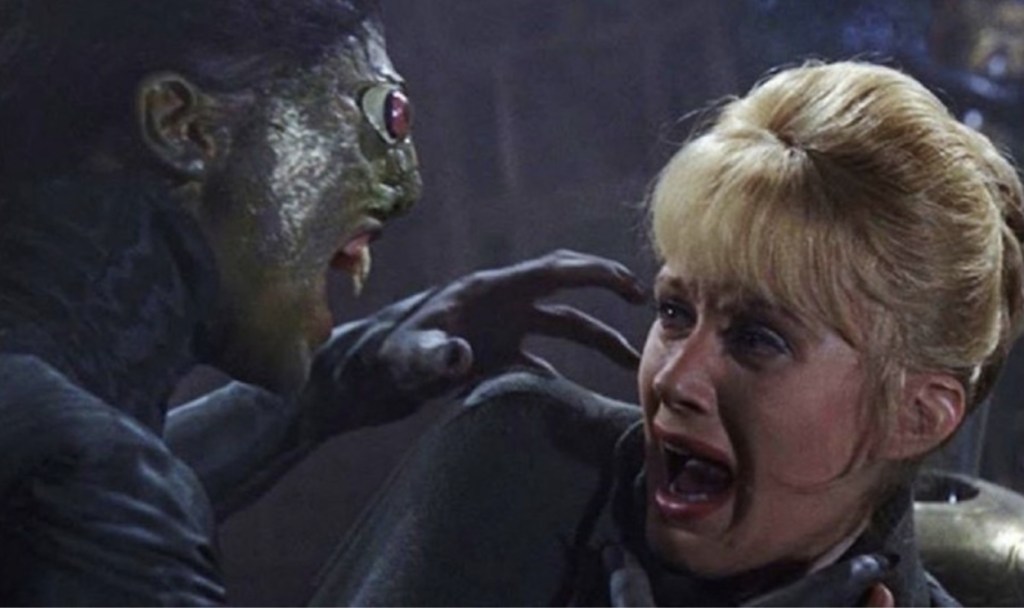
However, while she doesn’t get as much screen time as I’d like, it’s the monster who remains the most memorable with her rather attention spanning design. Essentially a curse heaped onto Anna after she was kidnapped by a Malay snake cult, it means that not only does she sporadically transform into a fanged, scaled snake woman, but she also sheds her skin every winter and retreats to the heat of an underground sulphur pool located under the house. With her buggy-out eyes and protruding fangs, she proves to be a legitimately ghastly vision and the movie has fun with her rather icky biological habits such as her father angrily taking his frustration out on his daughter’s discarded skin by beating it with his walking stick.

Of course matters are ultimately straightened out thanks to that old Hammer classic, a raging fire, but by the time the credits roll, you’ve found that The Reptile has proven to be a dependably reliable venture that does its job rather admirably. However, the real tragedy of the film is that Anna never got to live to see the possibilities of her condition – I mean, if she sheds every winter, she could have gotten herself a nice she-skin bag made up for the new season.
🌟🌟🌟
 We Have Issues