
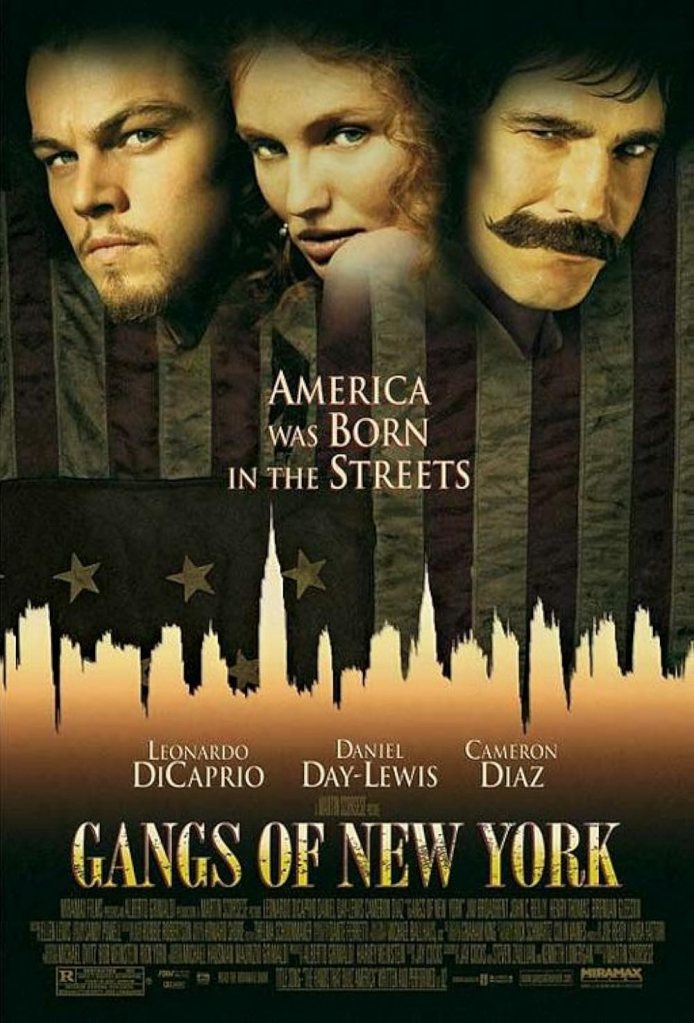

No one does sprawling crime epics quite like Martin Scorsese. Throughout the length and breath of his illustrious career, he’s cast his cinematic eye over gangster and mobsters from numerous periods delivering nail biting thrillers, stunning true stories and decades spanning epics. However, arguably his most epic crack at peeling back the layers of American crime is Gangs Of New York, a passion project he spend the best part of twenty years developing that shed a light on the New York underworld where Catholics and Protestants slugged it out in the streets while forging what would eventually become democracy in modern America.
It was big, it was bold and it ultimately ended up as muddy as the streets countless bled on, but one thing Gangs Of New York isn’t is forgettable. Offering up a movie every bit as uneven and malformed as the the times it was set in, it ultimately never gets mentioned much in the same breath as other Scorsese crime flicks, but under all that gore and grime lurks something of a flawed gem that certainly needs reassessing.
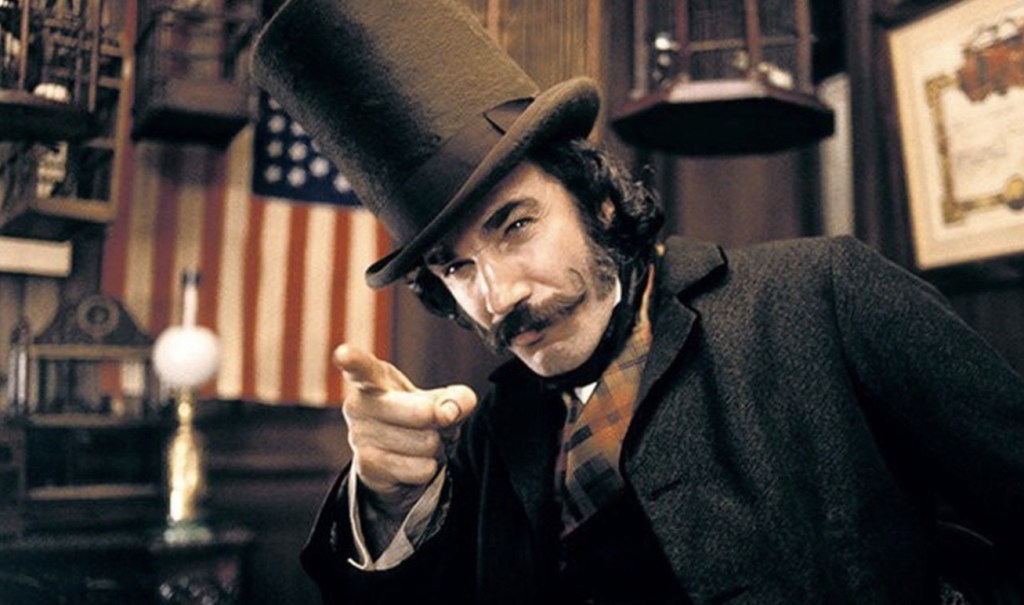
It’s 1846 and the New York of this savage era is certainly not the one Sinatra sang about as the two major gangs of the slums of the five points, the white supremist group the Confederation Of American Natives and the Irish Catholic immigrant group known as the Dead Rabbits engage in a vicious brawl to decide who holds power in the territory. Leading the Confederation is William “Bill The Butcher” Cutting, a charismatic thug with an affinity for knives and butchering meat and opposing him is the imposing “Priest” Vallon who hopes to secure the prosperity for all immigrants who have found their way to New York. While the battle is joined, Vallon’s young son, Amsterdam, looks on and witnesses his father die in battle, meaning that everyone who isn’t “native” to the land is outlawed,
Sixteen years later, Amsterdam returns in the shadow of the Civil War draft to seek revenge, but first has to aquaint himself with how New York is now run. Bill still rules with his iron will and his flashing blades and everyone, including a few former lieutenants of his father now serve him despite the Butcher’s infamous anti-Irish sentiments. Nevertheless, Amsterdam still manages to make Bill’s acquaintance and seeks to get recruited to his gang while wisely keeping his past a secret. But while he plots in full view of his target, he’s brought into Bill’s dealings with corrupt politician, William M. Tweed, and soon is regarded by his father’s murderer as his protégé; but matters are further complicated by his conflicted feelings for pickpocket Jenny Everdeane who is also loved from afar by Amsterdam’s childhood friend. Can Amsterdam get close enough to Bill to get the deed done or has his aim become clouded by the fact that the entire future of every man, woman and child residing in New York will be affected by what he does next?
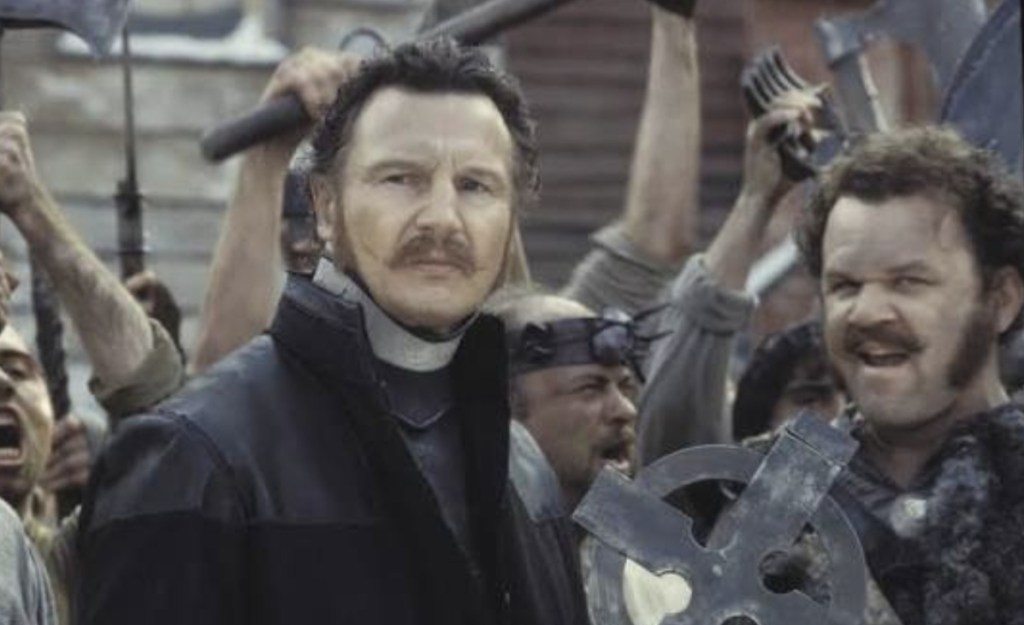
While it’s fair to say that the comings and goings of an average citizen of the New York slums of the 1860s would be fairly turbulent, one thing that Scorsese manages to nail throughout the messy and flawed runtime of Gangs Of New York is a sence of frenetic chaos that these violent and politically frenetic times seemed to come with. In fact, out of everything that the legendary filmmaker that hurls at the screen, two aspect manage to stick fast and hold the attention even when everything else about seems to have a varied effects and the first thing one notices is the painstaking efforts everyone has gone to to realise such a battered and bruised part of New York’s history. Vast, rickety looking sets tower over the cast as the melting pot of the slums of the five points offer up the type of rogues, crooks and whores all piled together that you’d usually find in scenes of Whitechapel during a Jack The Ripper movie. There’s no imagination necessary as you look around some of the most immaculate sets built for a movie and they somehow look even better when armies of thugs are bludgeoning each other sensess in the streets in the absolutely stellar opening sequence. In fact, watching Daniel Day Lewis pulling his best DeNiro face from under a luxurious mustache as he engages a crucifix waving Liam Neeson in mortal combat proves to be so good, the film struggles to best it as we then move on to a more standard revenge tale.
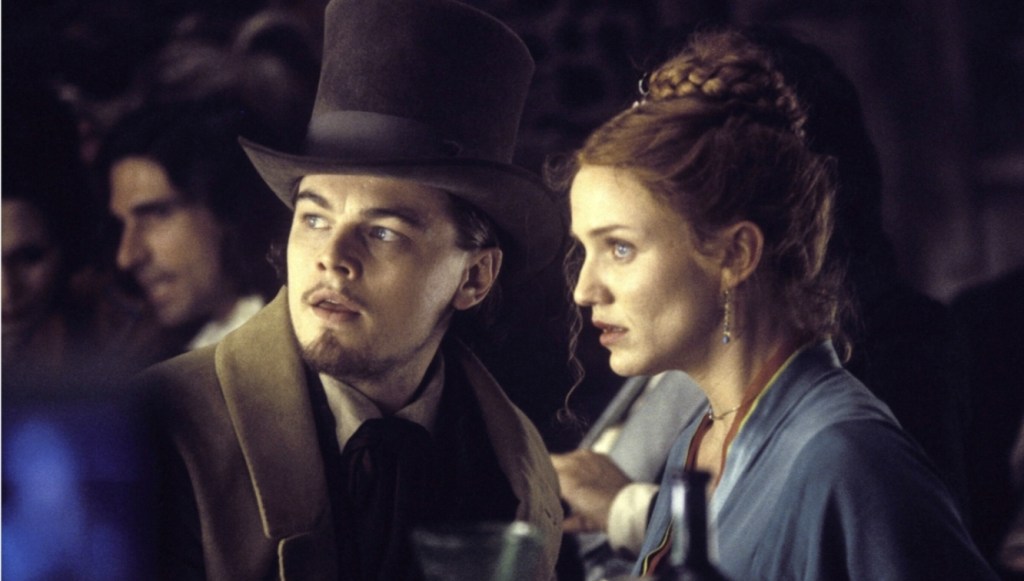
It’s here that some of the more figurative cracks in the film start to show as Amsterdam’s quest for bloody revenge gets complicated by… well, everything. Finally getting to shoot his dream project seems to have made Scorsese eager to cram as many ideas as he can into the ever-bloating screen time – however, not all of them manage to stick as deep as Bill’s blades. Overt racial warfare and vastly corrupt politics means that the film has unsurprisingly remained disturbingly prescient over the years, but the main issue with Gangs Of New York is that virtually everything co tained within the film is far more interesting that it’s main plot. Yes, we have the first instance of Leonardo DiCaprio teaming up with Scorsese, but both he and a noticably miscast Cameron Diaz seem a little at sea when surrounded by the ocean of talent around them. Liam Neeson, Brendan Gleeson, John C. Reilly, Stephen Graham, Jim Broadbent and Henry Thomas all swirl around the film while even more memorable background characters (was that a fucking cat lady?) and various political and historical subplots stand out leaving Leo’s revenge ploy looking a little weak in comparison.
However when you’ve got Daniel Day Lewis in full grandstanding mode, slicing up opponents with knives and giving bloodchilling monologues while drapped in old glory, he manages to make up for a lot of issues every time he strides on screen glaring at everybody from under an immense stove pipe hat. You could argue that his performance is so strong and his scene stealing so total, that DiCaprio is all but eclipsed like a fresh faced sun; however I will say that the rather raw, and lop-sided tone actually matches this unpredictable and incredibly violent time weirdly well.
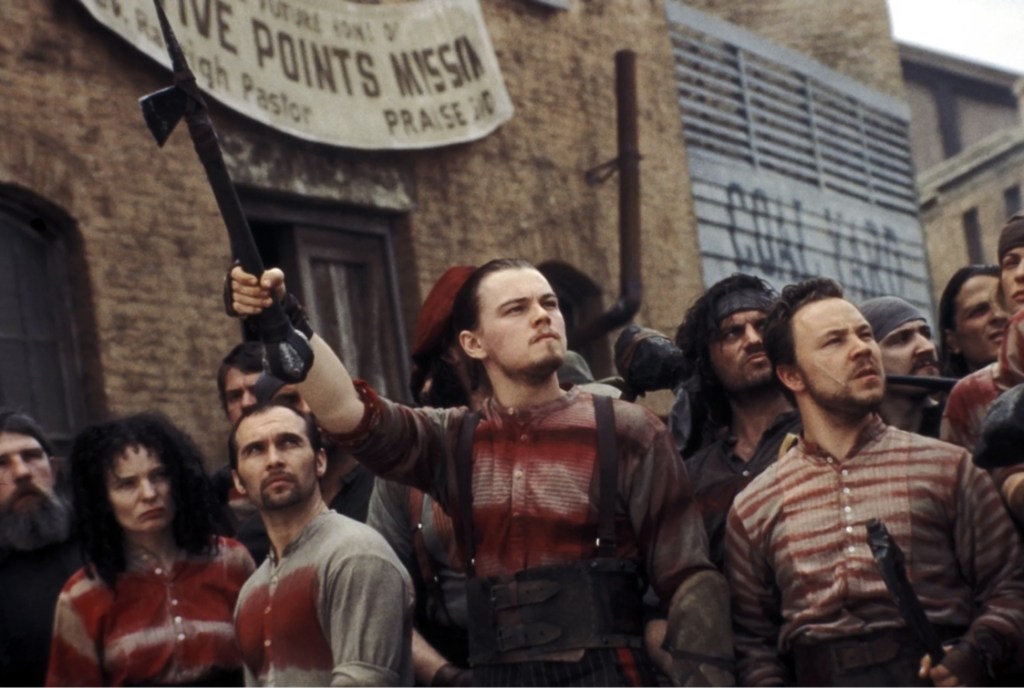
While not the most polished of Scorsese’s crime epics, Gangs Of New York manages to side-step most of its issues with a sheer sense of scale and a some exemplary sets and costumes that really do plonk you smack bang in the middle of the muck, snow and blood. It’s just a shame that the chaotic nature of the piece often turns up just as much things that don’t work than things that do. Still, as a brutally violent period piece that features Day Lewis consuming vast amounts of the magnificent scenery – and as a necessary stepping stone for DiCaprio and Scorsese to cement their union to go on to bigger and better things, Gangs Of New York has more ideas in its mud-caked little finger than some epics have in their entire body. Still not sure about using U2 in the end credits, though…
🌟🌟🌟🌟
 We Have Issues