
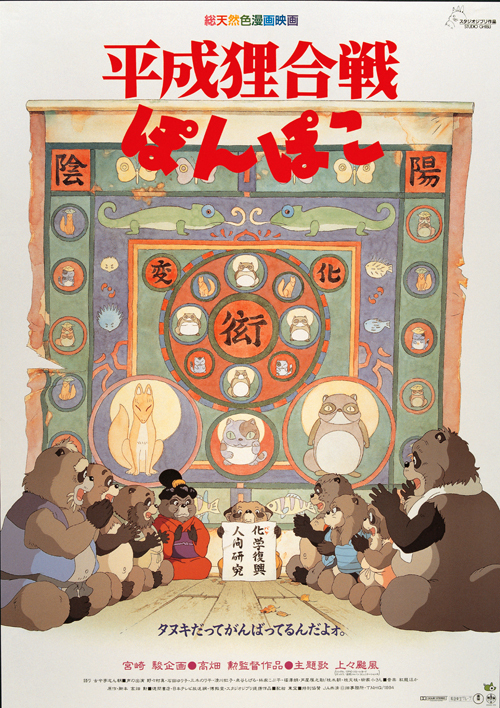

Up until this point in Studio Ghibli history, you could count on three things – the first was that it was painfully clear that the animation house had matters of quality very much in hand as their turnout was already the stuff of legend. However the other two things were a little more straight forward. Whenever you saw Hayao Miyazaki’s name on the director’s credit then you could be assured that you’re in store for a stunning, uplifting fantasy adventure where the only boundries were his imagination – however, whenever Isao Takahata took point, matters would become far more realistic and grounded as his previous Ghibli offerings dealt with two children starving at the end of the war (Grave Of The Fireflies) and a woman reassessing her life after a holiday recharges memories of her childhood (Only Yesterday). But in 1994, Takahata flipped the script with Pom Poko, an eco-fantasy that not only ditched conventional reality altogether, but found a curious use for the genitalia of certain, enchanted animals of the forest. Believe me, this is an animated film with balls – literally.
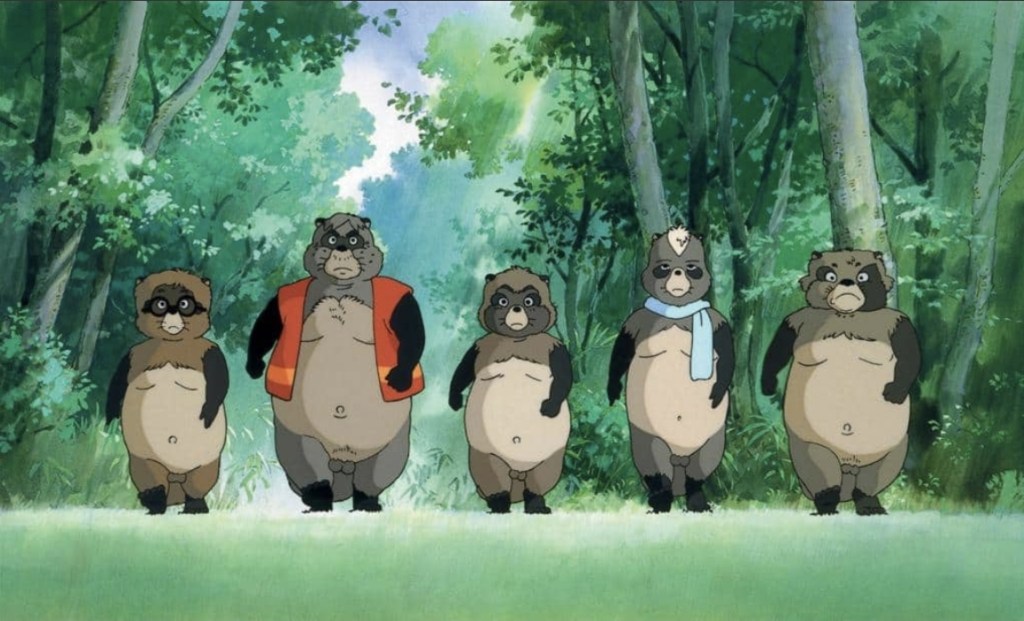
Meet the tanuki – more commonly known as Japanese racoon dogs – who, in Japanese folklore, are magical creatures who are endowed with the ability (if they can be bothered) to shape shift into anything they desire. However, as we focus on a tribe of tanuki around the time of the 1960s, we find their habitat on the outskirts of Tokyo is steadily being eaten away by a huge, suburban development project called New Tama. However, thanks to the tanuki being of the affable sort, they see it more of an annoyance.
However, when we rejoin the tribe in the early 1990s, matters have gotten decidedly more serious, with living spaces and food reserves decreasing more and more every year. In fact, it’s gotten so bad that the tanuki have resorted to fighting among themselves to see who gets what. Order is ultimately restored by the tribe matriarch, Oroku, who suggests that instead of clumsily brawling for resources, they should all combine forces and try and stop the development. As the tip of the spear of this resistance we find Oroku; gung-ho chief Gonta; wizened guru Seizaemon; and the young and enthusiastic Shoukichi and first order of business is to retrain the tanuki in their gift of shape-shifting as most of them have forgotten how.
However, while their acts of industrial sabotage actually claims lives, it doesn’t actually succeed much in slowing the humans down and so a call is put out to the legendary elders of other tribes to come and aid their efforts. But as time goes on, the notoriously easily distracted tanuki soon start dropping the disciplines they put in place at the start of their campaign, which inevitably puts an even greater strain on their lives. With the aid of a trio of elders, the tanuki have one last ditch effort to create an illusion so large, the humans will have to abandon their development; but what will they do if it fails?
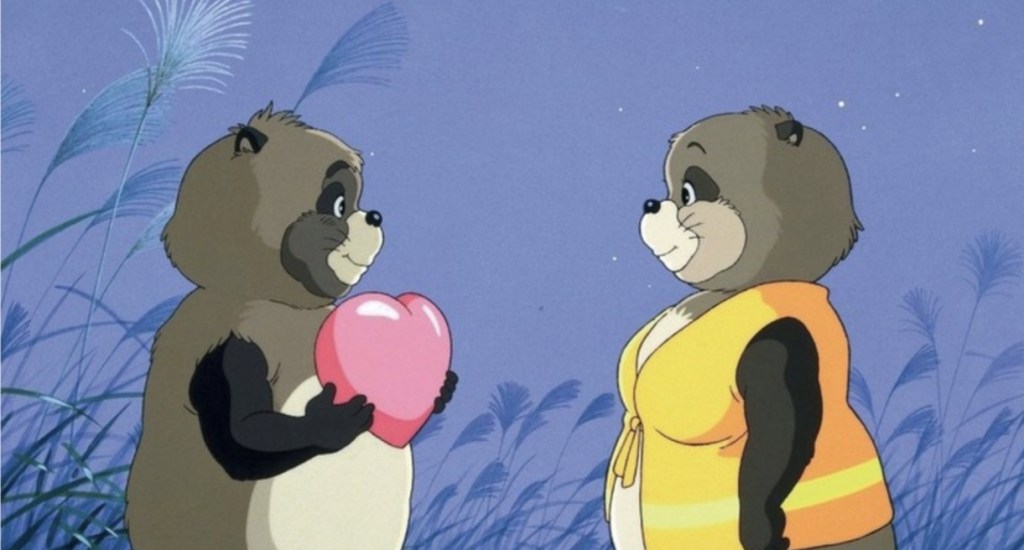
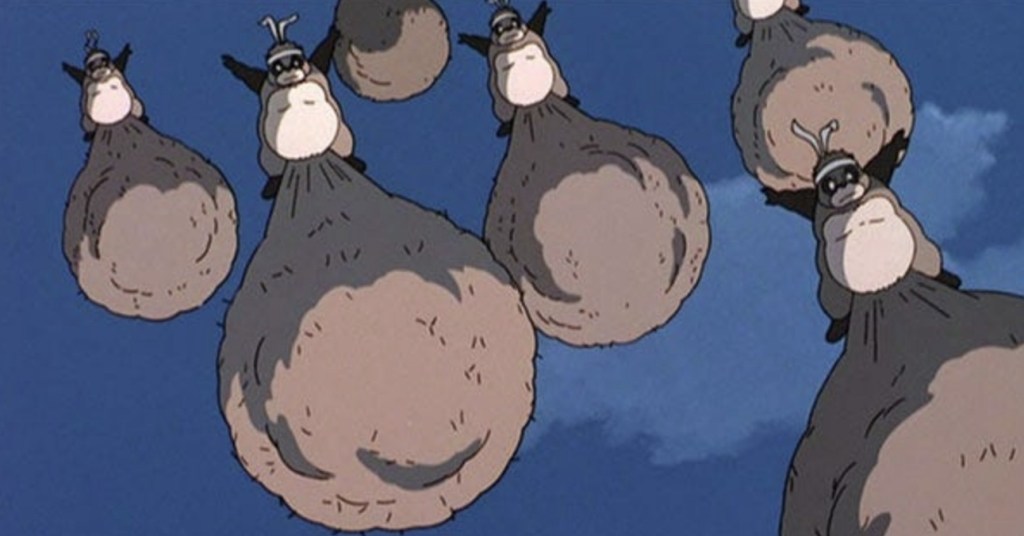
While Isao Takahata was certainly no stranger to animal-based, fantastical tales thanks to his pre-Ghibli work, the fact that he decided to take such a deep plunge after two such thoughtful, restrained works still proved to be a surprise. After all, if you glimpse at the surface of his previous two films, they’re tipified by the fact that they examine the fragility of childhood and both probably left you in a sobbing, snot-streaked wreck after watching them. However, it feels that Takahata understandibly wants to blow off some steam after making tear-jerking epics and go as crazy as he possibly can – and let’s be fair, you don’t get much crazier than a cluster of shape-shifting racoon dogs who live like care-free Hobbits and have a disconcerning habit of using their ball bags as offensive weapons at the drop of a hat.
Delving deep into Japanese folklore, Pom Poko manages to tread an impressive line between respecting the creatures from various myths and legends and deconstructing them into some sort of cheeky, post-modern comedy that not only places our fuzzy heroes in the real world, but has a few things to say about society in general. What’s especially interesting is that while a more Western approach to similar material would result in a more conventional adventure for a mismatched ensemble of critters, Pom Poko almost takes the form of a pseudo-biopic that not only spans years, but even gives us updates via different forms of narration. The result is a surprisingly mature piece of work that still has plenty of room to throw in the bizarre (the frequency of the tanuki’s genitals taking prominence in a scene), the beautiful (their grand illusion is an ode to various other Japanese creatures) and dutifully insering a eco-friendly message that unsurprisingly (for Takahata) doesn’t pull any punches.
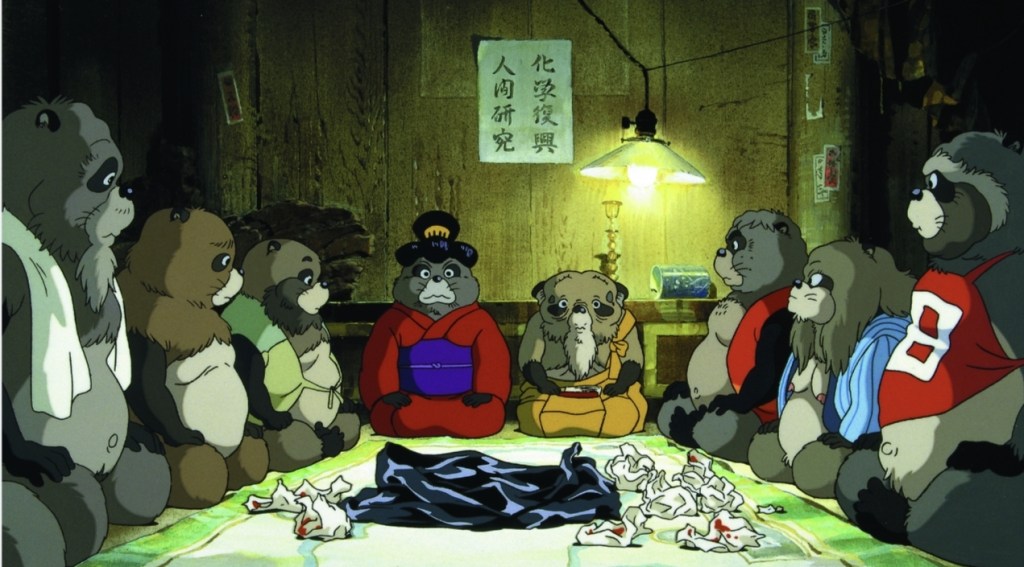
While there’s definitely large, Studio Ghibli levels of whimsy here, the film impressively keeps it’s themes present at all times, but yet never actually takes time to preach it’s case, content instead to let us watch the industrial progress of the humans gradually erode the tanuki’s way of life and let us form our own opinons. But while the final scenes end up being fairly depressing as the tanuki who can still shape-shift resort to pretending to be human and live their stressful lives just to survive, Pom Poko never forgets to be genuinely absurd throughout. In fact, there’s an argument to be made that Pom Poko could count as Ghibli’s first out and out comedy and it certainly stands as the animation house’s funniest effort as the affable racoon dogs try to fight for what they believe in despite being utterly unsuitable for a years long campaign against an unstoppable enemy.
Of course, as this is a Takahata joint, you can expect many a mature theme to punctuate the frivolity, but thanks to a steady hand and near-perfect balance, Pom Poko’s greatest achievement is that the more serious aspects of the story (sizable bodycount on both sides; quite a sad ending; numerous suggestions that modern life sucks) don’t undercut the funny bits (tanuki basically stink at planning; plenty of slapstick; racoon dogs love McDonalds apparently) and vice versa which leads to quite a sophisticated tone for a film that has wall to wall testicles. It’s to Takahata’s credit that the film can deliver its message so succinctly and also serve up all the wonder and light that usually comes from a Ghibli film, while still being really (and I do mean really) silly. The studio has always played fast and loose with reality, especially with such films as My Neighbour Totoro, but while the fantasy creatures there were sparcely used, Pom Poko literally goes nuts with Ghibli’s first balls-out comedy.
The Ghibli artistry is here, as is the unbridled humanity on display, as we witness a proud species whittled down by deforestation and development – however, Pom Poko sees the animation giant at its most silly as it makes its surreal creatures fully the stars of the show. Quite unlike anything you’ve ever seen before, I guess you could describe the film as the (racoon) dog’s bollocks…
🌟🌟🌟🌟

 We Have Issues
And a furry as well. Imagine my shock.
LikeLike
Whoopsie, looks like the deeply lonely man is badly in need of some attention again.
LikeLike