
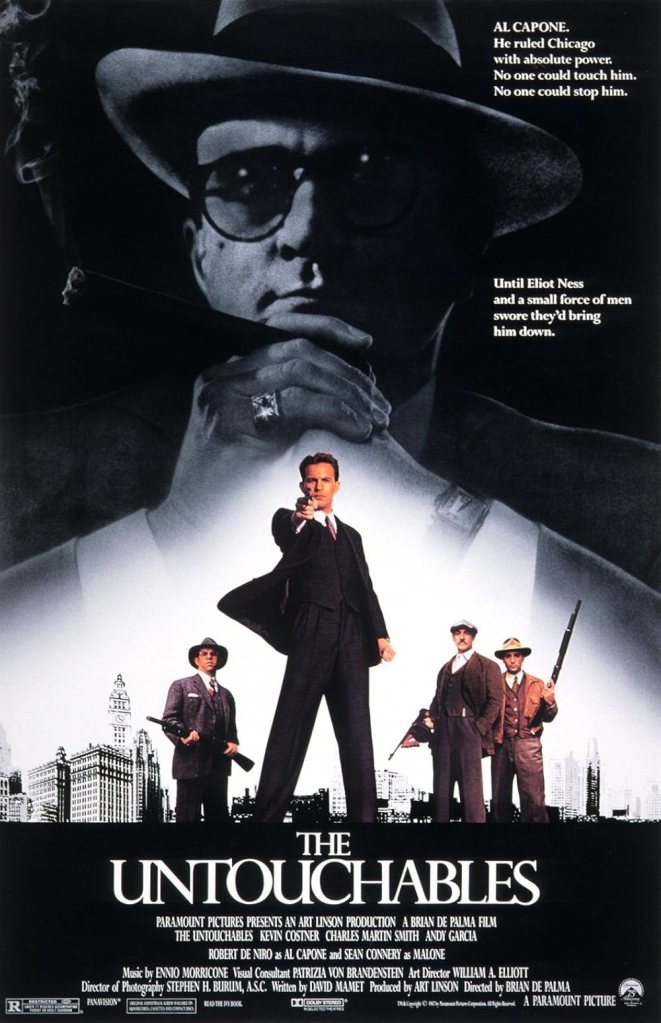

After starting the 80s by making a string of pumped up, psycho-sexual thrillers that tried to out Giallo Dario Argento and out Hitchcock Hitchcock, Brian De Palma seemed to also have an eye on giving the crime movie an enthusiastic once over after delivering the coke-fueled blow-out that was Scarface. But in 87, he delivered The Untouchables, a highly mythicized account of the grudge match that occurred between righteous prohibition agent Eliot Ness and larger than life gangster Al Capone against the backdrop of 1930s Chicago.
But while such directors as Francis Ford Coppola and Martin Scorsese looked to give their respective crime operas the most authentic feeling they humanly could, De Palma was never one to let pesky things as realism and subtlety to slow his roll. But what The Untouchables lacks in pinpoint, historical accuracy, it makes up for it by unleashing a rollicking action/thriller that not only helped Kevin Costner’s Hollywood good guy shtick stick, but it also nabbed Sean Connery an Oscar for a mentor role that’s basically the same one he played in Highlander…
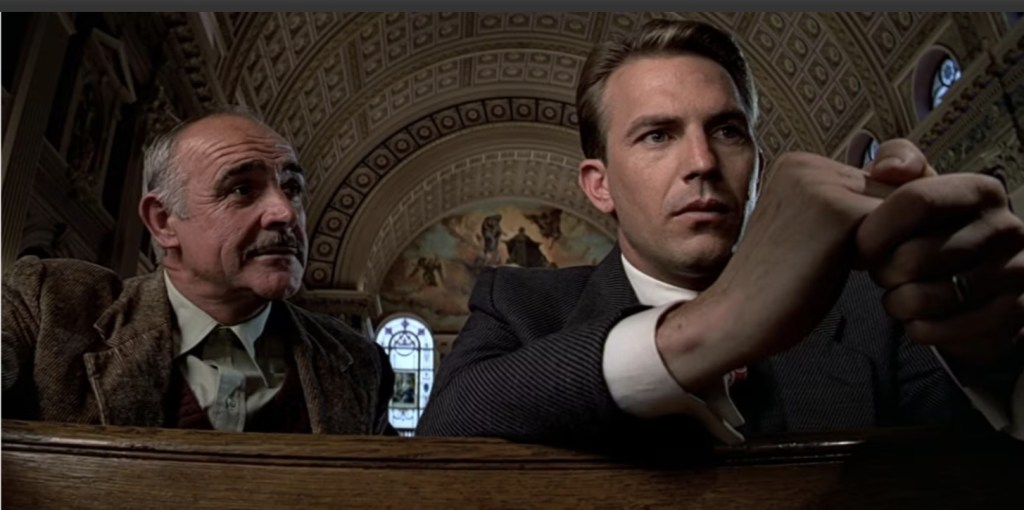
As prohibition laws demand to be enforced in 1930s Chicago, Bureau of Prohibition agent Eliot Ness is tasked with trying to dismantle the vice-like grip over illegal liquor that’s currently maintained by verbose, charismatic gangster, Al Capone. However, despite truly believing in the law he so desperately wants to uphold, he’s frequently let down by the corruption that manages to alert the bad guys before he can even arrive. After a bungled raid makes him look foolish in the newspapers, a dejected Eliot has a chance meeting with tough-as-nails beat cop, James Malone, whose Irish, no-nonsense demeanor gets Ness thinking he’s been going about his task all wrong.
Realising he needs to work with a smaller, more streetwise and more honest crew, Ness recruits Malone into a new task force that’ll hopefully avoid corruption and uphold the agent’s more idealistic view of the law. Soon they’ve recruited Italian-American trainee George Stone (or should that be Giuseppe Petri) right out of the academy and picked up FBI accountant Oscar Wallace along the way and before you know it, this team of “untouchable” lawmen are finally managing to nail Capone where it hurts.
Obviously, Capone isn’t about to take this lying down, and as Ness’ raid become more brazen, the gangsters in Capone’s employ start taking an interest in the crusader’s family. Realising that his nemesis is far too smart to directly tied to all that bootlegging, the Untouchables try to connect the Kingpin to other crimes that they can get to stick. But as the bodies soon start to pile up on both sides, can Malone’s iconic words of advice concerning street justice carry the quartet through to victory?
Whenever I watch The Untouchables, I’m always taken unawares by how thoroughly unserious the whole thing is. Oh, I’m not implying even for a minute that De Palma’s rambunctious detailing of the real life war between Ness and Capone is an out and out comedy (it’s not Bugsy Malone, for Christ’s sake), but compared to other crime epics that tend to treat their subjects with the reverence usually reserved for religious leaders, the Untouchables is a kick-ass romp that has more in common with a carefree action flick than a steely-eyed, true crime biopic. I suppose we should have expected it considering how bright, loud and vibrant De Palma made Scarface, his beautifully obnoxious ode to criminal excess. But even with such crazy things as chainsaw deaths, machine gun massacres and Al Pacino’s sledgehammer accent going on, there wasn’t such a sense of the carefree as there is here which De Palma bravely manages to keep up even when snappily dressed cops and robbers have their brains messily blown out against the nearest wall.
It’s almost as if De Palma wants to frame the whole affair through the gradually cracking prism of Eliot Ness’ innate goodness, drawing distinct lines dividing black and white, even if the movie wants you to believe that our hero’s incorruptable morals have swum into some murky waters. Of course, whenever you needed an actor to portray a guntotting boy scout who is able to avoid making the act of being a do-gooder look as square as fuck, it was often Costner that you called, and he’s nicely perfect as the straighter than straight arrow who has to learn some street smarts pronto if he’s going to put a dent in Capone’s armour.
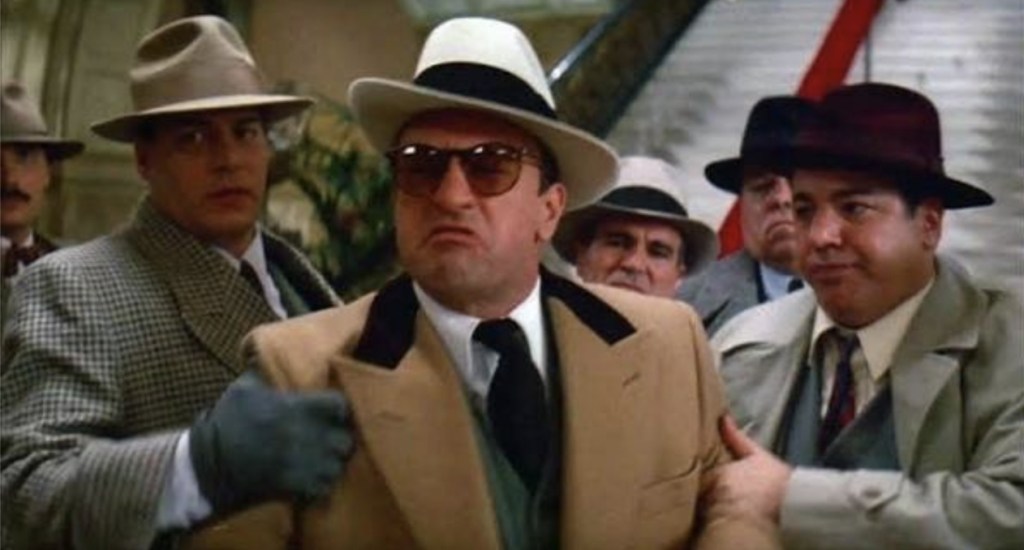
But while Kev’s whiter than white knight is apple pie and utterly devoted to only two women in his life (his wife and Lady Liberty, I’m guessing), Robert De Niro’s Al Capone sees the normally deadly serious actor get to have some fun while being bad to the bone. Grandstanding like he’s actually waging wits with Dick Tracy rather than Eliot Ness, it’s fun to watch the actor chew scenery as the ruthless criminal, giving careless barbers a coronary with but a mere glance and using baseball as metaphors for teamwork, before battering in the skull of dishonest underling. However, as much fun as De Niro’s Capone is, it’s somewhat frustrating that the story has to keep him sneering from the sidelines in something of a technical cameo and both Charles Martin Smith’s Oscar and Andy Garcia’s “Stone” aren’t given that much to do outside of looking cool with shotguns and pitching in when the bullets start flying – in fact Garcia’s so suave, I guess you could call him a “Petri dish”…
However, the losses are minimised thanks to an Oscar winning turn by Sean Connery who, if we’re being brutally honest here, really is just playing the exact same mentor role he did in that aforementioned, sword obsessed, fantasy film – only with way more practical clothing. However, comparisons to Juan Sánchez-Villalobos Ramirez aside, Connery excels as the rule bending ying to Ness’ honest yang, somehow managing to swipe the movie away from De Niro’s scene stealing crook by nabbing all the best lines. OK, so his Irish accent sounds suspiciously like Scottish, but who the Hell cares when it’s being used to deliver that unfeasibly badass “send one of theirs to the morgue” speech and watching him school Ness in playing dirty is one of the great student/mentor relationships in film.
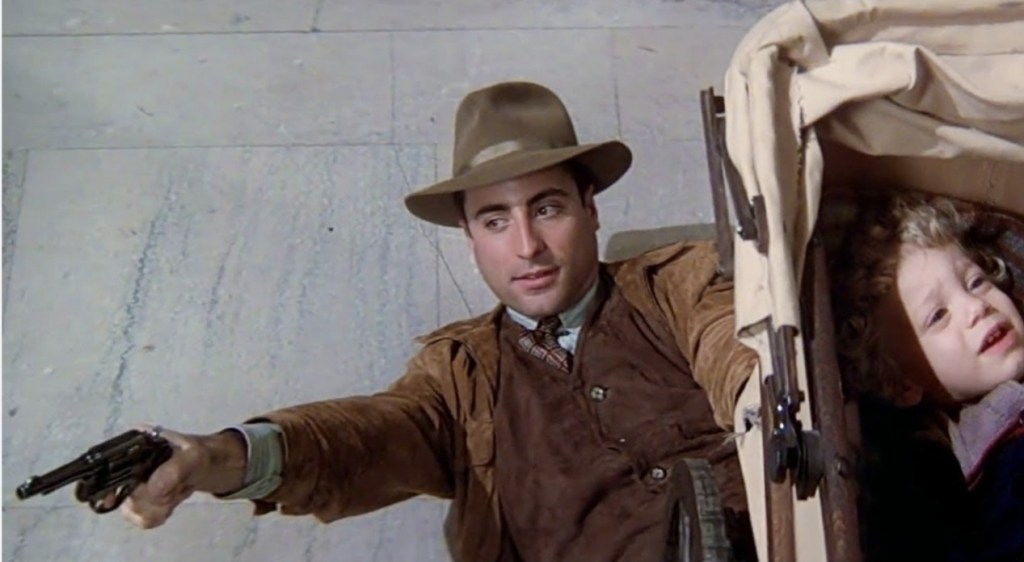
Of course, De Palma isn’t going to let those big performances have all the fun and as a result, goes all-in on some staggering set pieces that make full use of every trick in the book. The remarkable Union Station shootout somehow manages to cram Sam Peckhinpah visuals and child endangerment into a single action scene years before John Woo made Hard Boiled and it’s all made all the more expressive thanks to the fact that composer Ennio Morricone is in the exact same, anything-goes mood as both his director and a couple of the stars.
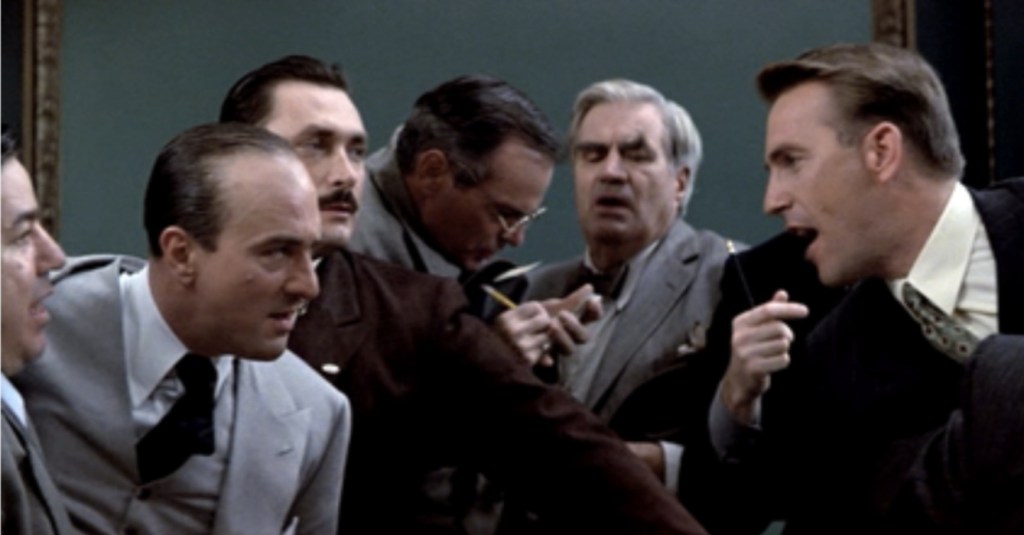
However, it’s exactly that action hero mentality that arguably trips The Untouchables up in the end. Any expecting a hard edged thriller/drama in the mould of a 70s crime epic may be confused at some of the big dumb action movie tropes liberally at play here as Costner even gets to deliver a kiss-off line worthy of Schwarzenegger after dropping Billy Drago’s slimy assassin off a roof. But while it’s main villain is too far removed from the action and that oddly jaunty tone is an odd match for all those gruesome head shots, all The Untouchables really seems to care about is kicking as much Giorgio Armani clad ass as it can – and by that measure, it most definitely succeeds.
Because that’s the Chicago way.
🌟🌟🌟🌟

 We Have Issues
“He pulls a knife, you pull a gun. He sends one of yours to the hospital, you send one of his to the morgue. That’s the Chicago way.” One of the best dialogues ever given by Sean Connery. Thanks for your review.
LikeLiked by 1 person