
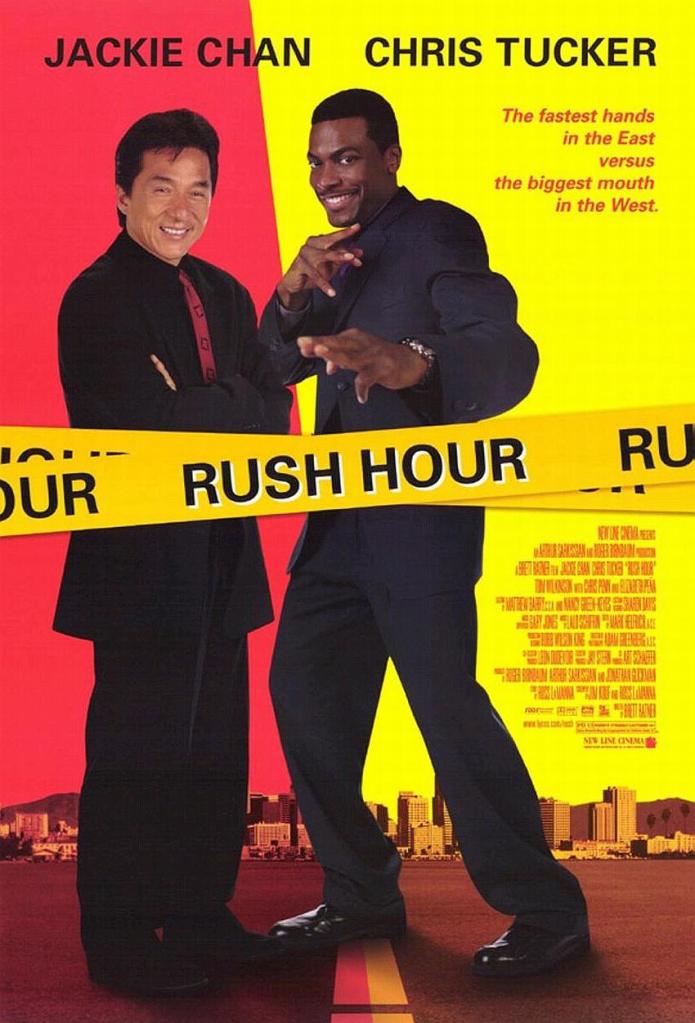
When you consider how many attempts it took to break Jackie Chan to the mass audiences of America, it makes you wonder what the hell various filmmakers were playing at for so long. However, after such failed attempts as The Protector, Battle Creek Brawl and The Cannonball Run II (where he was confounding paired with Richard Kiel) unsurprisingly proved unworthy of the kung-fu legend’s singular talents, no one could have predicted that the missing ingredient to finally get Chan over would have been the screeching guy from The Fifth Element.
Thus the world was introduced to Rush Hour, an East meets West action buddy comedy that saw Chan’s formidable skills at physical comedy combine with the rapid-fire rambling of Chris Tucker that finally allowed the Hong Kong star to finally headline an American picture even if he had to master a whole new language and let other stuntmen take the strain for a change.

Not long after the last day of the British rule over Hong Kong has ended, Soo Yung, the young daughter to the Chinese Consul is kidnapped a mere two months after her family moved to Los Angeles. The culprit is the unidentified, shadowy crime lord known only as Juntao, a man who gets his kicks stealing and hoarding Chinese cultural tresures and even though the FBI spring into action with their best men, Soo Yung’s father, Solon Hang, wants his good friend Detective Inspector Lee aiding the case.
Now, here’s where things get slightly racial; not wanting a cop from Hong Kong getting under their feet, the Feds contact the LAPD looking for some unwitting patsy to escort Lee around while unknowingly keeping him from the investigation and with that, pain in the ass Detective James Carter – a cop who’ll quite happily shoot at a car full of C-4 in a busy city street – is tricked into babysitting Lee in a convoluted plan to keep them collectively out of everybody’s hair.
Of course, right from the get go, neither of the two take to each other much with the staggeringly ignorant Carter assuming that Lee can’t speak English and Lee being such a fish out of water it’s a miracle he doesn’t have a hook in his mouth – but as the two slowly bond thanks to a slow burning mutual respect and a whole mess of racial jibes, they turn their respective talents towards finding Soo Yung and discovering the identity of Juntao.
Lee has lightning fast martial art skills and is as nimble as a proverbial cat on a hot tin roof, while Carter’s seemingly never ending stream of verbal bullshit never fails to talk him into – and then out of – any situation you can think of. Together, their formidable mix of Kung fu and oddly endearing racist teasing means that Juntao and his right hand man better watch their back, because is Lee doesn’t beat the shit out of them, Carter will no doubt talk them to death instead…
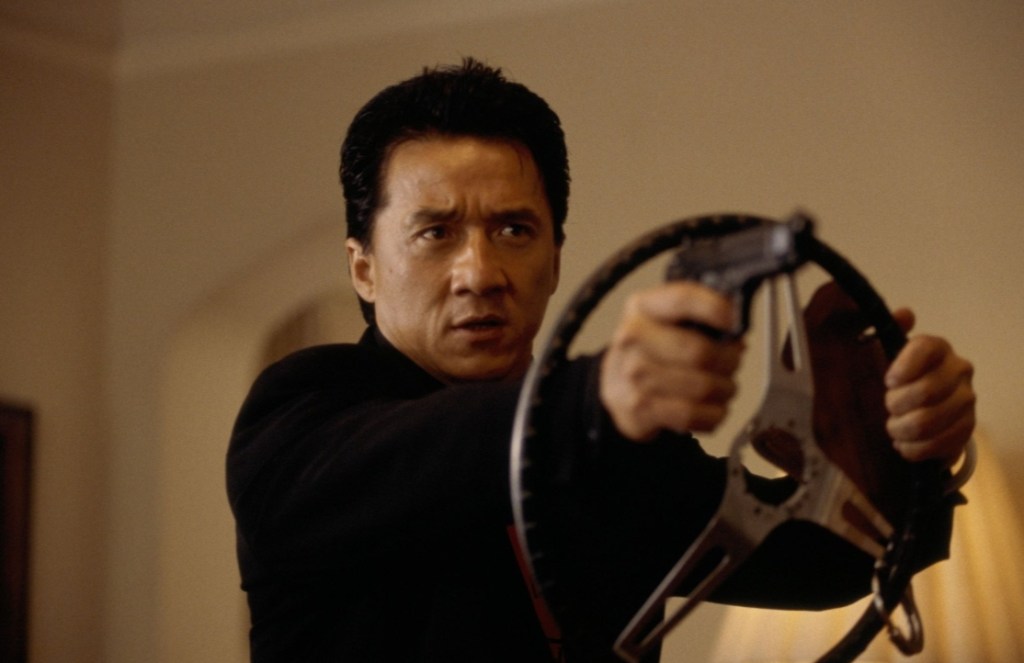
People generally approach Rush Hour one of two ways, with first usually being that of an incredibly reliable, nineties-styled buddy cop movie that reliably dispenses with all the unnecessary things like proper police procedure and common sense in order to make sure that the film movies as swiftly as one of Chan’s blink-and-you’ll-miss-them kicks. However, I personally fall into the second group, which is that I’ll begrudgingly concede that Rush Hour is a certified ton of fun despite the fact that the movie only is able to display a fraction of Jackie Chan’s abilities for disappointingly understandable reasons.
If Rush Hour was your first exposure to the insane comedic timing Chan inserts into his multi-layered fight sequences, then it must have been a quite a wild ride as you watched him hop up security walls as fast as a squirrel in heat or fight off a snooker hall full of heavies with blistering speed. However, my first meeting with Chan was in movies like Police Story, Dragons Forever and Project A that saw the plucky bugger literally repeatedly put his life on the line as his devastatingly complex fight sequences and potentially fatal stunt work proved that this man would literally bleed and break bones for his art. In comparison, the stuff he does in Rush Hour is barely at half-speed and the fact that he actually has a stunt double initially caused scoffs of derision to travel out of my body as Hollywood presented us with this light-beer aproximation of a Hong Kong legend.
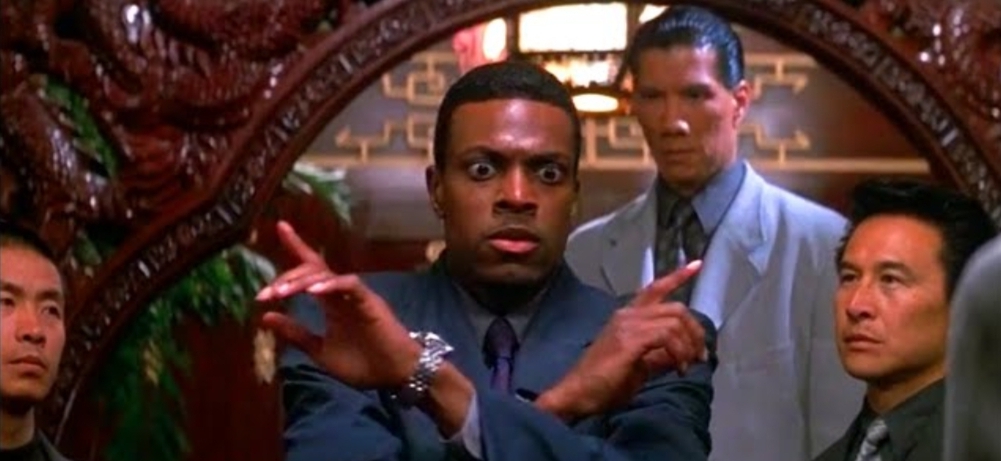
However, I’m older and more forgiving now, and after thankfully leaving my gatekeeping days back in my twenties (where it belonged) a greater understanding of the movie began to unfold. For a start, no Hollywood studio that exists could afford to insure the sort of shit Chan got up to in the 80s and after decades of pushing his body to its limits (the man once fractured his frickin’ skull), it must have been something of a relief to hand some of the stunt work off on the likes of stunt doubles or even the odd blue screen. This is not to say, however, that Chan isn’t treating his belated Hollywood break through lightly as he still indulges in some comically complex scraps involving snatching away guns mid-flight and desperately trying to stop priceless chinese artifacts from shattering while he’s getting pummeled by goons.
However, thanks to Chan rarely switching any higher than second gear (he’s usually in fifth), what manages to balance things out is the fact that Tucker literally never shuts the fuck up. Essentially borrowing from the Beverly Hills Cop/Bad Boys school of motormouthed detective work (Carter’s brand of policing makes the trigger-happy Lowery and Burnett look like fucking Columbo), Tucker’s brand of cock-sure verbal diarea proves to bizarrely be the perfect counterpoint to Lee’s stoic innocence. You couldn’t imagine Riggs and Murtaugh bonding over the mispronunciation of the word “Y’all” in Edwin Starr’s War and yet the union of Chan and Tucker manage to wash over any cracks in the plot with the liquid cement of their combined charisma in a way that you’ll barely care about the intricacies of the actual plot.
However, despite making virtually every other actor surplus to requirements (poor Tom Wilkinson looks so out of place trying to Baxter Chan with a suitcase it almost hurts), the chemistry between the leads also leads to some confusingly easy to swallow bigotry that sees both actors take racist cheap shots whenever they can. Is it progressive? Certainly not, but Jackie Chan is probably the only dude alive that could innocently drop the N-Word in a bar predominantly stacked with black dudes and then get away with beating the crap out of them as he defends himself; and the blizzard of Asian insults that comes out of Tucker is so thick, you oddly become oblivious to it.
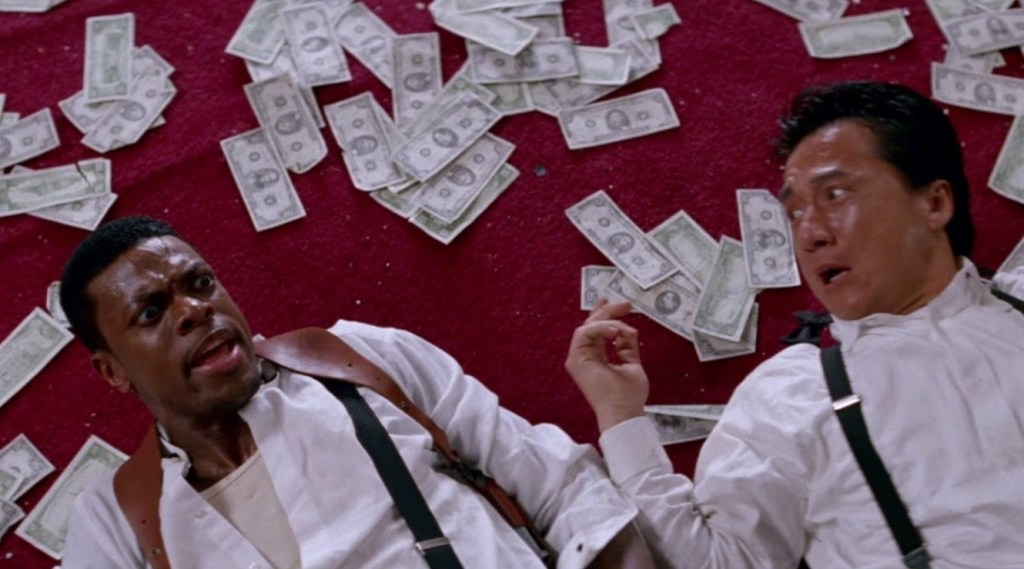
Fast, fun and deliriously entertaining, this might hardly represent Jackie Chan’s greatest work, but his teaming with Tucker speaks volumes… literally.
🌟🌟🌟
 We Have Issues