
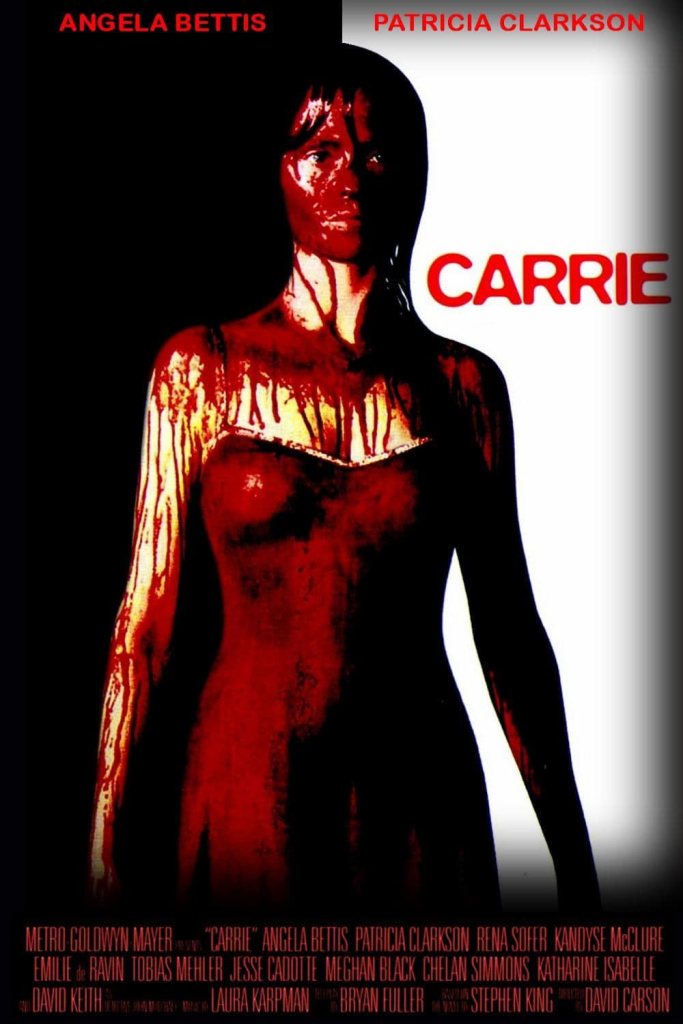
For every groundbreaking adaption that takes its cue from a Stephen King novel, there seems to be a somewhat unnecessary version later made for television that not only skews closer to the original prose, but completely drains out the artistic flair that made the first version so memorable.
Stanley Kubrick’s supremely ambiguous telling of The Shining got a “proper” version in 1997 that restored the living topiary animals but dropped the scares while even iconic tv miniseries got remade as less iconic miniseries when Salem’s Lot got another go-round in 2004 with Rob Lowe attached for some reason. However, arguably the most baffling attempt of all was a 2002 version of Carrie that most people don’t even know exists and that saw a promising cast attempt to emerge out of the garish, flamboyant and impossibly iconic shadow of Brian De Palma’s trailblazing original.

Carrie White, as you probably already know, has something of a miserable existence as the crushing, religious upbringing she’s received from her fanatical mother has left her impossibly unprepared as she tries to navigate the hellscape of high school. However, her attempts to vainly keep her head down are smashed when she gets her first period while showering after gym and her hysterical, terrified response proves to be perversely entertaining to the rest of the class.
After teacher, Ms. Desjarden, finally steps in and lays down the law, some of the girls involved have very differing opinions about how to handle themselves next. Fellow classmate Sue Snell realises her mistake and tries to atone for it by befriending the innocently strange outcast, but class bitch, Chris Hargensen and her sidekick Tina Blake choose to double down on their hatred and vow revenge on the girl who – in their twisted minds, anyway – got them in trouble.
In a cruel example of fate entwining, while Sue decides to convince her boyfriend Tommy Ross to ask Carrie to the upcoming prom in order to build up her self esteem and school standing, Chris and her nutjob boyfriend, Billy Nolan hijack the idea and plan to humiliate the poor girl after they rig the nominations for prom king and queen.
Obviously, Carrie gets some desperate pushback from her deranged mother who is convinced her daughter’s eternal soul dangles in the balance, but the real issue here is that Carrie is burdened with the gift/curse of having telekinesis and frequently moves more furniture than an IKEA stockboy when the pressure of her existence gets too much.
Before you know it, the prom arrives and all the pieces are set as they all edge toward disaster with the fateful pull of a string and the dropping of a bucket full of pig’s blood.

While studios had already tried a pointless sequel in order to harness the story of King’s legendary anti-heroine (surely Carrie is the deserving poster child for the “good for her” movement), some bright spark figured that the book was due for an update on a TV budget. However, a glimpse at the credits brings some hope to proceedings as quite a few names pop up that had quite the impact on the genre at large.
Firstly, in something of a spot of dream casting, the role of Carrie was played by Angela Bettis who had a notable role in Girl, Interrupted and who also made a splash in Lucky McKee’s May and in the role of her tyrannical mother was the very capable form of Patricia Clarkson. Elsewhere, Lost’s Emilie de Ravin and Ginger Snaps’ Katherine Isabelle took the roles of Carrie’s tormentors and on top of that, the roleplay was written by none other than Bryan Fuller who went on the bless the world with the series Hannibal – surely with such burgeoning talent involved, there was a good chance that this version of King’s novel could stand on it’s own two bloodstained feet? Unfortunately, that proved to not be the case for various reasons, but the main one was pretty obvious – it’s virtually impossible to top the 1976 version, especially when you’re missing the distinctive razzmatazz that De Palma brought to King’s memorably cruel tale. Credit where it’s due, Bettis works her ass off to portray the dangerously introverted timebomb of telekinesis that shuffles her way through life, but director David Carson (Star Trek: Generations and a butt-load of TV) handles the affair with almost a disinterested blandness that sucks the character out of scenes that De Palma went for broke on. Clarkson is disappointingly restrained compared to Piper Laurie’s truly pant-dampening performance of the terrifying Margret White and Ravin canto even hope to match the sheer face oscar-worthy spitefulness of Nancy Allen’s original Chris. Fuller’s script tries to follow the novel closer by bringing in flashback feel to it and adding a meteor shower and various police interviews to break up the momentum, but at extra thirty four minutes longer, you certainly feel the sag of the film’s midsection. For example, we get to the fateful prom with an hour still left on the clock and as a result, Carrie 2092 feels less like Fuller pushing for a more faithful adaptation of the source material and more like the tv movie version of someone desperately trying to make the minimum word count of an exam paper.

However, while virtually eclipsed at every turn by a version made twenty six years earlier, there are some aspects that stand out. Ok, Carson was never going to top the climactic prom massacre, but he almost manages the next best thing by sticking to the fact that in the book, Carrie’s rage destroys the entire town and while the strained CGI struggles visibly, the sight of a still bloodied White sleepwalking through a neighbourhood in flames is still an image that King purists will embrace like a lover.
However, despite its claim of being more accurate, the last five minutes or so manage to not only make that a lie, but also unravels a lot of the power of the story by an ending that ultimately pulls all the punches. Carrie not only survives, but fakes her death with the aid of Sue and ultimately hits the road like a telekinetic Thelma and Louise, only with with way more than the death of a rapist on their hands. On top of this, Ms. Desjardin also survives to tell the tale and the movie even attempts to remove direct blame from Carrie herself having her go catatonic once she goes scorched earth on her chuckling classmates. The reason for these changes is that Carrie was supposed to be the pilot for a series that never materialized that presumably would have seen Carrie and Sue seeking out other telekinetics on a weekly basis, but when you remove the tragedy of Carrie, you surgically cut out its poignancy and the fact that the damage from bullying is all encompassing.

A flat and unnecessary retread that does everything that De Palma’s version did – only blander, Carrie 2002 is proof that this time, maybe it was the filmmakers that should have plugged things up…
🌟🌟

 We Have Issues
LikeLike