

The American crime movie has always been cool as it usually features really bad people doing really bad things in a way that’s perversely endearing; however, in the eccentric hands of filmmaker John Boorman, it became something else. Oh it was still cool, alright, but inbetween the snappy patter, meticulous plotting and steely-jawed anti-heroes, the director decided to infuse the standard skirting beneath the law with a nightmarish, dream-like energy, that took the usual strong-arming of thugs and turned it into a delirious, surrealist freakout.
The result was Point Blank, arguably one of the coolest crime papers to emerge from the sixties, but its enduring legacy is so profound, its contents hasn’t just drawn praise for its content, it’s stirred decades-old debates as pundits and film historians search for hidden meanings harder that Walker trying to recoup that ever elusive $93,000.
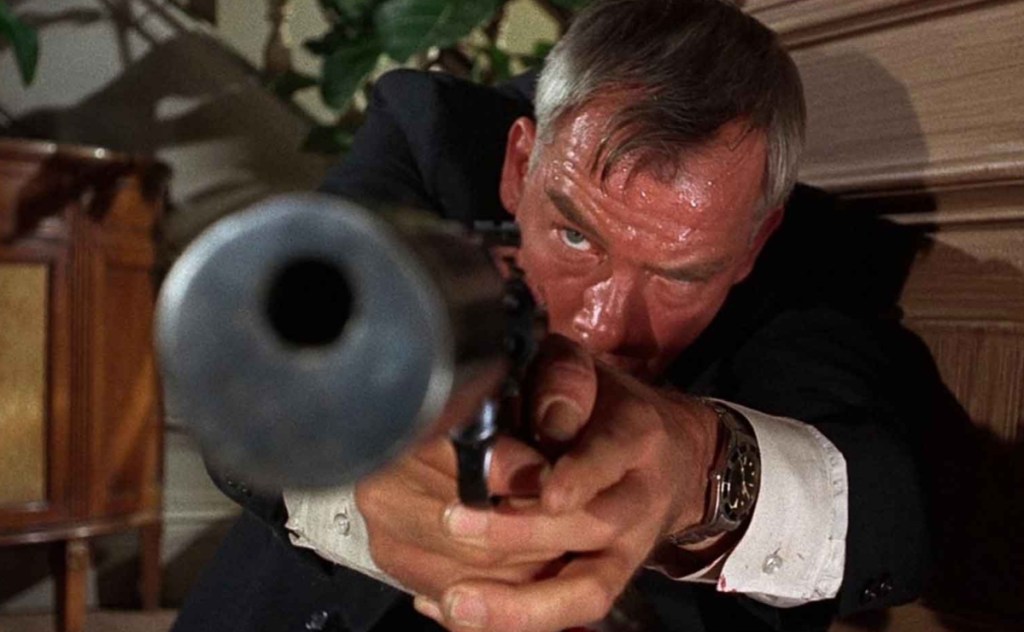
The hard-bitten Walker (first name missing: presumed dead) agrees to help out desperate friend-in-need Mal Reese and score some cash by robbing a major crime operation as they drop off a delivery of funds on Alcatraz island. However, best buddy Mal proves to be as trustworthy as a sting-happy scorpion when he finds that his cut simply won’t be enough, so he responds by shooting Walker twice, leaving him for dead and absconding with both his share of the money and his wife, Lynne.
An undetermined amount of time passes and it seems that rumours of Walker’s death have been greatly exaggerated as he emerges from the prison, fit as a pistol-waving fiddle, and is dead set on retrieving his share of the cash with help from the mysterious Yost. Walker’s first stop is to track down Mal, who as used the money to buy his way back into the very crime organisation he stole it from, but when he calls in on his ex-wife by politely booting in the door and emptying his revolver into the bed, he finds that his quarry has moved on to bigger and better things. After his drug-addled, guilt ridden wife logs out of the chat, permanently, Walker starts working his way back to Mal, who tells him a simple truth – there is no money any more and in these days of corporations and big business, kicking a door off its hinges and demanding cash is only going to get you so far.
However, undeterred by this knowledge, Walker then targets the Organisation itself for his $93,000 by – you guessed it – kicking doors of their hinges and demanding cash and as he targets Carter, Brewster and Fairfax – the three men who run the show – there’s a sense that in his desire to claim what’s his, our bludgeoning anti-hero hasn’t been paying attention to the bigger picture. Is all this carnage over a mere $93,000, or are there bigger forces at play here?

Point Blank is one of those movies that simply gets better the more you think about it. It’s absolutely great while it’s playing, but the second it ends and mind starts running over the events you’ve just seen, it gets the old wheels and cogs turning as you try to interpret the more stranger aspects of Boorman’s trippy masterpiece. The basics are superlative; a tight revenge tale that soon spirals into chaos as our hero’s stubbon and frankly illogical motive has him rip an entire crime organisation a new asshole. The players are superb with Lee Marvin all flushed in the face with mindless determination thanks to a character who very truly, does not give the slightest of fucks and Walker proves to be one of the most fascinating blunt instruments in all of crime cinema.
In his worst to achieve that very precise amount of dough, Marvin proves to be both an unstoppable force and an immovable object; and yet his unwavering desire to retrieve what’s his is both his greatest strength and his biggest weakness. Yes, he brazenly blows through thugs and obstacles like they weren’t even there, but because he can’t see any further beyond that $93,000, he proves to be utterly incapable of realising that that’s just not how the world works anymore. Friends and victims alike are cast aside in his wake and people are constantly confused about how firm he is on that absurdly specific amount – he doesn’t even want the equivalent of the entire haul, just his half – and the fact that the guys with all the power are more businessmen than bruisers adds to the whole absurdist nature of the thing.

However, while Walker’s almost single-minded nature is intriguing on it’s own, added to Boorman’s style is becomes almost super-human as the director accentuates his leads already formidable attributes with some startling use of perspective, sound and editing. Walker’s trip to his wife’s home is intercut of him striding through an airport in slow motion with the sounds of his footsteps sounding an intimidating death nell as he strides confidently toward punching fate directly in the face. Flashbacks are also presented with an exaggerated mythic quality – an earlier shot of him firing his pistol is replayed in ridiculously exaggerated fashion, the muzzle flash blowing his hair and tie back like he just fired a fucking tank shell at his intended target. The result of this is at times you not only question Walker’s highly dubious sanity and recollection of events, but some reviewers have concocted head cannons that go so far to suggest that the movie is either happening entirely within Walker’s head as he bleeds out on Alcatraz, or he’s even a ghost, locked into a mission of vengence he’s driven to enact. Whether you buy into any of this is entirely up to you, but the fact that so many interpretations exist just goes to show how many cylinders that Boorman and Marvin are firing on.
As the movie strides on to its deeply ambiguous conclusion, we also should give thanks that there’s some great character turns in here too to counter Marvin’s taciturn presence, with John Vernon’s magnificent shit heel turn as Mal, a typically gutsy showing from Angie Dickinson and a resplendent line reading from an exasperated Caroll O’Connor who chastises our hero after he appears out of nowhere and belts an underlying into sweet oblivion. In fact I believe that: “You’re a very bad man, Walker, a very destructive man! Why do you run around doing things like this?” may be one of the most underrated quotes of the entire decade and it’s just one of many lines that cements this film as being impossibly cool as hell.
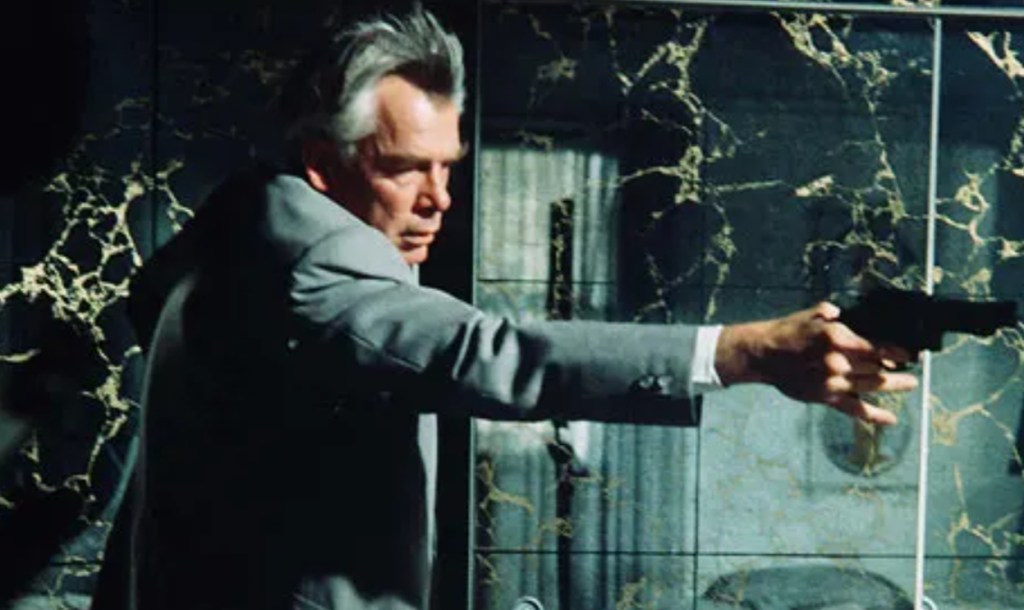
Flawless performances, delicious direction and a tone that’s just exquisite, Point Black has amassed a legacy that’s worth considerably more than $93,000.
🌟🌟🌟🌟🌟
 We Have Issues